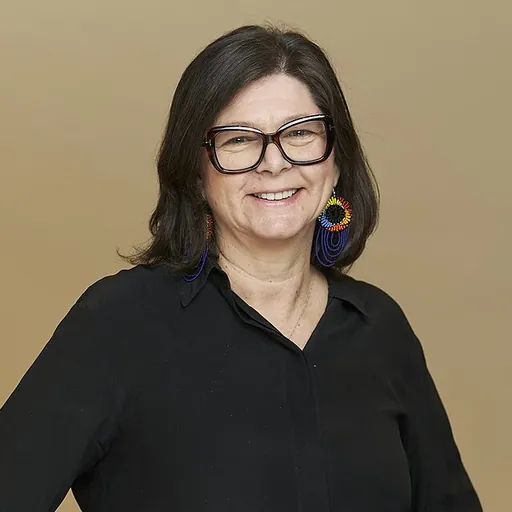
Mirjana Roksandic
Canadian paleoanthropologist and professor of anthropology
About Mirjana Roksandic
Mirjana Roksandic was a Canadian paleoanthropologist and university teacher.
Mirjana Roksandic is a Professor in the Department of Anthropology and coordinator of the interdisciplinary program in Bioanthropology at The University of Winnipeg and graduate faculty at the University of Manitoba. Her main research topics include Pleistocene hominin evolution in Europe and in particular Eastern Mediterranean and mortuary ritual among sedentary and semi-sedentary archaeological hunter-gatherers. She has two active international projects: one in Serbia focusing on hominins excavated in Paleolithic caves, and the other in Cuba and Nicaragua where she is working on questions of mortuary practice and ritual continuity in the Caribbean. She is interested in when, how, and why humans have moved across continents and vast expanses of lands and sea in the context of adaptation to climatic fluctuations and social pressures. Prof. Roksandic is a recipient of NSERC and SSHRC grants, and the recipient of the Nellie McClung Foundation Manitoba Women Trailblazer Award.
Education She has a Ph.D. from Simon Fraser University.
Academic career Roksandic is a professor at the University of Winnipeg and supervises graduate students through the University of Manitoba and international collaborations. She founded the Palaeoanthropological Society of Canada/Société canadienne de paléoanthropologie and served as its first president, helping grow its membership and organize academic meetings.
In 2023, she co-organized a workshop in Novi Sad, Serbia, focusing on Middle Pleistocene hominins. This event culminated in a collaborative paper addressing the complexities of hominin taxonomy during this period.
She has led several major international research projects, receiving nearly $4 million in funding from Canadian federal agencies such as NSERC and SSHRC. Her work in the Balkans uncovered some of the oldest hominin fossils in Southeastern Europe, including the BH-1 mandible from the Mala Balanica cave in Sićevo Gorge (Serbia). Her findings have reshaped views of Pleistocene human diversity in Europe.
Roksandic integrates fieldwork, 3D modeling, molecular anthropology, and geospatial technologies in her research.
Impact and recognition Her work has significantly influenced the understanding of hominin diversity and movements in Europe and has drawn attention to underrepresented research areas such as the Balkans and Caribbean. She has given keynote lectures at international conferences, delivered dozens of invited public lectures, and published widely in top journals.
In 2021, she received the Manitoba Women Trailblazer Award from the Nellie McClung Foundation. She has also been involved in creative science communication, including visual reconstructions of human ancestors and a podcast on human evolution in film.
Publications
Don’t just read it —
keep it.
Full-length biographies made to live with: read them, listen on the way to work, watch them tonight.
- E-book
- Audio
- Video
Instant download · yours to keep · every purchase keeps this site free
Important facts
Related people
Same field, nearest in time




Frequently asked questions
Who was Mirjana Roksandic?
Canadian paleoanthropologist and professor of anthropology
What was Mirjana Roksandic's occupation?
Mirjana Roksandic was a paleoanthropologist and university teacher.
What nationality was Mirjana Roksandic?
Mirjana Roksandic was Canadian.
Sources & further reading
· Wikipedia: Mirjana Roksandic
Cite this page
APA: Biography.guide. (2026). Mirjana Roksandic. https://biography.guide/mirjana-roksandic/
MLA: "Mirjana Roksandic." Biography.guide, https://biography.guide/mirjana-roksandic/.
Chicago: "Mirjana Roksandic." Biography.guide. https://biography.guide/mirjana-roksandic/.
Data last updated: 2026-09-22 · Spot an error? Report a correction.
Portrait: Wikimedia Commons · author & licence
Page generated 2026-09-27 04:58 UTC