
About Miriam Daly
Lived 1928 – 1980 (aged 51–52). Miriam Daly was a British academic.
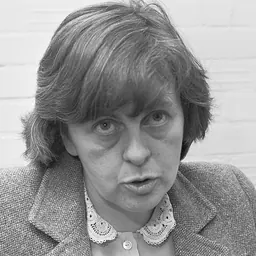
Miriam Daly (; 6 May 1928 – 26 June 1980) was an Irish republican and communist activist as well as a university lecturer who was assassinated by the loyalist Ulster Defence Association (UDA) in 1980.
Background and personal life She was born Miriam Annette McDonnell in the Curragh Irish Army camp, County Kildare, Ireland, one of the two daughters of Commandant Daniel McDonnell and Anne McDonnell (née Cummins). Her father had served under Michael Collins in the War of Independence and as part of the pro-treaty National Army during the Irish Civil War. Afterwards, he developed pro-Labour views.
She grew up in Hatch Street, Dublin, where she attended Loreto College on St Stephen's Green and then University College, Dublin.
In 1965 she married philosopher and social activist James Daly, who had family from Ulster. They moved to Ireland in 1968 and were appointed lecturers in the departments of scholastic philosophy and of economic and social history at Queen's University, Belfast. In 1970 they adopted twins. Some later IRSP/INLA material describes Daly as a 'volunteer', but she was never a member of the Irish National Liberation Army, the IRSP's military wing.
Assassination On 26 June 1980, Daly was shot dead at home, in the Andersonstown area of west Belfast.
According to reports in The Irish Times, members of the Ulster Defence Association (UDA) had gained entry to her home with the intention of killing her husband. They tied up Daly and waited for him to return home. Her husband was in Dublin at the time and so did not arrive.
Daly's death occurred soon after Conservative Party politician and incumbent Shadow Secretary of State for Northern Ireland Airey Neave was assassinated in Westminster Palace, London by members of the INLA, and some have speculated that the UDA's killing of Daly (along with the murder and attempted murder of other Irish Republican Socialist Party (ISRP) and National H-Block Committee members such as Ronnie Bunting, John Turnley and Bernadette Devlin McAliskey during this period) was in retaliation for Neave's murder. Solicitor Michael Brentnall claimed in an interview that "There are compelling circumstances which indicate that the killings were either committed by the British security services or facilitated by them and these killings are connected in proximity and organisational terms to the killing of Airey Neave."
During the 1982 trial of three UDA members for the death of John Turnley, one of the accused, Robert McConnell, stood up in court towards the end and read out a statement detailing how two members of the Special Air Service (SAS) had supplied him with weapons and other equipment and had discussed with him the activities of H-Block activists such as Miriam Daly, John Turnley and Bernadette Devlin McAliskey.
'Operation Ranc' was a series of planned actions by British Intelligence against the INLA following the assassination of Airey Neave. The 'G' (Guards) squadron of the 22 SAS Regiment were actively involved in Operation Ranc. It is believed by Fr. Raymond Murray that Daly, Bunting, Lyttle and Turnley were killed as part of the operation. The operation was prematurely terminated following protests from the Irish government.
Daly was buried in Swords, County Dublin with her first husband, after a paramilitary funeral. She is included as a volunteer on the INLA monument in Milltown Cemetery
In 2021 her commemoration held by the IRSP in Belfast was attended by her son and husband at the time of her death.
Political views Daly was an advocate of State Socialism based on the nation-state, with government control of credit and industry. She rejected capitalism and free trade on the basis of her belief that free trade was overwhelmingly biased in the favour of the already-developed countries. Daly developed this view from her academic research into 19th-century Ireland and in particular her analysis of the deindustrialising effect of improved transport links.
Daly considered the 1916 Easter Rising and the 1917 Russian Revolution to be twin revolutions against the "capitalist world order", and generally held pro-Soviet views.
Daly rejected the view that Ulster Protestants form a distinct "nation" within the geography of Ireland, dismissing them as "a product of British colonial manipulation and native collaboration".
Don’t just read it —
keep it.
Full-length biographies made to live with: read them, listen on the way to work, watch them tonight.
- E-book
- Audio
- Video
Instant download · yours to keep · every purchase keeps this site free
Important facts
People in Miriam Daly's life
Named in this biography and alive at the same time




Related people
Same field, nearest in time




Contemporaries
People whose lives overlapped Miriam Daly's

Frequently asked questions
Who was Miriam Daly?
Irish republican activist
When was Miriam Daly born?
Miriam Daly was born in 1928.
When did Miriam Daly die?
Miriam Daly died on 26 June 1980.
What was Miriam Daly's occupation?
Miriam Daly was an academic.
What nationality was Miriam Daly?
Miriam Daly was British.
Sources & further reading
Cite this page
APA: Biography.guide. (2026). Miriam Daly. https://biography.guide/miriam-daly/
MLA: "Miriam Daly." Biography.guide, https://biography.guide/miriam-daly/.
Chicago: "Miriam Daly." Biography.guide. https://biography.guide/miriam-daly/.
Data last updated: 2026-09-20 · Spot an error? Report a correction.
Page generated 2026-09-27 05:31 UTC