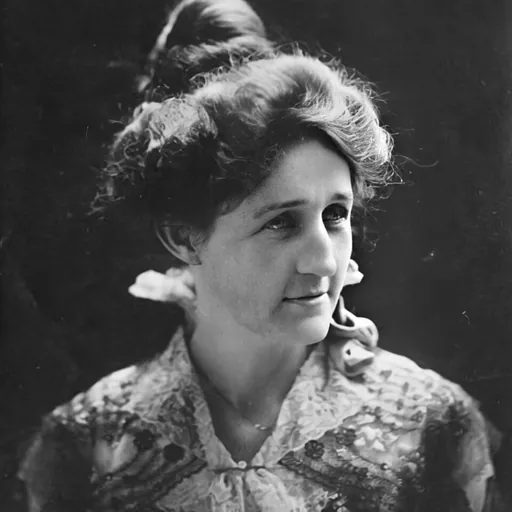
About Miriam A. Ferguson
Lived 1875 – 1961 (aged 86). Miriam A. Ferguson was an American politician.
Miriam Amanda "Ma" Ferguson ( Wallace; June 13, 1875 – June 25, 1961) was an American politician who served two non-consecutive terms as the governor of Texas: from 1925 to 1927, and from 1933 to 1935. She was the first female governor of Texas, and the second woman elected to the governorship of any U.S. state to assume office, after Nellie Tayloe Ross of Wyoming.
Early life
Miriam Amanda Wallace Ferguson was born in Bell County, Texas. She studied at Salado College and Baylor Female College. When she was 24, she married James Edward Ferguson, a lawyer, at her father's farm near Belton in Bell County, Texas.
Her nickname, "Ma", came from her initials, "M. A.", and the fact that her husband was known as "Pa" Ferguson. They had two daughters: Ouida Wallace Ferguson and Dorrace Watt Ferguson.
Early political career Her husband served as Governor of Texas from 1915 to 1917. During his second term, he was investigated by State Attorney General Dan Moody (who would, incidentally, succeed her as Governor in 1927 after her first term) for actions that had been taken against the University of Texas. The Texas State Senate impeached him, convicted him on ten charges, and prohibited him from holding state office in Texas again.
1924 election and first term After her husband's impeachment and conviction, Ma Ferguson ran in the primary for the Democratic nomination for governor and was successful, openly supported by her husband, whom she said she would consult for advice. She ran for office in the 1924 general election.
During her campaign, she said that voters would get "two governors for the price of one". Her speeches at rallies consisted of introducing him and letting him take the platform. A common campaign slogan was, "Me for Ma, and I Ain't Got a Durned Thing Against Pa." Patricia Bernstein of the Houston Chronicle stated "There was never a question in anyone's mind as to who was really running things when Ma was governor."
After her victory in the Democratic primary, Ferguson defeated George C. Butte, a prominent lawyer and University of Texas dean who emerged as the strongest Republican gubernatorial nominee in Texas since Reconstruction. Due to the widespread corruption of her husband's term, resulting in his impeachment, thousands of voters crossed party lines in the general election to vote for the Republican candidate. Republicans usually took between 11,000 and 30,000 votes for governor, but Butte won nearly 300,000 votes, many of them from women and suffragists. Suffragist activism provided a major contribution to her defeat, as these women rallied behind Moody and campaigned for him.
Views and policies
"Fergusonism", as the Fergusons' brand of populism was called, remains a controversial subject in Texas. As governor, she tackled some of the tougher issues of the day. Though a teetotaler like her husband, she aligned herself with the "wets" in the battle over prohibition. She opposed the Ku Klux Klan, which was on the decline after 1925 because of a national murder and sex scandal by its president, D. C. Stephenson.
Ferguson has been described as a fiscal conservative but also pushed for a state sales tax and corporate income tax. Variations of this statement have been dated to 1881, and were often used to ridicule the claimed backwardness of various unnamed Christians. Ferguson did not originate the quote.
Ferguson issued almost 4,000 pardons during her two nonconsecutive terms in office, many of them to free persons who had been convicted of violating prohibition laws. Though never proven, rumors persisted that pardons were available in exchange for cash payments to the governor's husband. In 1936, voters passed an amendment to the state constitution stripping the governor of the power to issue pardons and granting that power to a politically independent Texas Board of Pardons and Paroles (see Capital punishment in Texas).
A number of labor laws were also passed during Ferguson's two terms as governor.
In a 1932 speech, Ferguson's husband James E. Ferguson defended the record of "Fergusonism;" listing reforms such as child labor and workmen's compensation laws, aid for rural education, a free textbook law, and laws regulating the working hours of women. Miriam Ferguson herself defended “Fergusonism;” citing liberal measures such as a semi-monthly pay day law, an eight-hour law, the establishment of an Industrial Accident Board, and the creation of Lower Colorado and Brazos River Authorities.
Post-governorship
Except for an unsuccessful bid to replace Governor W. Lee "Pappy" O'Daniel in 1940, the Fergusons remained retired from political life after 1935. In the 1940 campaign, Ma Ferguson trailed O'Daniel's principal rival, Ernest O. Thompson of Amarillo, who was Texas Railroad Commissioner.
Her husband, James, died of a stroke in 1944. Miriam Ferguson died from congestive heart failure in 1961 at the age of 86. She was buried in the Texas State Cemetery in Austin.
Don’t just read it —
keep it.
Full-length biographies made to live with: read them, listen on the way to work, watch them tonight.
- E-book
- Audio
- Video
Instant download · yours to keep · every purchase keeps this site free
Important facts
Family & relationships
People in Miriam A. Ferguson's life
Named in this biography and alive at the same time



Related people
Same field, nearest in time





Contemporaries
People whose lives overlapped Miriam A. Ferguson's


Frequently asked questions
Who was Miriam A. Ferguson?
American politician (1875-1961)
When was Miriam A. Ferguson born?
Miriam A. Ferguson was born on 13 June 1875 in Bell County.
When did Miriam A. Ferguson die?
Miriam A. Ferguson died on 25 June 1961 in Austin.
What was Miriam A. Ferguson's occupation?
Miriam A. Ferguson was a politician.
What nationality was Miriam A. Ferguson?
Miriam A. Ferguson was American.
Sources & further reading
· Wikipedia: Miriam A. Ferguson
Cite this page
APA: Biography.guide. (2026). Miriam A. Ferguson. https://biography.guide/miriam-a-ferguson/
MLA: "Miriam A. Ferguson." Biography.guide, https://biography.guide/miriam-a-ferguson/.
Chicago: "Miriam A. Ferguson." Biography.guide. https://biography.guide/miriam-a-ferguson/.
Data last updated: 2026-09-21 · Spot an error? Report a correction.
Portrait: Wikimedia Commons · author & licence
Page generated 2026-09-27 04:59 UTC