
About Mirei Shigemori
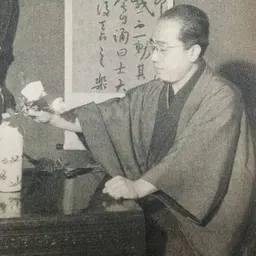
Lived 1896 – 1975 (aged 78). Mirei Shigemori was a Japanese landscape architect and kadōka.
, was a Japanese landscape architect and historian of Japanese gardens.
Life and career
Mirei Shigemori was a garden designer who actively participated in many areas of Japanese art and design. Shigemori was born in Kayō, Jōbō District, Okayama Prefecture, and in his youth was exposed to lessons in traditional tea ceremony and flower arrangement, as well as landscape ink and wash painting. In 1917, he entered the Tokyo Fine Arts School to study nihonga, or Japanese painting, and later completed a graduate degree from the Department of Research. In the early 1920s, he tried extensively to found a school of Japanese Culture, Bunka Daigakuin to synthesize the teaching of culture, but was foiled by the 1923 Great Kantō earthquake, which forced him to move back to his hometown near Kyoto.
He also intended to create a new style of ikebana, or flower arrangement, and produced art criticism and history writings, including the Complete Works of Japanese Flower Arrangement Art published in 1930, and the New Ikebana Declaration written with Sofu Teshigahara and Bunpo Nakayama in 1933. Throughout his later gardening career, he maintained a voice in avant garde criticism of ikebana through publishing Ikebana Geijutsu magazine beginning in 1950, and through the founding of an ikebana study group called Byakutosha in 1949.
At the same time, he cultivated an interest and knowledge in traditional Japanese gardens. He co-founded the Kyoto Rinsen Kyokai with others in 1932. After the destruction caused by the Muroto typhoon in 1934, he began a survey of significant gardens in Japan. In 1938, he finished publishing the 26-volume Illustrated Book on the History of the Japanese Garden, a meticulous documentation of major gardens in the country which he revised in 1971, shortly before his death.
He began practicing as a garden designer in 1914 with a garden and tea room on his family’s property. His first major work was a design for the garden at Tofuku-ji Temple in 1939. He designed 240 gardens, and worked mostly in karesansui, or dry landscape gardens. Many of his gardens are on existing religious sites, but a few of his works are in cultural or commercial settings. He also collaborated with Isamu Noguchi in choosing stones for the UNESCO Garden in Paris.
Design philosophy Shigemori’s work and writings reflect and interface with the changing political and cultural framework of Japan during his life. Kendall Brown, in his preface to Mirei Shigemori: Rebel in the Garden notes that “Shigemori embodies the central artistic quest of his era – a new direction in Japanese creativity founded on the desire to overcome a fundamental tension between the perceived polarities of dynamic Western Culture and the relative stasis attributed to the Asian tradition.” On the other hand, modernists saw the past as a relic, or obstacle to be discarded, and old forms were seen as a “negative against which to measure progress.” In his argument, Shigemori argued for a hybrid approach, in which the past would inform and give cultural resonance to present developments in form. He advocated for studying the past masters, and that designers should “emulate their way to invention rather than the results achieved, (so) gardenmakers could distill the most valuable inspiration for their work.” Shigemori’s work reflects this idea of culturally grounded innovation.
Shigemori was greatly influenced by Western culture in his Japanese garden design. The modernist movement which arrived in Japan during the 1920s and 1930s had a profound impact on his approach to design. “In Shigemori’s experience, exploration of the Western avant-garde and Japanese pre-modern culture played equally large roles.” While continuing his graduate degree Shigemori studied contemporary aesthetics, art history and philosophy. This would greatly influence Shigemori and his design approach for the rest of his life. At the age of 29, Shigemori changed his first name from Kazuo to Mirei the Japanese pronunciation for Francois Millet, a French landscape painter. During this period, Shigemori was still working in other mediums such as ikebana. During the Showa period (1925 onward), Shigemori advocated a new approach to the arrangements of flowers. Traditional ikebana arrangements aspired to imitate nature, known as naturalism. His new style attempted to mimic the surrealist movements found in western cultures at the time while still rooted in Japanese aesthetics. Throughout Shigemori’s career, regardless of medium he persistently questioned the traditional norms. The extreme to traditional arts would have been to advocate the modernist movement. In that approach designers and artist abandon design traditional Japanese philosophies and attempted to recreate Western aesthetics. Instead Shigemori embraced a balance between the past and modernist movement. He resisted the trend in the Japan at the time that advocated completely Western and modern approach to design.
As Shigemori became more interested in Japanese garden design, he meticulously surveyed and researched 242 gardens in Japan. His findings were published in 1938 as a collection called Illustrated Book on the History of the Japanese Garden. Upon completing his research, Shigemori started to apply his own aesthetics to garden design. Shigemori believed that Japanese garden design had stopped evolving since the Edo Period (1600-1868), and resolved to modernize the medium. His first major work was at Tofu-kuji Temple in Kyoto. Within the gardens Shigemori blended traditional garden design with more contemporary concepts. The gardens of Tofu-kuji have strong elements of cubism and surrealism in particular in the use of stone. The stones consisted of square cubes, creating a checker pattern as well as round stone pillars which replaced naturally shaped stone. While at first glance the gardens appear to have abandoned traditional constraints, the design upon closer examination highlight an evolution of aesthetics. Shigemori continued to be a prolific designer and scholar until his death in 1975. His philosophical approach to Japanese garden design reinterpreted foreign influences to breathe new vitality to a traditional medium. He took uniquely Western design aesthetics and created an evolved Japanese garden.
He spoke extensively of the growing estrangement between people and the primordial power of nature, and his gardens are full of hybrid symbols that seek to reveal the cultural and natural histories their sites. Traditional garden forms are reinterpreted with modern materials and attempt to reengage the viewer with the ever developing continuum of Japanese culture.
Major projects
Kasuga Taisha, 1934 Tōfuku-ji Hojo, 1939 Kishiwada-jo, 1953 Maegaki Residence, 1955 Kogawa Residence, 1958–65 Zuiho-in, 1961 Kōzen-ji, 1963 Ryogin-an, 1964 Kitano Bijutsukan, 1965 Sumiyoshi Shrine, 1966 Sekizo-ji, 1972 Yurin no Niwa, 1969 Tenrai-an, 1969 Ashida Residence, 1971 Hōkoku Shrine, Tamba, Hyōgo 1972 Fukuchi-in, 1973 Matsunoo-taisha, in Matsuo, Kyoto, 1975
Books by Shigemori translated into English Shigemori, Mirei. Gardens of Japan. Vol. 1. Kyoto: Nissha, 1949. Shigemori, Mirei and Hashizume Mitsuharu. The Art of Flower Arrangement in Japan. Kyoto: Kasuke Murakami, 1933.
Don’t just read it —
keep it.
Full-length biographies made to live with: read them, listen on the way to work, watch them tonight.
- E-book
- Audio
- Video
Instant download · yours to keep · every purchase keeps this site free
Important facts
People in Mirei Shigemori's life
Named in this biography and alive at the same time

Related people
Same field, nearest in time






Contemporaries
People whose lives overlapped Mirei Shigemori's


Frequently asked questions
Who was Mirei Shigemori?
Japanese landscape architect (1896–1975)
When was Mirei Shigemori born?
Mirei Shigemori was born on 20 August 1896 in Kibi-chūō Chō.
When did Mirei Shigemori die?
Mirei Shigemori died on 12 March 1975.
What was Mirei Shigemori's occupation?
Mirei Shigemori was a landscape architect and kadōka.
What nationality was Mirei Shigemori?
Mirei Shigemori was Japanese.
Sources & further reading
Cite this page
APA: Biography.guide. (2026). Mirei Shigemori. https://biography.guide/mirei-shigemori/
MLA: "Mirei Shigemori." Biography.guide, https://biography.guide/mirei-shigemori/.
Chicago: "Mirei Shigemori." Biography.guide. https://biography.guide/mirei-shigemori/.
Data last updated: 2026-09-20 · Spot an error? Report a correction.
Page generated 2026-09-27 05:16 UTC