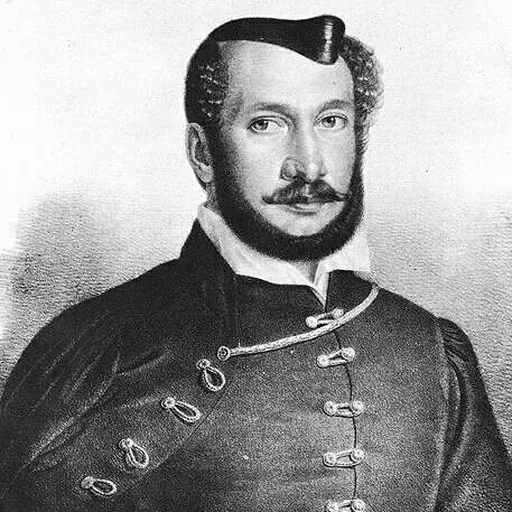
Miklós Jósika
Hungarian noble, writer, politician (1794/6-1865)
About Miklós Jósika
Lived 1794 – 1865 (aged 70). Miklós Jósika was a Hungarian writer, politician, military officer and novelist.
Miklós Jósika (; 28 April 1794 – 27 February 1865) was a Hungarian soldier, politician and writer. He is recognized as the first successful novelist in Hungarian literature, through the publishing of one of his first works, Abafi, a historical novel set in his native Transylvania in the style of Romantic writers of the era such as Walter Scott.
His political writings and activities as a member of the Transylvanian and Hungarian Diets supported the union of Transylvania and Hungary, as well as the Hungarian Revolution of 1848. He joined the revolution's representative government and was elected to the National Defense Committee which governed Hungary for seven months. Following the revolution's defeat in 1849, his family estate lands were seized and he went into exile for the remainder of his life, which ended in Dresden in 1865.
Life Miklós Jósika was born in 1794 in Turda, a town in Central Europe's Pannonian Basin which was at the time under Hungarian control. He was the son of Baron Miklós Jósika and his wife Eleanor Lázár. Following the death of his mother in 1799, his paternal grandmother, Anna Bornemissza, oversaw his childhood. Despite living on the estate of a baron, Jósika spent most of his childhood by himself, alone. He was enrolled in a school in Kolozsvár run by the Piarists Fathers where he studied under the guidance of a multiethnic faculty. The most influential teacher in his life was the French colonel Leonir Dubignon d'Armand. Jósika graduated with a degree in law at Klausenburg, where he was also introduced to the works of classical writers. Together with other noblemen, Wesselényi and Jósika were among the gentry liberal opposition and formed the "Pro-British League of Transylvanian Aristocrats."
In addition to politics, Jósika turned his attention to writing, producing more than 60 romance novels between the early 1830s and 1854. His first work, Abafi, was published in 1836. The book is a morality tale, describing a fictional knight in the service of Transylvanian prince Sigismund Bathory. Over the course of the book, the eponymous hero transforms his life from one of debauchery to public respect and promotion, before sacrificing himself in the battle to protect his prince. It was Josika's best-selling work and was an inspiration to inventor Nikola Tesla, among others, who credited it with setting him on the path to mental self-discipline. Elements of Jósikas liberal political philosophy were evident in his casting of the characters, and the work remained popular among socially progressive Hungarians into the early twentieth century.
Jósikas literary achievements garnered substantial societal recognition in Hungary. In the late 1830s he was elected as a member of the Hungarian Academy of Sciences and of the Kisfaludy Society, a prominent literary group of which he became director in 1841 and vice-president in 1842. His political pursuits continued; in 1847 he appeared before the Transylvanian Diet as a representative for Szolnok to unsuccessfully advocate for a formal union between Transylvania and Hungary. Influenced by his political allies, he also converted to Protestantism. In 1847 he procured a divorce from his wife Elizabeth, whom he had not seen for many years. Once this was obtained Jósika immediately entered into an engagement, and then marriage with Baroness Julia Podmaniczky, a fellow writer and member of an influential Hungarian family.
Later years The Hungarian Revolution of 1848 gave power to the Radical Opposition, including Jósikas erstwhile political foe Lajos Kossuth. Jósika closely associated himself with the new government and was rewarded with appointments to a restructured Hungarian Upper House and to the committee of national defence. However, after the defeat of the Hungarian Revolution of 1848, Jósika and his wife went into exile in Dresden in 1849. They never returned to Hungary. Instead, they chose to relocate to Brussels in 1850 where Jósika returned to writing romance novels under a pseudonym. In declining health, he returned to Dresden in 1864 and died there on 27 February 1865. His body was interred at the Hajongard cemetery in Cluj-Napoca, around from his birthplace of Turda.
Works Irány (1835) Vázolatok (1835) Abafi (1836) Zólyomi (1836) Az utolsó Bátori (1837) A könnyelműek (1837) The Czechs in Hungary (1839) Végnapok (1842) Zrínyi, a költő (1843) A két Barcsai (1844) Ifjabb Békesi Ferenc kalandjai (1845) Diamante (1846) Akarat és hajlam (1846) A Two-Storey House in Budapest (1847) Stephen Jósika (1847) A Hungarian Family During the Revolution (1852) Eszther (1853) The Witches in Szeged (1854) Pygmaleon, or, A Hungarian Family in Paris (1856) The Hidden Wound (1857) Visszhangok (1859) Francis Rákóczi II (1862) Two lives (1862) Clara and Clare (1863) Sziklarózsa (1864)
Don’t just read it —
keep it.
Full-length biographies made to live with: read them, listen on the way to work, watch them tonight.
- E-book
- Audio
- Video
Instant download · yours to keep · every purchase keeps this site free
Important facts
People in Miklós Jósika's life
Named in this biography and alive at the same time
Related people
Same field, nearest in time



Contemporaries
People whose lives overlapped Miklós Jósika's





Frequently asked questions
Who was Miklós Jósika?
Hungarian noble, writer, politician (1794/6-1865)
When was Miklós Jósika born?
Miklós Jósika was born on 28 April 1794 in Turda.
When did Miklós Jósika die?
Miklós Jósika died on 27 February 1865 in Dresden.
What was Miklós Jósika's occupation?
Miklós Jósika was a writer, politician, military officer and novelist.
What nationality was Miklós Jósika?
Miklós Jósika was Hungarian.
Sources & further reading
Cite this page
APA: Biography.guide. (2026). Miklós Jósika. https://biography.guide/miklos-josika/
MLA: "Miklós Jósika." Biography.guide, https://biography.guide/miklos-josika/.
Chicago: "Miklós Jósika." Biography.guide. https://biography.guide/miklos-josika/.
Data last updated: 2026-09-23 · Spot an error? Report a correction.
Portrait: Wikimedia Commons · author & licence
Page generated 2026-09-27 05:07 UTC