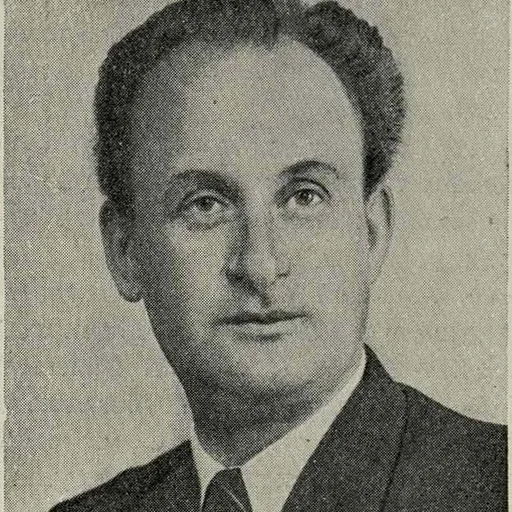
About Mikhail Posokhin
Lived 1910 – 1989 (aged 78). Mikhail Posokhin was a Russian architect, urban planner and politician.
Mikhail Vasilyevich Posokhin (; 30 November 1910 - 22 January 1989) was a Soviet, Russian architect and teacher. People's Architect of the USSR. Laureate of the Lenin Prize (1962), State Prize of the USSR (1980) and Stalin Prize of the second degree (1949). He is mostly known for being Chief Architect of Moscow (1960–1980). Among his main completed projects are a high-rise residential building on Kudrinskaya Square and the development of New Arbat Avenue in Moscow. He served as a member of the Union of Architects of the USSR. Full member of the USSR Academy of Arts (1979), member of the Presidium, academician-secretary of the Department of Architecture and Monumental Art of the USSR Academy of Arts (1979). Corresponding member of the USSR Academy of Architecture (1950–1955), Academy of Construction and Architecture (1956–1963).
Biography Early life Born on November 30 (December 13), 1910 in Tomsk. His parents, Vasily Mikhailovich and Maria Alexandrovna, belonged to the educated philistines. His father worked in a printing house while his mother worked in a library.
After graduating from high school in 1927, he enrolled as a student at the Siberian Technological Institute, at the same time attended the creative studio of the artist Vadim Mizerov and worked as an apprentice decorator at the Tomsk Drama Theater.
Soon he moved to Kuznetsk-Sibirsky and began working on the construction of the Kuznetsk Metallurgical Plant.
In 1935, he moved to Moscow to enter the workshop of Alexey Shchusev at the Moscow Architectural Institute, and graduated from the university as an external student in three years. In the late 1930s, their first joint projects were presented at competitions at the air terminal in Moscow and the theater in Komsomolsk-on-Amur. The unique building received an individual layout, expensive finishing and equipment. In particular, 28 four-room apartments were built in the house. In all apartments, the kitchens were equipped with refrigerators, built-in furniture, sinks with a crusher for the destruction of large waste, and access to a garbage chute was provided.
Posokhin wrote about the work on this building in his memoirs "Roads of Life". Among other things, he noted the fact that architects were categorically forbidden to use foreign magazines in order to avoid copying the techniques of Western masters. In 1949, the architect was awarded the Stalin Prize of the second degree for the completed project.
Typical residential development He was interested not only in the creation of outstanding structures - he was one of the first architects in the USSR to develop and implement projects for large-panel buildings. In his book, published in 1953, he explained in detail the new principles of residential construction. He emphasized that for the rapid construction of new residential areas on the outskirts of the capital, “all-out industrialization is necessary... based on the typification and widespread use of structures, architectural details, elements of factory-made sanitary and engineering equipment.” The master believed that it was necessary to design new frame houses taking into account the future placement of shops, children's educational institutions and entertainment organizations on the ground floors. Builders should also think about decorating the rear facades and organizing the courtyard space.
He managed to realize his vision during the construction of four-story houses on Khoroshevskoye Highway. Work on the site began in 1948. This was the first experience in Soviet history of complex development of a residential area with panel-frame buildings. The next complex built was ten-story buildings on Kuusinen Street, the design of which was proposed back in 1953. The principles of residential housing construction that the architect promoted were close to the views of Nikita Khrushchev. Thanks to this, he avoided the accusations of “embellishment” that the leadership of the CPSU leveled against Soviet architects in the mid-1950s. and in the early 1970s, he initiated a quarter-by-quarter survey of the historical buildings of Moscow. As a result, the multi-volume book "Architectural Monuments of Moscow"
From an architectural point of view, the more interesting foreign projects were the USSR pavilions, which the architect designed for the World Exhibitions in Montreal (1967) and Expo '70 in Osaka (1970). The Canadian pavilion was designed in the style of Moscow buildings. The building received glazing along the entire perimeter and a powerful stylobate, which housed part of the public premises.
Don’t just read it —
keep it.
Full-length biographies made to live with: read them, listen on the way to work, watch them tonight.
- E-book
- Audio
- Video
Instant download · yours to keep · every purchase keeps this site free
Important facts
People in Mikhail Posokhin's life
Named in this biography and alive at the same time

Related people
Same field, nearest in time
Contemporaries
People whose lives overlapped Mikhail Posokhin's





Frequently asked questions
Who was Mikhail Posokhin?
Russian architect (1910-1989)
When was Mikhail Posokhin born?
Mikhail Posokhin was born on 30 November 1910 in Tomsk.
When did Mikhail Posokhin die?
Mikhail Posokhin died on 22 January 1989 in Moscow.
What was Mikhail Posokhin's occupation?
Mikhail Posokhin was an architect, urban planner and politician.
What nationality was Mikhail Posokhin?
Mikhail Posokhin was Russian.
Sources & further reading
Cite this page
APA: Biography.guide. (2026). Mikhail Posokhin. https://biography.guide/mikhail-posokhin/
MLA: "Mikhail Posokhin." Biography.guide, https://biography.guide/mikhail-posokhin/.
Chicago: "Mikhail Posokhin." Biography.guide. https://biography.guide/mikhail-posokhin/.
Data last updated: 2026-09-22 · Spot an error? Report a correction.
Portrait: Wikimedia Commons · author & licence
Page generated 2026-09-27 05:01 UTC