
About Mikhail Oktan
Born 1912. Mikhail Oktan is a Russian journalist and soldier.
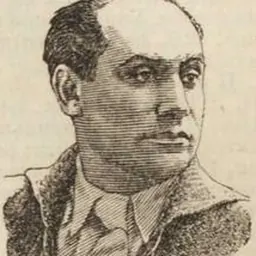
Mikhail Aleksandrovich Ilinich (; ; February 4, 1912, Gosudarev Bairak, Bakhmut uezd, Yekaterinoslav Governorate, Russian Empire (now Ukraine) – after 1945), better known by the pseudonym of Mikhail Oktan (; ) was a Russian Nazi collaborator during World War II who served as de facto mayor of the city of Oryol under Nazi occupation, as well as an important Russian collaborationist in Bobruisk. He was active in Russia, Belarus, and Poland.
Early life Little is known about Oktan's early life although it's speculated he had Croatian origins or ancestry based on his surname Ilinich. It was alleged that he was born in the city of Odessa. In 2025, genealogists discovered his birth document. He was born on January 22 (February 4) as a son of a mining engineer Aleksandr Ilinich in Gosudarev Bairak (currently Horlivka in Ukraine).
He described himself to German officers as an engineer, and was, according to historian Alexander Dallin, said by some peers to have studied economics. It was claimed by a newspaperman close to Oktan that he had been a member of the Communist Party of the Soviet Union prior to World War II, possibly as a propagandist or local functionary. This claim was also repeated in intelligence from Soviet partisans, which stated Oktan had been head of the Oryol Oblast education department prior to the outbreak of the war.
According to a 1943 article in The New York Times, Oktan's ethnicity was unclear, and his grasp of the Russian language was "doubtful." This claim is in dispute with Dallin's paper, which describes Oktan as possessing significant oratory and journalistic skill.
Author John Loftus claimed in his book America's Nazi Secret that Oktan was a naturalised United States citizen after the founding of the Office of Special Investigations in 1979, and that the OSI was pursuing his denaturalisation. Loftus additionally claimed that Oktan was working for Mykola Lebed at the time of OSI's investigation. However, these claims remain unconfirmed.
Ideology and personality According to Dallin, Oktan was described as adventurous by other collaborators, and alternatively as idealist and opportunist, as well as demagogic. One collaborator said that he "skillfully combined the qualities of a German officer, an Odesan tradesman, and a clever lickspittle." He imitated the gestures and appearance of Hitler, and was known to have a love for medals, alcohol, and women. He was described by the wartime police chief of Mogilev as a "habitual drunkard", and it was recounted by a young officer that when he visited the offices of Rech, all seven of the newspaper's employees (Oktan included) were inebriated.
Oktan was known to have two assistants, an adjutant and a valet. The latter also acted as a treasurer for Oktan, paying Oktan's expenses for him. In Babruysk, Oktan was known to award local artistic figures and actresses, and additionally assisted in the establishment of local orphanages, chess clubs, and businesses. He was known to impress audiences with carefully-choreographed displays at dinners, with one account describing the course of events as such:
He was also regarded as relatively independent among the collaborators, often debating with German officers and charting a course independently from that of other collaborators. At the same time, however, Oktan showed more loyalty to Germany than any other Russian collaborator or group.
Relations with other collaborators Oktan had fraught relations with other collaborators, particularly Bronislav Kaminski and the National Alliance of Russian Solidarists (NTS). Both Kaminski and NTS leader Viktor Baidalakov expressed a desire to hang Oktan, and Oktan likewise barred both from influencing his fiefdom, banning Kaminski from conducting political activities and speaking against "outside influence." Samarin, Oktan's second-in-command, was known to be a member of the NTS.
Oktan also had generally negative, though more ambivalent, views towards Andrey Vlasov. He repeatedly stated that 'Vlasovite ideals' were banned in areas under his control, and expressed the view that he could have exceeded Vlasov in terms of building a collaborationist military force. Nonetheless, following the establishment of the Russian Liberation Army (ROA), Oktan became a lieutenant, though he never actively participated in the ROA. He claimed that he was willing to "cede" the 70,000 men of the Union to the ROA in return for a significant position within the army, but was turned down.
Don’t just read it —
keep it.
Full-length biographies made to live with: read them, listen on the way to work, watch them tonight.
- E-book
- Audio
- Video
Instant download · yours to keep · every purchase keeps this site free
Important facts
People in Mikhail Oktan's life
Named in this biography and alive at the same time




Related people
Same field, nearest in time


Contemporaries
People whose lives overlapped Mikhail Oktan's






Frequently asked questions
Who is Mikhail Oktan?
Russian Axis collaborationist journalist
When was Mikhail Oktan born?
Mikhail Oktan was born on 4 February 1912 in Horlivka.
What is Mikhail Oktan's occupation?
Mikhail Oktan is a journalist and soldier.
What nationality is Mikhail Oktan?
Mikhail Oktan is Russian.
Sources & further reading
Cite this page
APA: Biography.guide. (2026). Mikhail Oktan. https://biography.guide/mikhail-oktan/
MLA: "Mikhail Oktan." Biography.guide, https://biography.guide/mikhail-oktan/.
Chicago: "Mikhail Oktan." Biography.guide. https://biography.guide/mikhail-oktan/.
Data last updated: 2026-09-20 · Spot an error? Report a correction.
Page generated 2026-09-27 05:25 UTC