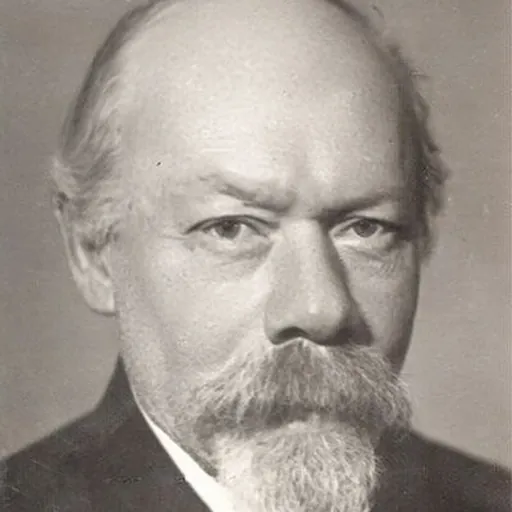
About Mikhail Gnesin
Lived 1883 – 1957 (aged 74). Mikhail Gnesin was a Russian composer, music educator and professor.
Mikhail Fabianovich Gnessin (or Gnesin; ; 5 May 1957) was a Russian Jewish composer and teacher. His grandfather Y'shayah was also a famous singer and Badchen (wedding entertainer) in Vilnius. Each of the Gnessin children appears to have possessed musical talent, and Gnessin's three elder sisters, Evgenia, Elena and Maria, all graduated with distinction from the Moscow Conservatory. His sisters went on to found the Gnessin State Musical College (now the Gnessin Russian Academy of Music), an elite music school in Moscow in 1895. and others, the Society for Jewish Folk Music. During this period Gnessin continued to take part in Socialist activities, teaching music to factory workers at workmen's clubs.
Just prior to the Revolution, Jewish music and musicians in Russia were experiencing a nationalist boom. Figures such as Rimsky-Korsakov and Stasov were actively encouraging the establishment of such a school...both Tsarist and Soviet authorities were not too happy about this development, and gave grudging permission for the folk side of Jewish culture to be established, rather than an openly Jewish nationalist compositional movement. Paradoxically, the number of Jewish performers within Russian culture was huge, and included many world-famous names.
In 1911, Gnessin traveled abroad, studying in Berlin and Paris. In return for a nominal fee students were provided classes in theatre history, commedia dell'arte, Scenic Movement, and practical music and speech. The latter class was taught by Gnessin.
After the Revolution After the Revolution, Gnessin and his music, initially, fared quite well. Traditional Jewish art, including music, flourished during this period, and a Jewish nationalist school of music was encouraged by the new Soviet government. Gnessin produced several works during this period, among them: Songs from the Old Country (1919); The Maccabees (1921); The Youth of Abraham (1922); Song of Songs (1922); The Jewish Orchestra at the Ball of the Town Bailiff (1926); Red-Headed Motele (1926–1929); Ten Jewish Songs (1927).
Pursuing his interest in traditional Jewish music, Gnessin traveled to Palestine in 1914, and again, in 1921. During the latter visit he "secluded himself for a few months in the wild mountain scenery of Bab al Wad," where he composed the first act of his opera The Youth of Abraham. He briefly considered emigrating to Palestine, but became "disenchanted" and returned to the Soviet Union. His teaching career also suffered. While he would retain his position as titular head of the Gnessin Institute until his death, in the late 1940s, Gnessin's sister, Elena, was compelled by Communist Party stalwarts to dismiss him from his teaching duties.
Apart from the Conservatoire, other educational institutions incurred repressions; as a consequence of the anti-cosmopolitanism campaign, the Gnessin Music Institute received commands and notices from higher bodies to fire various members of staff, the most distinguished being the composer and teacher Mikhail Gnessin. Yelena Fabianovna Gnessina felt how differently her relations changed with the Committee of Arts. She discovered the intimidating reports and slanderous letters given against her and Mikhail Fabianovich. Sadly, there was no other course but to release her brother from his teaching duties so as to avoid a worse fate.
He died in Moscow on 5 May 1957, and was buried at Novodevichy Cemetery.
Works
Writings O prirode muzikal'novo iskusstva i o russkoy muzyke. Muzykal'nyy Sovremennik, 3 ( 1915):5. Cherkesskie pesni. Narodnoe tvorchestvo, 12 ( 1937). Muzykal'nyy fol'klor i rabota kompozitora. Muzyka, 20 ( 1937). Nachal'nyy kurs prakticheskoy kompozitsii. Moscow, 1941/ 1962. Maximilian Shteynberg. SovMuz, 12 ( 1946):29. O russkom epicheskom simfonizme. SovMuz, 6 ( 1948):44; 3 ( 1949):50; 1 (1950):78. Mysli i vospominaniya o N. A. Rimskom-Korsakove. Moscow, 1956. An Autobiography, in R. Glazer, M. P Gnessin (Moscow, 1961 (Russ.)), Hebrew trans. in Tatzlil, 2 (1961).
Compositions Op.1. Quartre pieces (Bal'mont, Zhukovsky, Galinoy) pour chant et piano Op.3. 2 Songs (Pushkin) for voice and piano Op.4. Prometheus Unbound. Symphonic Fragment after Shelley (1908) Op.5. Bal'mont songs for voice and piano Op.6. Ruth. Dramatic Song for voice and orchestra (1909) Balagan (Blok) for voice and piano/orchestra (some sources give as Op.6 ( 1909) Op.7. Sonata-Ballade for cello and piano (1909) Op.8. Vrubel' (Bryusov). Symphonic Dithyramb for orchestra and voice (1911) Op.9. Compositions for voice and piano Op.10. Dedications (Ivanov, Bal'mont and Sologub) for voice and piano (1912–1914) Iz pesen' moevo deda for violin and piano (1912) Op.11. Requiem for piano quintet (1912–1914) Op.12. The Conqueror Worm, after Poe for voice and orchestra (1913) Op.13. Antigone ( Sophocles, trans. Merezhkovskiy). Incidental music for musical declamatory reading of the monologues and choruses (1912–1913) A Nigun for Shike Fyfer for violin and piano (1914) Op.14. The Rose and the Cross (Blok). Incidental music (1914) Op.15. The Rose Garden (Ivanov) for voice and piano Op.16. Blok cycle for voice and piano Variations on a Jewish Theme for string quartet (1916) Op.17. The Phoenician Women (Euripides, trans. Annenskiy). Incidental music (1912–1916) Op.18. From Shelley (Shelley, trans. Bal'mont) for musical declamation and piano Net, ne budi zmeyu Song of Beatrice from the tragedy "The Cenci" Op.19. Oedipus Rex (Sophocles, trans. Merezhkovskiy). Incidental music for musical declamation of the choruses (1915) Op.20. Songs of Adonis (after Shelley) for orchestra (1917) Op.22. Sologub cycle for voice and piano Op.24. Variations on a Hebrew Theme for string quartet (1917) Funeral Dances for orchestra (1917) Op.26. Sapphic Strophes for voice and piano Op.28. Pesnya stranstvuyushchevo ritsarya for string quartet and harp (1917) Op.30. Songs of the Old Country. Symphonic Fantasy (1919) Op.32. Hebraic Songs for voice and piano Op.33. Hebraic Songs for voice and piano The Maccabeans. Opera (1921) Op.34. Pesnya stranstvuyeshchevo rytsarya for cello and piano (1921) Op.34. Hebrew folk song for cello and piano Op.36. Abraham's Youth. Opera (1923) Zvezdnye sny (stage work) (1923) Op.37. Hebrew Songs for voice and piano (1926) Op.38. Hebrew Song for voice and piano Op.39. Examples of Musical Reading (Declamation and piano) Op.40. 1905–1917 (Esenin). Symphonic monument for voices, chorus, and orchestra (1925) Op.41. The Inspector-General (Gogol). Incidental music (1926) Evreiskiy orkestr na balu u Gorodnichevo for orchestra (some sources give Op.41) (1926) Op.42. Hebraic Songs for voice and piano Op.43. Sonata for violin and piano (1928) Op.44. The Story of Red-Headed Mottele (Utkin) for voice and piano (1926–1929) Op.45. Azerbaidzhan Folk songs for string quartet (1930) Op.48. Adygeya for violin, viola, cello, clarinet, horn, and piano (1933) Op.50. V Germanii (Svetlov) for chorus and orchestra (1937) Op.51. 2 Songs of Laura (Pushkin) for voice and piano Op.53. Songs of Adygeya for piano duet Op.55. Amangeldy (Djambul). Heroic Song (1940) Op.57. Elegiya-pastoral for piano trio (1940) Cantata to the Red Army (1942–1943) Op.59. Suita for violin and piano (1956) Op.60. Three Little Pieces for clarinet, violin, cello, and piano (1942) Op. 63 Piano Trio (1947) Op. 64 Piano Quartet (Sonata-Fantasia) for piano, violin, viola, and cello (1947)
Don’t just read it —
keep it.
Full-length biographies made to live with: read them, listen on the way to work, watch them tonight.
- E-book
- Audio
- Video
Instant download · yours to keep · every purchase keeps this site free
Important facts
Related people
Same field, nearest in time



Contemporaries
People whose lives overlapped Mikhail Gnesin's


Frequently asked questions
Who was Mikhail Gnesin?
Russian Jewish composer and teacher (1883–1957)
When was Mikhail Gnesin born?
Mikhail Gnesin was born on 21 January 1883 in Rostov-on-Don.
When did Mikhail Gnesin die?
Mikhail Gnesin died on 5 May 1957 in Moscow.
What was Mikhail Gnesin's occupation?
Mikhail Gnesin was a composer, music educator and professor.
What nationality was Mikhail Gnesin?
Mikhail Gnesin was Russian.
Sources & further reading
Cite this page
APA: Biography.guide. (2026). Mikhail Gnesin. https://biography.guide/mikhail-gnesin/
MLA: "Mikhail Gnesin." Biography.guide, https://biography.guide/mikhail-gnesin/.
Chicago: "Mikhail Gnesin." Biography.guide. https://biography.guide/mikhail-gnesin/.
Data last updated: 2026-09-20 · Spot an error? Report a correction.
Portrait: Wikimedia Commons · author & licence
Page generated 2026-09-27 04:58 UTC