
About Miguel Jorge
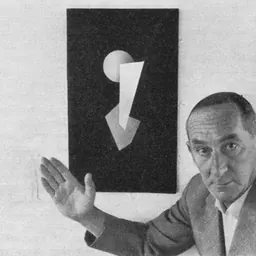
Lived 1928 – 1984 (aged 55–56). Miguel Jorge was a visual artist, contemporary artist and painter.
Miguel Jorge (1928–1984), also known as “Micky” Jorge, was a Cuban artist who was influential in the establishment of South Florida's early Latin American art market in the Greater Miami area from the 1960s through the 1980s.
Life and career Early life
Miguel Jorge was born in Havana, Cuba in 1928. He displayed a high degree of intellect and an interest in art and design early in life, leading Jorge to pursue extensive academic studies in fine art and architecture. He studied architecture in the University of Havana, where he also took courses in color dynamics under Josef Albers of Yale, a mentor of his. During his upbringing and studies in Cuba he became strongly influenced by the art of Amelia Peláez, one of the leaders of Cuba's Vanguardia movement. He gained early recognition in the arts for his exhibitions in Havana's prestigious Lyceum in the 1950s and had become close to the prominent Gómez-Mena family of Spaniard nobility and Cuban aristocracy by way of the Cuban sugar industry.
Architecture would be an important influence on his art and connected him to several key figures of Miami’s early Latin art community, including Jesús Permuy, Baruj Salinas, and Rafael Consuegra, each of whom shared architecture backgrounds.
Miami art career
Jorge continued to paint avidly while in his architecture career in Miami, though he sought to transition into a greater focus on his art. A major challenge to Cuban exile artists in the 1960s and 1970s was the lack of institutional support for Latin American artists. During this early period, two groups of established artists would come to shape the emerging Latin American Art market of South Florida.
Recognition and death
Jorge was a neighbor of famed Cuban artist Juan González while they resided within the main business and cultural hub of Coral Gables, Florida during the late 1960s and early 1970s. The gallery would become a significant cultural nexus that contributed to the establishment of Miami's modern art market. Through the 1970s he had also been commissioned to paint several public art murals in South Florida and in Europe. In 1976, another key period of Jorge's career, he painted a series of three murals for the Nova Club of Miami which were unveiled with an extensive exhibition of his work. The exhibition featured over 30 paintings, including several from his Profeta (Prophet) series. Jorge was also a featured artist in the exhibition, which was held that June. In October of that year he also organized and led the illustrated conference "Jose Miguel Rodriguez: A Caribbean Painter in the Middle of Castille" in Miami. In 1978 Jorge was one of the featured artists included in the Lowe Art Museum's first traveling exhibition, which included a showing in the Museum of Modern Art of Latin America in Washington D.C. In the early 1980s Jorge was one of the central figures in organizing the landmark Miami Generation exhibitions, the first major exhibition dedicated exclusively on the generation of Cuban exile artists that were educated in South Florida and not by Cuban art institutions such as the Academia San Alejandro. This furthered his influence and impact on younger generations of Cuban and Latin American artists such as Humberto Calzada, who Jorge mentored.
Even as his artistic recognition increased, Jorge continued to struggle with his mental health and suffered from Manic depressive disorder.
Jorge exhibited extensively in both individual and group showings throughout Cuba, Spain, and the United States.
The year following his death, the Cuban Museum of Arts and Culture held a tribute exhibition of Jorge's work in recognition of his life and career in the arts. The exhibition was held from January 24 - February 24 of 1985 and featured painted works from his Profeta series, ceramics, and Jorge’s portrait series of notable figures in his circle including: Dennis Perkins, Lourdes Gomez Franca, Marta Permuy, Juan Gonzalez, Jose Mijares, Baruj Salinas, Humberto Calzada, Rafael Consuegra, art critic Lillian Dobbs, as well as Cuban socialite and Vanguardia patron Maria Luisa Gomez Mena. Works were also loaned to the exhibition from the private collections of Margarita and Pablo Cano, the Jorge family, and other collectors of Jorge’s works.
Due to his cultural significance to South Florida and the Cuban diaspora, the University of Miami maintains records of Jorge's career in the Artist Files of its Cuban Heritage Collection. Jorge's artwork is featured in several prominent collections of Latin American Art, including the Lowe Art Museum as well as the Permuy and Pinedo Collections.
Don’t just read it —
keep it.
Full-length biographies made to live with: read them, listen on the way to work, watch them tonight.
- E-book
- Audio
- Video
Instant download · yours to keep · every purchase keeps this site free
Important facts
People in Miguel Jorge's life
Named in this biography and alive at the same time




Related people
Same field, nearest in time


Contemporaries
People whose lives overlapped Miguel Jorge's




Frequently asked questions
Who was Miguel Jorge?
Cuban artist
When was Miguel Jorge born?
Miguel Jorge was born in 1928 in Havana.
When did Miguel Jorge die?
Miguel Jorge died in 1984 in Coral Gables, Florida.
What was Miguel Jorge's occupation?
Miguel Jorge was a visual artist, contemporary artist and painter.
What nationality was Miguel Jorge?
Miguel Jorge's recorded nationality: Cuban-American.
Sources & further reading
Cite this page
APA: Biography.guide. (2026). Miguel Jorge. https://biography.guide/miguel-jorge/
MLA: "Miguel Jorge." Biography.guide, https://biography.guide/miguel-jorge/.
Chicago: "Miguel Jorge." Biography.guide. https://biography.guide/miguel-jorge/.
Data last updated: 2026-09-22 · Spot an error? Report a correction.
Page generated 2026-09-27 05:29 UTC