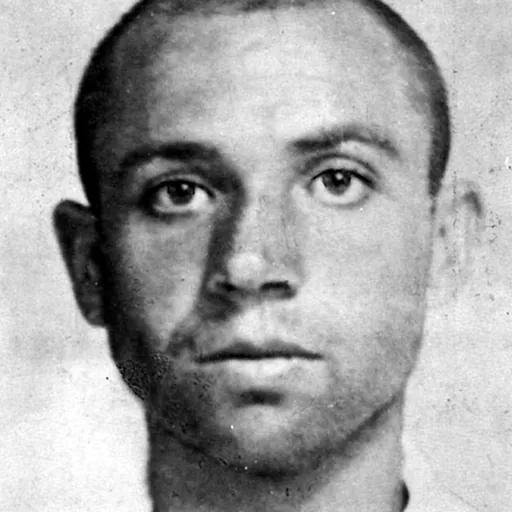
About Miguel Hernández
Lived 1910 – 1942 (aged 31). Miguel Hernández was a Spanish poet, playwright, writer and dramaturge.
Miguel Hernández Gilabert (30 October 1910 – 28 March 1942 ) was a 20th-century Spanish-language poet and playwright associated with the Generation of '27 and the Generation of '36 movements. Born and raised in a family of low resources, he was self-taught in what refers to literature, and struggled against an unfavourable environment to build up his intellectual education, such as a father who physically abused him for spending time with books instead of working, and who took him out of school as soon as he finished his primary education. At school, he became a friend of Ramón Sijé, a well-educated boy who lent and recommended books to Hernández, and whose death would inspire his most famous poem, Elegy.
Hernández died of tuberculosis, imprisoned due to his active participation on the Republican side of the civil war. His last book, , was published after his death, and is a collection of the poems he wrote in prison, some written in rudimentary pieces of toilet paper, others preserved in letters to his wife, is considered one of the finest pieces of Spanish poetry of the 20th century.
Biography Hernández was born in Orihuela, Alicante, to a poor family and received little formal education; he published his first book of poetry at 23, and gained considerable fame before his death. He spent his childhood as a goatherd and farmhand, and was, for the most part, self-taught, although he did receive basic education from state schools and the Jesuits. He was introduced to literature by friend Ramón Sijé. As a youth, Hernández greatly admired the Spanish Baroque lyric poet Luis de Góngora, who was an influence in his early works. and served in the 11th Division during the Battle of Teruel. He campaigned for the Republic during the war, writing poetry and addressing troops deployed to the front.
Unlike others, he could not escape Spain after the Republican surrender and was arrested multiple times after the war for his anti-fascist sympathies. He was tried in 1939, along with Eduardo de Guzmán and 27 others, accused of being a communist commissar and of writing poems harmful to the Francoist cause. He was eventually sentenced to death. His death sentence, however, was commuted to a prison term of 30 years, leading to incarceration in multiple jails under extraordinarily harsh conditions. He suffered pneumonia in Palencia prison, bronchitis in Ocaña prison and eventually succumbed to typhus and tuberculosis in 1942 in Alicante gaol. Just before his death, Hernández scrawled his last verse on the wall of the hospital: Goodbye, brothers, comrades, friends: let me take my leave of the sun and the fields.
Perhaps Hernández's best known poem is "Nanas de la cebolla" ("Onion Lullaby"), a reply in verse to a letter from his wife in which she informed him that she was surviving on bread and onions. In this as in other poems, the poet turns his wife's body into a mythic symbol of desperation and hope, of regenerative power desperately needed in a broken Spain.
Recovery and consecration Truly, decade of the seventies marks the definitive affirmation of the figure and work of Hernández through titles like Cómo fue Miguel Hernández (Manuel Muñoz Hidalgo, Barcelona, Planeta, 1975), Miguel Hernández, corazón desmesurado (José María Balcells Doménech, Barcelona, Dirosa, 1975), Miguel Hernández, rayo que no cesa (María de Gracia Ifach, Barcelona, Plaza y Janés, 1975), Miguel Hernández, en la encrucijada (Agustín Sánchez Vidal, Madrid, Edicusa, 1976) and many others.
In 1980 Josefina Manresa's memoirs were published, Recuerdos de la viuda de Miguel Hernández (Madrid, Ed. de la Torre), and after Franco's death and the disappearance of Francoism, the definitive period of the poet's official consecration begins.
In July 2010 the poet's family filed a lawsuit in the Spanish Supreme Court in which they asked for his guilty verdict (for his supposed crime of left wing sympathies), to be annulled. In 1939 he had been condemned to death as "an extremely dangerous and despicable element to all good Spaniards." Franco later reduced the sentence so that he would not become an international martyr, as García Lorca did. In March 2010 the family had a posthumous "declaration of reparation" from the Spanish government, but, his daughter-in-law Lucía Izquierdo said: "We want something more, that they void the death sentence.. that they hand down a ruling of innocent". Lawyers for the poet's family had new evidence, a 1939 letter from a fascist military official, Juan Bellod, testifying to his innocence. "I have known Miguel Hernández since he was a boy", the letter began. "He is a person with an impeccable past, generous sentiments and deep religious and humanist training, but whose excessive sensitivity and poetic temperament have led him to act in accordance with the passion of the moment rather than calm, firm will. I fully guarantee his behaviour and his patriotic and religious fervour. I do not believe that he is, at heart, an enemy of our Glorious Movement".
Works The poet's works include:
Poetry Perito en lunas (Lunar expert, 1933) Imagen de tu huella (1934) Hijos de la piedra (The sons of the stone, 1935) El labrador de más aire (The farmer of more air, 1937)
Legacy Miguel Hernández University of Elche, and Alicante-Elche Miguel Hernández Airport are named after him, as is the Madrid Metro station , which is decorated with his poetry.
In 2010, Spain's Ministry of Culture established the Miguel Hernández National Youth Poetry Award in his honor.
Don’t just read it —
keep it.
Full-length biographies made to live with: read them, listen on the way to work, watch them tonight.
- E-book
- Audio
- Video
Instant download · yours to keep · every purchase keeps this site free
Important facts
Family & relationships
People in Miguel Hernández's life
Named in this biography and alive at the same time

Related people
Same field, nearest in time


Contemporaries
People whose lives overlapped Miguel Hernández's






Frequently asked questions
Who was Miguel Hernández?
Spanish poet (1910–1942)
When was Miguel Hernández born?
Miguel Hernández was born on 30 October 1910 in Orihuela.
When did Miguel Hernández die?
Miguel Hernández died on 28 March 1942 in Alicante.
What was Miguel Hernández's occupation?
Miguel Hernández was a poet, playwright, writer and dramaturge.
What nationality was Miguel Hernández?
Miguel Hernández was Spanish.
Sources & further reading
Cite this page
APA: Biography.guide. (2026). Miguel Hernández. https://biography.guide/miguel-hernandez-poet/
MLA: "Miguel Hernández." Biography.guide, https://biography.guide/miguel-hernandez-poet/.
Chicago: "Miguel Hernández." Biography.guide. https://biography.guide/miguel-hernandez-poet/.
Data last updated: 2026-09-22 · Spot an error? Report a correction.
Portrait: Wikimedia Commons · author & licence
Page generated 2026-09-27 05:01 UTC