
Miguel Ángel Virasoro
Argentine physicist
About Miguel Ángel Virasoro
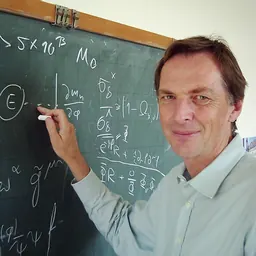
Lived 1940 – 2021 (aged 81). Miguel Ángel Virasoro was an Argentine and Italian theoretical physicist, university teacher and physicist, known for Cavity method, Virasoro algebra and Virasoro conformal block.
Miguel Ángel Virasoro (;9 May 1940 – 23 July 2021) the Virasoro algebra, the super Virasoro algebra, the Virasoro vertex operator algebra, the Virasoro group, the Virasoro conjecture, the Virasoro conformal block, and the Virasoro minimal model are all named after him.
Biography
Early life in Argentina Miguel Ángel Virasoro was born in Buenos Aires, Argentina in on May 9, 1940. He shared a name with his father, a noted Argentinian philosopher who founded dialectical existentialism. The younger Virasoro studied physics at the University of Buenos Aires (UBA) from 1958 to 1966. He received his Licenciate degree in 1962 and his PhD in 1966.
Research in Israel and the United States In 1966, Virasoro left Argentina after La Noche de los Bastones Largos, a violent dislodging of students and teachers from UBA who opposed the military government of Argentinian General Juan Carlos Onganía. After his time at UW-M, Virasoro spent another year as a postdoc in the United States at the University of California, Berkeley.
Return to Argentina Virasoro returned to Argentina after the end of Juan Carlos Onganía's dictatorship in 1970. In 1971, he accepted a professorship at his alma mater UBA. Then in 1976, General Jorge Rafael Videla came to power in Argentina and established another military dictatorship. As a result, Virasoro was unable to return to his home country after his year in the United States and instead moved to Europe. At La Sapienza, Virasoro performed research in mathematical physics, string theory, and statistical mechanics and taught courses on electromagnetism and on physical-mathematical models for economics. He was also a director of the Abdus Salam International Centre for Theoretical Physics (ICTP) in Trieste, Italy from 1995 until 2002. In 1993, he was awarded the Rammal Award by the French Physical Society. In 1998, he was elected as an international honorary member of the American Academy of Arts and Sciences. In 2009, he was awarded the Enrico Fermi Prize of the Italian Physical Society, which he shared with Greek physicist Dimitri Nanopoulos, for "the discovery of an infinite-dimensional algebra of primary importance for the construction of string theories." In 2020, he was awarded the Dirac Medal of the ICTP, which he shared with French physicists André Neveu and Pierre Ramond, "for their pioneering contributions to the inception and formulation of string theory which introduced new bosonic and fermionic symmetries into physics."
From 2011 until his death, Virasoro was an honorary professor at the Universidad Nacional de General Sarmiento in his home country of Argentina. Then in 1969 during his time at University of Wisconsin-Madison, Virasoro successfully generalized Veneziano's theory and discovered a formula (the Virasoro-Shapiro amplitude) which described the scattering of closed strings. At the time, the formulas of Veneziano and Virasoro were understood in terms of so-called dual resonance models. Only later was their work understood to describe strings.
Soon after his discovery of the Virasoro-Shapiro amplitude, Virasoro introduced what became known as the Virasoro algebra. The Virasoro algebra is an infinite-dimensional Lie algebra which describes the conformal symmetry of the worldsheet of a string embedded in spacetime. A supersymmetric generalization of this algebra, the super Virasoro algebra, describes the super conformal symmetry of the worldsheet of a supersymmetric string (or superstring). Pedagogical introductions to the Virasoro-Shapiro amplitude and the Virasoro algebra may be found in David Tong's introductory lectures on string theory.
Several mathematical concepts related to Lie algebras and conformal field theory are named after Virasoro. These include the Virasoro vertex operator algebra, the Virasoro group, the Virasoro conjecture, the Virasoro conformal block, and the Virasoro minimal model.
Spin glasses While working in Italy, Virasoro studied spin glasses and other systems in statistical mechanics. Together with Italian physicist Giorgio Parisi and French physicist Marc Mézard, Virasoro discovered the ultrametric organization of low-temperature spin glass states in infinite dimensions.
Don’t just read it —
keep it.
Full-length biographies made to live with: read them, listen on the way to work, watch them tonight.
- E-book
- Audio
- Video
Instant download · yours to keep · every purchase keeps this site free
Important facts
People in Miguel Ángel Virasoro's life
Named in this biography and alive at the same time



Related people
Same field, nearest in time

Contemporaries
People whose lives overlapped Miguel Ángel Virasoro's


Frequently asked questions
Who was Miguel Ángel Virasoro?
Argentine physicist
When was Miguel Ángel Virasoro born?
Miguel Ángel Virasoro was born on 9 May 1940 in Buenos Aires.
When did Miguel Ángel Virasoro die?
Miguel Ángel Virasoro died on 23 July 2021 in Buenos Aires.
What was Miguel Ángel Virasoro's occupation?
Miguel Ángel Virasoro was a theoretical physicist, university teacher and physicist.
What was Miguel Ángel Virasoro known for?
Miguel Ángel Virasoro was known for Cavity method, Virasoro algebra and Virasoro conformal block.
What nationality was Miguel Ángel Virasoro?
Miguel Ángel Virasoro was Argentine and Italian.
Sources & further reading
· Wikipedia: Miguel Ángel Virasoro
· DBpedia: Miguel Ángel Virasoro (physicist)
Cite this page
APA: Biography.guide. (2026). Miguel Ángel Virasoro. https://biography.guide/miguel-angel-virasoro/
MLA: "Miguel Ángel Virasoro." Biography.guide, https://biography.guide/miguel-angel-virasoro/.
Chicago: "Miguel Ángel Virasoro." Biography.guide. https://biography.guide/miguel-angel-virasoro/.
Data last updated: 2026-09-20 · Spot an error? Report a correction.
Page generated 2026-09-27 05:33 UTC