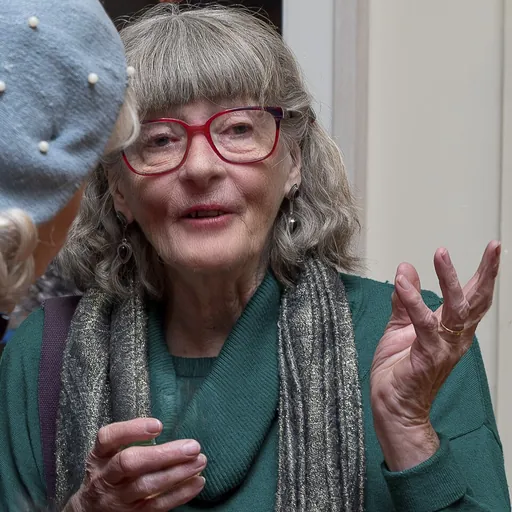
About Micky Allan
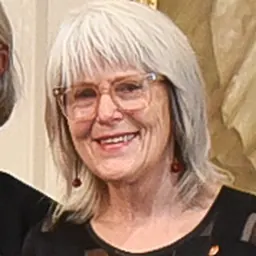
Born 1944. Micky Allan is an Australian photographer, painter, artist and draftsperson.
Micky Allan (born 1944) is an Australian photographer and artist whose work covers paintings, drawings, engraved glass overlays, installations and photography. Allan has become an influential public speaker and has been invited to be a part of many discussions on feminist politics and present a number of speeches held in galleries across Australia about art photography of the 1970s.
Early life and education Allan was born in Melbourne in 1944. From the age of two, she lived in Japan, before in 1950 her family moved back to Melbourne where Allan attended the Melbourne Church of England Girls Grammar School, in South Yarra. There she received an American Field Service Scholarship allowing her to study in the U.S. Allan took up painting as a teenager and attended a girls school in Kansas City in 1961. The school held Allan's first solo exhibition when her paintings were displayed in a national art contest.
After returning from Kansas, Allan studied Fine Arts at the University of Melbourne under art historian Joseph Burke in 1963. in 1965 she commenced a full-time Diploma of Painting course at the National Gallery of Victoria Art School which she completed in 1967.
Work Finding it unlikely that she would make a living from painting, Allan began taking photographs in 1974 after joining Melbourne's experimental arts and theatre space, the Pram Factory. She began working on sets and costumes and designing posters for the plays held there and, needing to photograph performances, learned darkroom photographic processing from housemate Virginia Coventry. The series become a documentation of how women were perceived when travelling alone during the years of second-wave feminism.
Hand-colouring Allan associated with a network of feminist photographers that included Sue Ford and Ashe Venn, with whom she exhibited at Abraxas gallery in Manuka, and also in 1975, from her practice in painting, she turned to hand-colouring monochrome photographic prints, as did her colleagues Viva Gibb, Ruth Maddison and Janina Green. Dr Shaune Lakin, Senior Curator of Photography at the National Gallery of Australia, considers Allan to be the initiator of that genre amongst the group. They revived, with a consciously feminist intent, that technique which had been developed by predominantly women retouchers in commercial photography studios for over a century to 'colour' black-and-white portraits and wedding photos. Traditionally hand-colouring involved manually adding colour to a black-and-white photograph, through the materials and techniques of painting and the use of paints, inks and dyes. In the 1970s chromogenic prints from colour negatives had become affordable, though still complex to undertake in a home darkroom, and commercial hand-colouring was disappearing, but for these artists, such manipulation personalised the work and extended the means of creative photographic expression.
Each print from the same negative thereby became a unique work. Gael Newton, writing in Art + Australia remarks that "handcolouring, which Allan more or less pioneered in the 1970s, was seen then as being a feminist strategy that subverted the dominant pure print fetish of mainstream art photography and also, by extension, the one-dimensional realities with which photo naturalism colluded. The philosophical meaning of colour as a continuing essence and site of Allan’s work does not undo the past readings but rather enlarges our understanding of how she has developed her feminism." For a conservative male reaction, Dal Pozzo reports that Max Dupain's contemporaneous declaration was that hand-colouring "should be stamped out". The following year Allan worked on a series titled Babies which became part of a set of ongoing series concerned with life cycles. The first were portraits of babies in high key and contrast with the face filling the frame and delicately coloured in pencil. The work was displayed in the National Gallery of Australia. Allan's fascination with age cycles continued with her 1978 the series, Old Age. In close-up photographs of elderly people, Allan highlighted the physical ageing process which can be regarded as unattractive by society. Allan's work raised humanist concerns and the work has been displayed in many galleries across Australia. while Ennis positions Allan's act as one that "upheld the values of the counter-culture [by] destroying the barriers between art and life." The black-and-white photographs consisted mainly of views near the bay, with some more general views of the area including hand-painted images of flowers, with an emphasis on the contrast between the industrial and natural world. The body of this work, exhibited at the NGV in 1980 by curator Jennie Boddington, focused on the industrial devastation of the coastline, raising awareness of the impact it has on daily life.
In 1982 the National Gallery of Australia acquired Allan's photographs through the Philip Morris fund among those of 107 significant Australian photographers of whom 25 were women, including Allan's associates Viva Gibb, Sandy Edwards, Sue Ford, and Ponch Hawkes.
Painter Allan returned to painting as her primary medium in 1982, a move which Newton addresses in her 1995 Art + Australia article: I made a decision a few years ago not to hold back in any way from generating anything in my work that might issue from my femaleness. I don’t care how delicate, how soft, how subtle it becomes. Love, compassion, beauty, praise. In their clear form they are neither male nor female, but how far have we associated them really with ‘female’ and therefore ‘lesser’, and women also have thrown them off in reaction. In an art world that idealises toughness (rather than spiritedness), ugliness, shock, even anger and hatred, I see young art students struggle every day as they make these qualities internalised shoulds. The question that intrigues me now is: What would women really paint (or perform or install or sculpt or write or curate) if they did it from their heart of hearts? In an art world that idealises toughness (ratherIn 2010, Allan returned to Botany Bay with a partner, Steenus von Steensen, to find that not a lot had changed from her first visit in 1980, instead the area appeared more dire and grim than it had before. Botany Bay 2010 is a follow up to the 1980 series, but using colour photography with some minimal colour painting. In 2010, Hazelhurst Regional Gallery and Arts Centre held the first exhibition of the series Botany Bay 2010, since which the series has been displayed at national galleries across Australia, alongside Allan's more recent work.
Reception Of Allan's contribution to the exhibition On the Edge: Australian Photographers of the Seventies at The San Diego Museum of Art, California during the first half of 1995 and curated by Gael Newton, Helen Ennis writes that, while little of the work shown warranted attention after the 1970s, "Micky Allan and Bill Henson are two exceptions whose art practice has become richer and more significant."
Awards / prizes / residencies
1975 Special Project Grant, Visual Art /Craft Board, Australia Council for the Arts 1979 Special Project Grant, Visual Art /Craft Board, Australia Council for the Arts 1979 Artist-in-Residence, University of Sydney 1982 Maude Vizard-Wholohan Prize, Art Gallery of South Australia (joint award) 1983 Michael Karolyi Foundation, Vence, France 1985 University of New South Wales Art Purchase Prize 1985 Australia Council for the Arts Studio Cité internationale des arts in Paris
1990 Artist Development Grant, Visual Arts/Crafts Board of the Australia Council 1990 The Melbourne Savage Club Invitation Drawing Prize (joint award) 1994 Artist-in-Residence, Canberra School of Art 2003 Grant for New Work, Visual Arts/Crafts Board, Australia Council for the arts 2006 Artist-in-Residence, Bundanon, NSW 2007 Rosalie GascoingneAward, CAPO, Capital Arts Patrons Organisation, Canberra 2010 Artist-in-residence (with Steenus von Steensen), Hazelhurst Regional Gallery, Sydney
Solo exhibitions
Allen's solo exhibitions include: 1978 Photography, Drawing and Poetry, A Live-in Show, Ewing and George Paton Galleries, University of Melbourne, and Watters Gallery, Sydney 1979 Landscapes and People on the Edges of Landscapes, Link Exhibitions, Art Gallery of South Australia 1980 Travelogue, Watters Gallery, Sydney 1980 Botany Bay Today, NGV, Melbourne and Australian Centre for Photography, Sydney 1982 The Pavilion of Death, Dreams and Desire: The Family Room, Adelaide Festival of the Arts 1984 Old Age (Project Show), Art Gallery of New South Wales, Sydney 1985 Travels without my Aunt, 200 Gertude Street, Melbourne and Watters Gallery, Sydney 1986 Recent Works, United Artists Gallery, Melbourne 1987 Micky Allan Perspective, 1975-1987, (curator: Jenepher Duncan), Monash University Gallery 1988 Places in Space, City Gallery, Melbourne 1990 Harvest (with Aleks Danko), Watters Gallery, Sydney & Contemporary Art Centre, Adelaide 1990 ACCA Experiments I: For Love of the Divine, Australian Centre for Contemporary Art, Melbourne 1991 What is this Thing called Love? Deutscher Brunswick Street, Melbourne 1992 Further Travels, Watters Gallery, Sydney 1994 Gardens, Watters Gallery, Sydney 2003 Parallel Worlds, Helen Maxwell Gallery, Canberra 2005 Quietly, Infinity in the Everyday, Helen Maxwell Gallery, Canberra 2008 Sunlight and Shadow, Helen Maxwell Gallery, Canberra 2008 Inner Weather, Tin Sheds Gallery, Sydney 2011 Spacious, Canberra Contemporary Art Space 2013 Sea, ANU School of Arts Gallery, Canberra 2025, 5 July–26 October: The Power of Delicacy, Sinclair Gallery, Castlemaine Art Museum
Publications
Don’t just read it —
keep it.
Full-length biographies made to live with: read them, listen on the way to work, watch them tonight.
- E-book
- Audio
- Video
Instant download · yours to keep · every purchase keeps this site free
Important facts
People in Micky Allan's life
Named in this biography and alive at the same time






Related people
Same field, nearest in time

Contemporaries
People whose lives overlapped Micky Allan's




Frequently asked questions
Who is Micky Allan?
Australian photographer and painter (born 1944)
When was Micky Allan born?
Micky Allan was born on 1 April 1944 in Melbourne.
What is Micky Allan's occupation?
Micky Allan is a photographer, painter, artist and draftsperson.
What nationality is Micky Allan?
Micky Allan is Australian.
Sources & further reading
Cite this page
APA: Biography.guide. (2026). Micky Allan. https://biography.guide/micky-allan/
MLA: "Micky Allan." Biography.guide, https://biography.guide/micky-allan/.
Chicago: "Micky Allan." Biography.guide. https://biography.guide/micky-allan/.
Data last updated: 2026-09-24 · Spot an error? Report a correction.
Portrait: Wikimedia Commons · author & licence
Page generated 2026-09-27 05:09 UTC