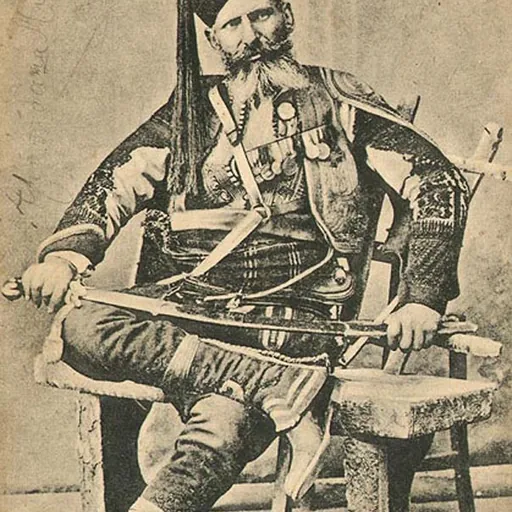
About Micko Krstić
Lived 1855 – 1909 (aged 53–54). Micko Krstić was a Macedonian military personnel.
Micko Krstić-Porečki (, 1855 – October 29, 1909), known as Vojvoda Micko, was a Macedonian Serb rebel and military leader active in the Poreče region.
Origin and early life Krstić was born in Latovo, near Makedonski Brod in the Poreče region, at the time part of the Sanjak of Monastir, Ottoman Empire (present-day North Macedonia). His family hailed from nearby Trebino. His birth year is mostly given as 1855, and rarely as 1840. He espoused a Serb identity. His teacher in Latovo was Obradović.
Serbian–Ottoman War (1876–78) and aftermath He volunteered in the Serbian–Ottoman War (1876–78). He then participated in the Kumanovo Uprising (January 20 — May 20, 1878).
After the war, the Serbian military government sent armament and aid to rebels in Kosovo and Macedonia. Christian rebel bands were formed all over the region. Many of those bands, privately funded and aided by the government, were established in Serbia and crossed into Ottoman territory. In that way, Micko Krstić formed a rebel band in 1879 in Niš, with the help of Nikola Rašić and the military government in Vranje.
Micko's bands received weapons and ammunition in Vranje. It crossed the border and came into conflict with Ottomans in around Kriva Palanka, where many of his fighters were killed. With only one comrade, Micko went to Poreče and joined the band of Stevan Petrović–Porečanin, established in the same year.
Brsjak Revolt
On 14 October 1880, an uprising broke out in Poreče, known as the Brsjak Revolt. Micko was one of the leaders, along with Ilija Delija, Rista Kostadinović, and Anđelko Tanasević. This uprising would span little more than a year.
In springtime 1881, in the Devet Jugovića-inn in Vranje, Micko Krstić assembled a band of 13 fighters, friends, blood-brothers and followers, left Serbia in springtime 1881. One of the members were Čakr-paša. Their first teacher and leader was Čerkez Ilija. In April 1881, the bands of Čerkez Ilija and Micko were surrounded near Kriva Palanka. The bands were devastated by a force of Ottoman soldiers and Albanians, with Čerkez Ilija and his band all dead, Micko and the survivors fled for safety. In the fight, half of Micko's band fell. Micko and the survivors crossed the mountains heading to Poreče, while Čakr-paša stayed on the Kozjak.
He was the successor as leader of the četa (rebel band) of Rista Kostadinović when Rista had died in battle. He was given Rista's gun which was ornamented with silver and nacre. He was suited with the red vojvoda mintan (under jacket) by tailors in Kičevo in secrecy during the night. Serbia secretly and carefully aided the Christians in the Ottoman areas; in the Brsjak revolt, however, by the end of 1881, the aid was stopped by the intervention of the Ottoman government. The Ottoman army succeeded in suppressing the rebellion in the winter of 1880/1881, and many of the leaders were exiled. When the revolt had been suppressed in Demir-Hisar, Micko refused to give himself up. The Brsjak Revolt, and the preceding ones in Kumanovo, Kriva Palanka and Kratovo, had all a Serbian character, planned in the Serbian cause, thus, the unsuccessful outcome resulted in persecution of Serbs in the Macedonia region, with an increased Bulgarization of the region's Christian Slavic populace.
Imprisonment
Krstić was imprisoned in 1882 by the Ottomans, and held in the Bitola prison. He was sentenced to 20 years imprisonment. He wrote nine letters to the Serbian consulate in Bitola, Milojko Veselinović. During the Greco-Turkish War (1897), the Bulgarians granted amnesty to Bulgarians held in Ottoman prisons; Micko refused to identify as Bulgarian and stayed in jail.
Meanwhile, the first Serbian guerilla bands were formed through self-organizing of Serb villages in Poreče, Kumanovo and Kratovo provinces, which, along Veles, were exposed the most to Bulgarian violence.
He is the protagonist of the following Serbian folk songs: "Sednal mi Džemo", "Micko kumita", "Porečko mome", "Mladi Micko" and "Izlegol Micko od Zindan"
Don’t just read it —
keep it.
Full-length biographies made to live with: read them, listen on the way to work, watch them tonight.
- E-book
- Audio
- Video
Instant download · yours to keep · every purchase keeps this site free
Important facts
People in Micko Krstić's life
Named in this biography and alive at the same time

Related people
Same field, nearest in time



Contemporaries
People whose lives overlapped Micko Krstić's

Frequently asked questions
Who was Micko Krstić?
guerilla leader
When was Micko Krstić born?
Micko Krstić was born in 1855 in Latovo.
When did Micko Krstić die?
Micko Krstić died on 29 October 1909 in Macedonia, Ižište.
What was Micko Krstić's occupation?
Micko Krstić was a military personnel.
What nationality was Micko Krstić?
Micko Krstić was Macedonian.
Sources & further reading
Cite this page
APA: Biography.guide. (2026). Micko Krstić. https://biography.guide/micko-krstic/
MLA: "Micko Krstić." Biography.guide, https://biography.guide/micko-krstic/.
Chicago: "Micko Krstić." Biography.guide. https://biography.guide/micko-krstic/.
Data last updated: 2026-09-22 · Spot an error? Report a correction.
Portrait: Wikimedia Commons · author & licence
Page generated 2026-09-27 05:04 UTC