About Michele Giambono
Lived 1400 – 1462. Michele Giambono was an Italian painter.
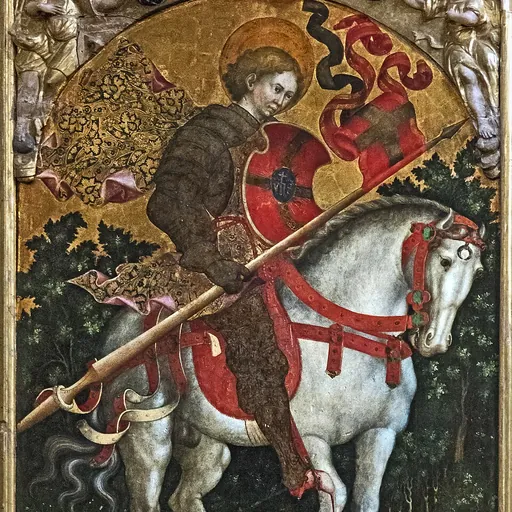
Michele Giambono, St. Chrysogonus on Horseback, c. 1450, Panel 199 x 134 cm, San Trovaso, Venice
Michele Taddeo di Giovanni Bono, known as Giambono ( 1400 Venice – c. 1462 Venice) was an Italian painter, whose work reflected the International Gothic style with a Venetian influence. He designed the mosaics of the Birth of the Virgin and Presentation in the Temple (St. Mark's, Venice). His best known paintings are the Man of Sorrows (Metropolitan Mus.) and the St. Peter (National Gall. of Art, Washington, D.C.).
Biography Early life Michele Taddeo di Giovanni Bono, known as Giambono was born in Venice c. 1400. His grandfather and father were painters. If the identification with Zanino di Pietro is accepted, then he was in Bologna in 1389-1404 and returned to Venice in c. 1407
Personal life He was married in 1420. There is no known portrait of Giambono and little is known of his personal life.
Early career He was an artist of the International Gothic style of art prevalent in Europe during the last half of the 14th century and the early years of the 15th century and decorated frames and wood in gold and polychromy. Originally known for his mosaic designs located in the Mascoli Chapel, San Marco, Venice, he is also now recognized as an accomplished panel painter.
Death Giambono died in Venice in 1462.
Art Style The International Gothic style is characterized by elegant and graceful figures Artwork of the period is typified by the use of light, bright colors especially gold used in “manuscripts and panel paintings, tapestries and polychromed sculpture”. Gentile da Fabriano (c. 1360- c 1450) ” similar to the backgrounds found in art work by Gentile da Fabriano. A group of people stand at the front of the building and surround the infant child. The mosaic has elaborate decorative elements that give the appearance of "complexity and detailed observation". The "tense pose of the Saint", suggested movement of the horse, and the flowing shape of the pennant and cloak provides an emotional force that is not seen in comparable paintings of this time period. The richly decorated velvet background features pomegranates, a fruit closely “associated with blood, death and resurrection”. The portrait has also been attributed to Gentile de Fabriano and Pisanello, but the generalized facial characteristics set “against a uniform bluish background are typical of Giambono's work".
Polyptych of St. James (c. 1450) Gallerie dell’Accademia, Venice
The polyptych has five panels each featuring a religious saint. St. James the Greater occupies the larger central panel with St John the Evangelist and St Filippo Benizzi situated to the left, is St Michael the Archangel and St Louis of Toulouse are to the right of the central panel. The highly detailed figures provide a “slow semicircular rhythm” to the polyptych. Each figure is painted in bold solid colors contrasting against a gold ground. The depiction of the Archangel Michael in his heavy armor decorated with gold, his pale face and mass of curls, particularly reflects the strong influence of Pisanello. “Although Christ is unquestionably dead, there is still energy in his partly lowered head and extended arms. Streams of blood, sculpted in thick gesso, gush from wounds carved into the panel”. St. Francis is receiving the stigmata that come from the wounds of Christ.
Coronation of the Virgin (c. 1448) Gallerie dell’Accademia, Venice
Coronation of the Virgin, also known as Paradise, was “commissioned from Giambono in 1447 by Giovanni Dotto”. The work was originally destined for the Church of S. Agnese but is currently located in the Gallerie dell’ Accademia, Venice. Giovani Dotto stipulated that the painting be similar to the one previously painted by Antonio Vivarini and Giovanni d'Alemagna for the church of San Pantalon, Venice.
Coronation of the Virgin (c. 1448) Gallerie dell’Accademia, Venice Movement: Renaissance (Early Italian, “quattrocentro”) Theme: New Testament Technique: Tempera on panel Size: 229 x 176 cm
Don’t just read it —
keep it.
Full-length biographies made to live with: read them, listen on the way to work, watch them tonight.
- E-book
- Audio
- Video
Instant download · yours to keep · every purchase keeps this site free
Important facts
more
Giambono Bono, Michele Bono, Michele di Taddeo di Giovanni Bono Zambono, Michele di Taddeo di Giovanni Bono Bono, giambono michele, Giambono, m. giambono, Michael Giovanni BonoPeople in Michele Giambono's life
Named in this biography and alive at the same time


Related people
Same field, nearest in time

Contemporaries
People whose lives overlapped Michele Giambono's



Frequently asked questions
Who was Michele Giambono?
Italian painter (c.1400-1462)
When was Michele Giambono born?
Michele Giambono was born in 1400 in Venice.
When did Michele Giambono die?
Michele Giambono died in 1462 in Venice.
What was Michele Giambono's occupation?
Michele Giambono was a painter.
What nationality was Michele Giambono?
Michele Giambono was Italian.
Sources & further reading
Cite this page
APA: Biography.guide. (2026). Michele Giambono. https://biography.guide/michele-giambono/
MLA: "Michele Giambono." Biography.guide, https://biography.guide/michele-giambono/.
Chicago: "Michele Giambono." Biography.guide. https://biography.guide/michele-giambono/.
Data last updated: 2026-09-22 · Spot an error? Report a correction.
Portrait: Wikimedia Commons · author & licence
Page generated 2026-09-27 05:03 UTC