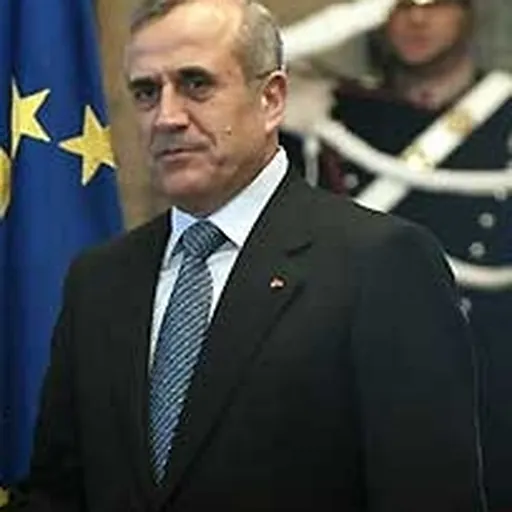
About Michel Suleiman
Born 1948. Michel Suleiman is a Lebanese politician and military officer.
Michel Suleiman ( ; born 21 November 1948) is a Lebanese politician who served as the 12th president of Lebanon from 2008 to 2014. Before becoming president, he served as commander of the Lebanese Armed Forces from 1998 to 2008.
After Lebanese Armed Forces (LAF) commander Émile Lahoud took office as president in November 1998, Suleiman succeeded him, taking his place in December. Suleiman was later elected President and was sworn into office on 25 May 2008.
Early life and education Suleiman was born in Amsheet in a Maronite Christian family on 21 November 1948. He joined the Lebanese Armed Forces in 1967 and went on to graduate from the military academy as 2nd lieutenant in 1970. He holds a Bachelor of Arts in politics and administrative sciences from the Lebanese University. His appointment was reported to be a result of his family relations with a Syrian high-level official.
On 7 May 2008, an ongoing political crisis between government loyalists and the opposition quickly spiraled out of control when Hezbollah announced that the government's decisions to declare the group's private telecommunications network as illegal and to relieve the head of security at Beirut International Airport (an alleged Hezbollah sympathizer) of his duties amounted to a "declaration of war". Fighting immediately broke out throughout the country, with members of Hezbollah and its allies in the Amal Movement and the Syrian Social Nationalist Party quickly bearing down on their enemies in the Future Movement and the Progressive Socialist Party. The fighting lasted until 14 May 2008, when the Lebanese government canceled its two decisions after the proposition of Suleiman to do so. As the crisis ended, Suleiman was the subject of criticism by some commentators and politicians since the Army did not directly intervene in the armed clashes that took place but instead tried to separate between fighters and protected political figures. On the other hand, others defended his stance by arguing that the only way to preserve the Army's unity and prevent another civil war was to ensure that it remained uninvolved in the fighting against the Lebanese citizens.
Military achievements Fighting terrorism and extremism, notably through the following operations: Offering a plan to end the 2006 Lebanon War, with a compromise solution for all parties. This plan included the planning and the preparation for the deployment of Lebanese Army in the south and on the land and sea crossover, this operation carried out accurately and faithfully and at the conclusion of the operation on the second of October, the Lebanese flag was hoisted on the hill of Labbouni adjacent to the southern border indicating the return of the Lebanese sovereignty to the south.
When the vote was finally held in Parliament on 25 May 2008, Suleiman was elected with a majority of 118 votes out of 127. He was indirectly elected by the Lebanese Parliament, which hadn't had a session, as a result of the ongoing political crisis in the country, for 18 months. Parliament's session was attended by senior representatives from across Lebanon, the Arab region, the United Nations and the European Union, the United States, European states and many other countries. In his acceptance speech which was welcomed by all political figures across the country, the Arab region and the rest of the world, Suleiman spoke of "uniting and working towards a solid reconciliation of the country. We have paid dearly for our national unity. Let us preserve it hand-in-hand". He also made reference to the long-standing crisis between the country's two main political camps when he said that "the people have given us their confidence to fulfill their aspirations, not to afflict them with our petty political disputes".
Presidency
Suleiman meeting with U.S. Secretary of State John Kerry in Paris, 5 March 2014 On 28 May 2008, President Suleiman reappointed Fouad Siniora as prime minister. Siniora was the parliamentary majority's candidate for the position, and Suleiman appointed him in accordance with the country's Constitution and with a majority of 68 MPs who named him.
Shortly after assuming the presidency, Suleiman departed from tradition when he asked that posters bearing his likeness be removed from public display despite the fact that he thanked "citizens, institutions, municipalities and cultural organizations for the outpouring of support and affection".
The priorities of Suleiman's presidential term were set out clearly, notably national reconciliation; affirming Lebanon's active role as a message of dialogue and conviviality; protecting the country's independence, unity and territorial integrity; providing security and favorable conditions for economic and social growth; reinforcing constitutional institutions; fighting terrorism; implementing international resolutions related to Lebanon; opposing any form of settlement for Palestinian refugees on the Lebanese territories.
Suleiman launched the table of national dialogue at the Presidential Palace in Baabda on 16 September 2008, in pursuance of the Doha Agreement's articles, and in view of consolidating National Reconciliation and Entente.
Parallel to local issues, Suleiman exchanged visits with heads of friendly countries, and took part in the work of regional and international organizations, especially the United Nations, in order to consecrate Lebanon's rights and defend its supreme interests.
On Mary McAleese's final overseas visit as President of Ireland, she met Suleiman at the Presidential Palace in Baabda. His presidency term came to its conclusion on 25 May 2014 amid no internal or foreign consensus on who would be elected as the next president of the Lebanese Republic. Lebanon remained without a president until Michel Aoun was elected on 31 October 2016.
Decorations, medals, awards and honors National honours
Military honours Decoration of Military Pride, silver grade Medal of War Decoration of Military Valor, silver grade Decoration of the National Unity Decoration of the Dawn of the South Certificate of Honor of the Arab Union Decoration of Arab Union for Military Sports, 2nd degree (commander) Military Medal Internal Security forces' Medal General Security Medal State security Medal Commemorative Medal of Conferences for the year 2002 Citations of the Armed Forces Commander, 4 times – Felicitations of the Armed Forces Commander, 18 times – Felicitations of the Brigade Commander, once
Honorary Degree Doctorate Honoris Causa from the Moscow State Institute for International Relations (MGIMO)- 2010 Doctorate Honoris Causa from the National University of the Third of February in Buenos Aires (UNTREF) – 2012 see his international decorations
Personal life Michel Suleiman is married to Wafaa Suleiman and has three children: His mother tongue is Arabic and he is also fluent in both French and English. He is a Maronite Christian.
Don’t just read it —
keep it.
Full-length biographies made to live with: read them, listen on the way to work, watch them tonight.
- E-book
- Audio
- Video
Instant download · yours to keep · every purchase keeps this site free
Important facts
Family & relationships
People in Michel Suleiman's life
Named in this biography and alive at the same time






Related people
Same field, nearest in time


Contemporaries
People whose lives overlapped Michel Suleiman's


Frequently asked questions
Who is Michel Suleiman?
12th President of Lebanon
When was Michel Suleiman born?
Michel Suleiman was born on 21 November 1948 in Amchit, Lebanon.
What is Michel Suleiman's occupation?
Michel Suleiman is a politician and military officer.
What nationality is Michel Suleiman?
Michel Suleiman is Lebanese.
Sources & further reading
Cite this page
APA: Biography.guide. (2026). Michel Suleiman. https://biography.guide/michel-suleiman/
MLA: "Michel Suleiman." Biography.guide, https://biography.guide/michel-suleiman/.
Chicago: "Michel Suleiman." Biography.guide. https://biography.guide/michel-suleiman/.
Data last updated: 2026-09-20 · Spot an error? Report a correction.
Page generated 2026-09-27 05:10 UTC