
About Michael of Ephesus
Lived 1050 – 1129 (aged 78–79). Michael of Ephesus was a Byzantine philosopher and writer.
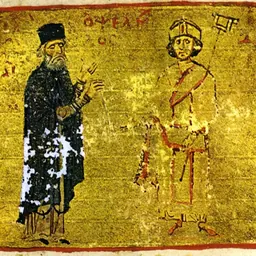
Michael of Ephesus or Michael Ephesius (; c. 1050 – 1129) was a Byzantine scholar. He wrote important commentaries on Aristotle, including the first full commentary on the Sophistical Refutations, which established the regular study of that text.
Life Little is known about Michael's life. It is known that he worked in the philosophy college of the University of Constantinople. Together with Eustratius of Nicaea, he was part of a circle organized by Anna Comnena. As Michael suggests at the end of his Parva Naturalia commentary, his goal was to provide coverage of texts in the Corpus Aristotelicum that had been neglected by earlier commentators; this was "part of a cooperative scholarly undertaking conceived and guided by Anna Comnena."
The fanciful suggestion that the Aristotelian commentator was none other than Michael VII Doukas, making good on his tuition under Michael Psellos (who was apparently not Michael of Ephesus' teacher) and turning after his abdication to scholarship as the archbishop of Ephesus, is no longer taken seriously.
Work Michael's breadth is remarkable, and his interpretive method has been compared to that of Alexander of Aphrodisias; the commentary on Metaphysics Books 7–14 attributed to Alexander is considered to be his work. Michael's commentaries draw on Neoplatonist ideas and on the exegetical tradition of Stephen of Alexandria. At times they allude to contemporary Byzantine matters and include criticism of the emperor and of the current state of education.
Works The commentaries: Greek texts On Sophistical Refutations: Commentaria in Aristotelem Graeca II.3 On Generation of Animals: CAG XIV.3 On Nicomachean Ethics, books 9-10: CAG XX On Parva Naturalia: CAG XXII.1 On Parts of Animals, Movement of Animals, Progression of Animals: CAG XXII.2 On Nicomachean Ethics, book 5: CAG XXII.3 Michael's commentary on the pseudo-Aristotelian On Colors remains unedited, and his commentary on Politics survives only in part.
English translations Aristotle and Michael of Ephesus on the Movement and Progression of Animals, trans. Anthony Preus, Hildesheim: Georg Olms, 1981. . Aspasius, Anonymous, Michael of Ephesus, On Aristotle: Nicomachean Ethics 8 and 9, trans. David Konstan, Duckworth, 2001. . 276 pages.
Don’t just read it —
keep it.
Full-length biographies made to live with: read them, listen on the way to work, watch them tonight.
- E-book
- Audio
- Video
Instant download · yours to keep · every purchase keeps this site free
Important facts
People in Michael of Ephesus's life
Named in this biography and alive at the same time


Related people
Same field, nearest in time



Contemporaries
People whose lives overlapped Michael of Ephesus's



Frequently asked questions
Who was Michael of Ephesus?
Byzantine philosopher
When was Michael of Ephesus born?
Michael of Ephesus was born in 1050.
When did Michael of Ephesus die?
Michael of Ephesus died in 1129.
What was Michael of Ephesus's occupation?
Michael of Ephesus was a philosopher and writer.
What nationality was Michael of Ephesus?
Michael of Ephesus was Byzantine.
Sources & further reading
· Wikipedia: Michael of Ephesus
Cite this page
APA: Biography.guide. (2026). Michael of Ephesus. https://biography.guide/michael-of-ephesus/
MLA: "Michael of Ephesus." Biography.guide, https://biography.guide/michael-of-ephesus/.
Chicago: "Michael of Ephesus." Biography.guide. https://biography.guide/michael-of-ephesus/.
Data last updated: 2026-09-20 · Spot an error? Report a correction.
Page generated 2026-09-27 05:12 UTC