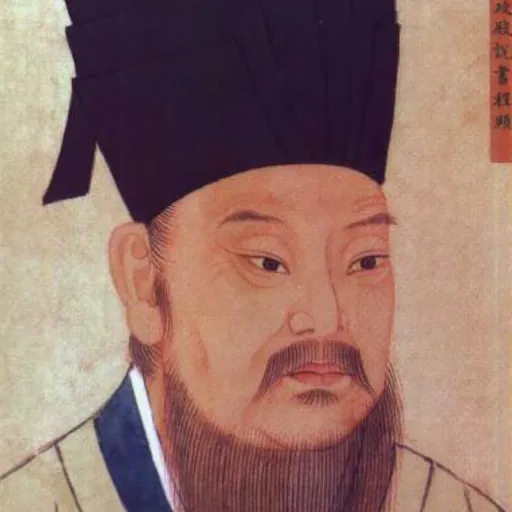
About Cheng Yi
Lived 1033 – 1107 (aged 73–74). Cheng Yi was a Chinese philosopher.
Cheng Yi (1033–1107), also known by various other names and romanizations, was a Chinese classicist, essayist, philosopher, and politician of the Song Dynasty. He worked with his older brother Cheng Hao. Like his brother, he was a student of Zhou Dunyi, a friend of Shao Yong, and a nephew of Zhang Zai. The five of them, along with Sima Guang, are called the Six Great Masters by his follower Zhu Xi. He became a prominent figure in neo-Confucianism, and the philosophy of Cheng Yi, Cheng Hao and Zhu Xi is referred to as the Cheng–Zhu school or the Rationalistic School.
Life Cheng was born in Luoyang, Henan in 1033. Cheng entered the national university in 1056, and received the "presented scholar" degree in 1059. He lived and taught in Luoyang, and declined numerous appointments to high offices. He campaigned against the reformist policies of Wang Anshi, and after the reformers were dismissed from office, he was appointed expositor-in-waiting in 1086 to begin lecturing the emperor on Confucianism. He was more aggressive and obstinate than his brother, and made several enemies, including Su Shi, the leader of the Sichuan group. In 1097, his enemies were able to ban his teachings, confiscate his properties, and banish him. He was pardoned three years later, but was blacklisted and his work was once more banned in 1103. He was finally pardoned in 1106, one year before his death.
In 1452 the title Wujing Boshi was bestowed upon the descendants of Cheng Yi and other Confucian sages such as Mencius, Zengzi, Zhou Dunyi, and Zhu Xi.
A well known chengyu refers to an incident when two men (Yang Shi and You Zuo), requesting to be taken on as his disciples, stood in the snow for hours at his door. They became renowned examples of the Confucian virtues of devotion to learning and respect for one's master.
Cheng Yi is widely believed to be responsible for the rise of the cult of widow chastity. He argued that it would be improper for a man to marry a widow since she had lost her integrity. On the question of widows who had become impoverished due to the death of their husbands, Cheng stated: "To starve to death is a small matter, but to lose one's chastity is a great matter." . as well as a dramatic increase in suicides by widows during the Ming era. In reality, however, Cheng only insisted the practice on the class of scholar-officials and understood the limitations of peasant life.
Don’t just read it —
keep it.
Full-length biographies made to live with: read them, listen on the way to work, watch them tonight.
- E-book
- Audio
- Video
Instant download · yours to keep · every purchase keeps this site free
Important facts
more
Cheng I, Ch'eng Cheng-shu, Cheng-shu, I-ch'uan, I-chuan, Ch'eng Cheng, Cheng Cheng, ChengPeople in Cheng Yi's life
Named in this biography and alive at the same time




Related people
Same field, nearest in time


Contemporaries
People whose lives overlapped Cheng Yi's




Frequently asked questions
Who was Cheng Yi?
Chinese philosopher (1033–1107)
When was Cheng Yi born?
Cheng Yi was born in 1033 in Huangpi District.
When did Cheng Yi die?
Cheng Yi died on 5 October 1107.
What was Cheng Yi's occupation?
Cheng Yi was a philosopher.
What nationality was Cheng Yi?
Cheng Yi was Chinese.
Sources & further reading
· DBpedia: Cheng Yi (philosopher)
Cite this page
APA: Biography.guide. (2026). Cheng Yi. https://biography.guide/cheng-yi-philosopher/
MLA: "Cheng Yi." Biography.guide, https://biography.guide/cheng-yi-philosopher/.
Chicago: "Cheng Yi." Biography.guide. https://biography.guide/cheng-yi-philosopher/.
Data last updated: 2026-09-21 · Spot an error? Report a correction.
Portrait: Wikimedia Commons · author & licence
Page generated 2026-09-27 04:59 UTC