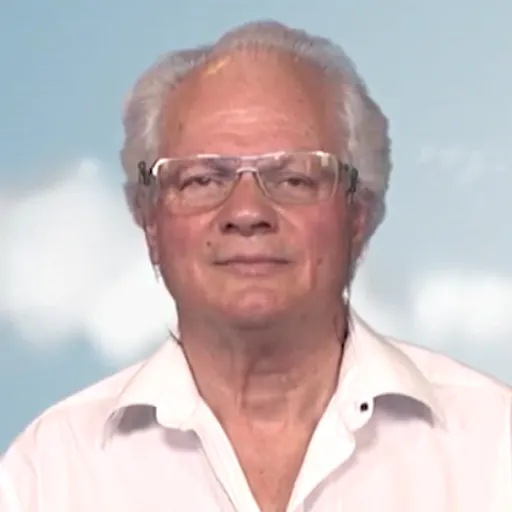
About Michael Ghil
Born 1944. Michael Ghil is an American and Israeli geophysicist, university teacher and meteorologist, known for Boolean Delay Equations, Climate Dynamics and Data Assimilation.
Michael Ghil (; born 10 June 1944 in Budapest, Hungary) is an American and European mathematician and physicist, focusing on the climate sciences and their interdisciplinary aspects. He is a founder of theoretical climate dynamics, as well as of advanced data assimilation methodology.
Early life and education Ghil spent his childhood in Romania before moving to Israel. He studied Mechanical Engineering at the Technion–Israel Institute of Technology, Haifa, Israel from where he received his B.Sc. in August 1966, and his M.Sc. in June 1971. He studied mathematics at the Courant Institute of Mathematical Sciences, New York University, New York from where he received a Master's in February 1973 and a Ph.D. in June 1975, under the supervision of Peter Lax (Abel Prize 2005).
Career Ghil was affiliated with the Courant Institute of Mathematical Sciences, from September 1971 until May 1987, first as a Research Assistant (1971–1975) and then as a Research Professor (1982–1987), via intermediate appointments. While in New York, he was a NAS/NRC Research Associate at the NASA Goddard Institute for Space Studies, New York from August 1975 to September 1976.
Research Ghil has played an important role in the foundations of modern theoretical climate dynamics. During the late 1970s, he worked in the application of dynamical systems theory to problems of the climate sciences. Starting from the work of Budyko and Sellers, Ghil proposed a 1D Energy Balance Model able to provide a succinct but essentially correct description of the climate system. Ghil's analysis complemented the ones by Budyko and Sellers and played a key role for understanding the multistability of the Earth system, which features competing snowball and warm states. Paleoclimatological evidence that the Earth had indeed experienced snowball episodes in the Pre-Cambrian emerged in the 1990s. Energy balance models like Ghil's, once supplemented with stochastic forcings (along the direction of Hasselmann's programme) led to the discovery of phenomena like stochastic resonance.
Throughout the 1980s and 1990s Ghil contributed to the development of data assimilation techniques in meteorology and oceanography, and to the theory of low-frequency variability of the atmosphere (with a special emphasis on the study of blocking), as well as to the understanding of large-scale ocean dynamics. He introduced the use of advanced spectral methods for the analysis of chaotic geophysical time series, and most prominently the singular-spectrum analysis technique (SSA). In the 2000s, he extended his studies of the El Niño-Southern Oscillation phenomenon (ENSO) using Boolean delay and delay differential equations, and worked on the statistics and dynamics of extreme events. Recently, Ghil proposed the pullback attractor as a mathematical framework able to encompass the random and time-dependent nature of the climate system. Another area of research has been the development of data-driven methods for reconstructing the surrogate dynamics of partially observed systems. Additionally, he has contributed to data analysis and modeling in macroeconomics and population dynamics, as well as to coupled climate-economy-biosphere modeling.
Honors and awards 2022 American Physical Society Fellow 2012 A. Wegener Medal & Honorary Member, European Geosciences Union (EGU) 2010 Honorary Member, Hungarian Academy of Sciences 2005 Lorenz Lecture, American Geophysical Union 2005 Foreign Member, Austrian Academy of Sciences (OeAW) 2004 L. F. Richardson Medal, European Geosciences Union 2002 Honorary Fellow of the Royal Astronomical Society 1998 Member, Academia Europaea 1995 Fellow, American Geophysical Union 1991 - 1992 Guggenheim Fellow 1988 Fellow, American Meteorological Society
Publications A selection of books and papers is given below.
Selected books
Selected papers Theory of Climate Dynamics and Climate Variability
Paleoclimate
Data assimilation
Blockings
Dynamical Systems Theory
Macroeconomics & coupled climate-macroeconomics
Don’t just read it —
keep it.
Full-length biographies made to live with: read them, listen on the way to work, watch them tonight.
- E-book
- Audio
- Video
Instant download · yours to keep · every purchase keeps this site free
Important facts
People in Michael Ghil's life
Named in this biography and alive at the same time

Related people
Same field, nearest in time




Contemporaries
People whose lives overlapped Michael Ghil's



Frequently asked questions
Who is Michael Ghil?
American geophysicist
When was Michael Ghil born?
Michael Ghil was born on 10 June 1944 in Budapest.
What is Michael Ghil's occupation?
Michael Ghil is a geophysicist, university teacher and meteorologist.
What is Michael Ghil known for?
Michael Ghil is known for Boolean Delay Equations, Climate Dynamics, Data Assimilation, El Niño-Southern Oscillation and Singular Spectrum Analysis.
What nationality is Michael Ghil?
Michael Ghil is American and Israeli.
Sources & further reading
Cite this page
APA: Biography.guide. (2026). Michael Ghil. https://biography.guide/michael-ghil/
MLA: "Michael Ghil." Biography.guide, https://biography.guide/michael-ghil/.
Chicago: "Michael Ghil." Biography.guide. https://biography.guide/michael-ghil/.
Data last updated: 2026-09-20 · Spot an error? Report a correction.
Portrait: Wikimedia Commons · author & licence
Page generated 2026-09-27 04:57 UTC