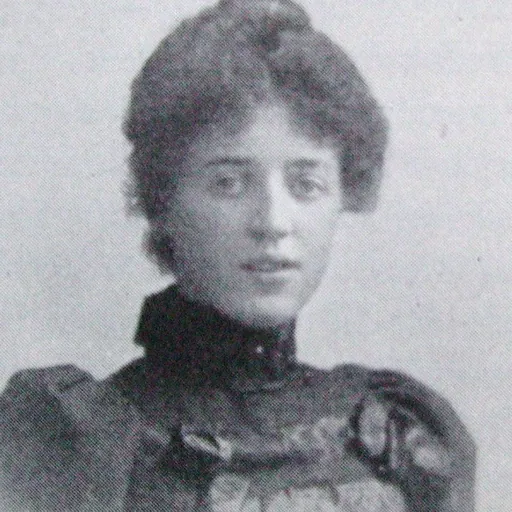
About Mia Leche Löfgren
Lived 1878 – 1966 (aged 87). Mia Leche Löfgren was a Swedish author, journalist and peace movement.
Ebba Maria Lovisa "Mia" Leche Löfgren (10 October 1878 – 8 April 1966) was a Swedish journalist, writer and peace activist, known for her strong stance against National Socialism and anti-Semitism as well as her involvement in refugee aid and humanitarian relief.
Biography
Family and personal life Mia Leche Löfgren was born on 10 October 1878, in Lund. The daughter of Jakob Wilhelm Ebbe Gustaf Leche (4 September 1850 in Helsingborg – 29 January 1927 in Stockholm) and Wilhelmina (Minchen) Dorothea Fredrika Louisa Sager (16 July 1855 in Lintrup, Denmark – 28 April 1947 in Stockholm), she grew up in a bourgeois family with close contacts to local academic and intellectual circles. When her father, a zoologist, was appointed principal of Stockholm University College the family moved to the Swedish capital. In 1884, he was promoted to professor of zoology. Mia Leche Löfgren's husband Eliel Löfgren and their daughter Ulla. In the late 1890s, Leche Löfgren continued her education with various language and writing courses, although she did not obtain an official degree. She also attended lectures about working class issues and the position of women in society. On 6 October 1900, at age 22, she married Fredrik Hjalmar von Friesen (28 June 1873 in Forsmark – 31 January 1947). The couple had a son, Otto Bertil von Friesen (4 June 1901 in Stockholm – 13 February 1990 in Gothenburg), who later became a medical doctor, as well as a daughter, Anna Lisa von Friesen. Her later writings reveal that the marriage was not a happy one and in 1908 the couple filed for divorce. The separation process caused somewhat of a public scandal and in the end, Leche Löfgren lost custody of her children and was forbidden any direct contact with them. She would not see her older daughter Anna Lisa again as she died when still a child, but could re-establish contact with her son Otto Bertil after he reached his majority. In the 1950s she moved back to Stockholm, where she continued to be an active figure in various organizations engaged in peace education, refugee aid and other humanitarian matters.
Journalism and writing activities Having occasionally worked as a translator for public and legal documents, Back at home she wrote an anti-militarist article that she sent anonymously to , apparently in error as this conservative newspaper did not really align with her political convictions. With her first article published, she then continued to send articles and comments to the literary and women's periodical Idun as well as the satirical magazines Kurre and Söndagsnisse.
From 1906 to 1908, she was employed by the conservative newspaper as a writer of book reviews for literature that the journal's chief literary critic, Carl David af Wirsén, was not interested in, especially works written by and for women.
The 1930s and the rising threat of Nazism did not only have an impact on her political activism in the Swedish peace movement, but also brought her back to journalism. She increased her writing activities for , taking on a decidedly anti-Nazist stance and quickly developing into one of the most prominent political voices of the paper.
Involvement in peace activism, anti-Nazism and refugee relief Leche Löfgren later described that she found her inspiration for humanitarian engagement in a speech held by Ellen Key in the auditorium of the Swedish Academy of Sciences one evening in 1906: "In the wake of the union crisis [between Sweden and the newly independent Norway] Ellen Key raised her calm, wise voice in a warm-hearted call for peace. The speech she gave in the auditorium of the old Academy of Sciences was the first peace oration that I heard, and it left an indelible impression on me."
"" She became a member of various women's groups that were engaged in the question of universal suffrage, peace work and humanitarianism, although it was pacifism that interested her the most: “Like all liberal women of the day, I was an all-round feminist, but Ann-Margret Holmgren, Karolina Widerström, Gerda Hallberg, Lydia Wahlström, Anna Bugge-Wicksell, Gulli Petrini, Signe Bergman, and other pioneering suffragists were from a somewhat earlier generation. If I was part of that movement, it was primarily for the cause of pacifism."
"" In 1914, Leche Löfgren was one of the initiators of the women's association (Liberal-Minded Women) and in 1915 she participated in the Women's Peace Congress in The Hague, Netherlands, that had been organized to protest against the continuation of the First World War. Next to her written condemnations of Nazism, political persecution and anti-Semitism, among them a number of articles in Jewish newspaper Judisk tidskrift, she frequently appeared as a public speaker. Reflecting on this time in her autobiographical work, Leche Löfgren described how the Swedish authorities attempted to hinder her work as they feared that it would further increase the attraction of Sweden as a secure harbour for refugees.
In her last work (Closure), published in 1962, Leche Löfgren turned her attention to the other side of the political spectrum, warning that communist ideas might infiltrate the peace movement – in her opinion, the Swedish peace movement should remain strictly non-partisan and not align with any specific political party.
Leaving a rich legacy behind as one of the leading voices in Swedish peace activism during the first half of the 20th century, Leche Löfgren spent her last years in Stockholm until her death in 1966.
Awards Leche Löfgren was awarded the Illis quorum by the Swedish government for her work.
Bibliography (selection)
Autobiographical works Leche Löfgren's autobiographical work, published in six books over almost 30 years, aspires to literary quality, encompassing both her personal life experiences, impressions of renowned contemporary personalities as well as musings and reactions to political and societal developments.
. Stockholm: Lars Hökerbergs bokförlag, 1934. . Stockholm: Hökerberg, 1941. . Stockholm: Hökerberg, 1946. . Stockholm: Hökerberg, 1952. . Stockholm: Hökerberg, 1959. . Stockholm: Hökerberg, 1962.
Other works
. Stockholm: Sveriges folkskollärarinneförbund, 1924. . Stockholm: Sv. Andelsförl., 1924. (together with Elin Wägner) . Stockholm: Natur och kultur, 1930. . Stockholm: Internationella Kvinnoförbundet för Fred och Frihet, 1945.
Articles
"". Judisk tidskrift. 1945(18). pp. 137–142. (ed. together with Jeanna Oterdahl) "". Judisk tidskrift. 1947(20). pp. 276–278. "". Judisk tidskrift. 1948(21). pp. 290–291.
Don’t just read it —
keep it.
Full-length biographies made to live with: read them, listen on the way to work, watch them tonight.
- E-book
- Audio
- Video
Instant download · yours to keep · every purchase keeps this site free
Important facts
People in Mia Leche Löfgren's life
Named in this biography and alive at the same time




Related people
Same field, nearest in time

Contemporaries
People whose lives overlapped Mia Leche Löfgren's




Frequently asked questions
Who was Mia Leche Löfgren?
Swedish author (1878-1966)
When was Mia Leche Löfgren born?
Mia Leche Löfgren was born on 10 October 1878 in Lund.
When did Mia Leche Löfgren die?
Mia Leche Löfgren died on 8 April 1966 in Engelbrekt church parish.
What was Mia Leche Löfgren's occupation?
Mia Leche Löfgren was an author, journalist and peace movement.
What nationality was Mia Leche Löfgren?
Mia Leche Löfgren was Swedish.
Sources & further reading
· Wikipedia: Mia Leche Löfgren
Cite this page
APA: Biography.guide. (2026). Mia Leche Löfgren. https://biography.guide/mia-leche-lofgren/
MLA: "Mia Leche Löfgren." Biography.guide, https://biography.guide/mia-leche-lofgren/.
Chicago: "Mia Leche Löfgren." Biography.guide. https://biography.guide/mia-leche-lofgren/.
Data last updated: 2026-09-23 · Spot an error? Report a correction.
Portrait: Wikimedia Commons · author & licence
Page generated 2026-09-27 05:08 UTC