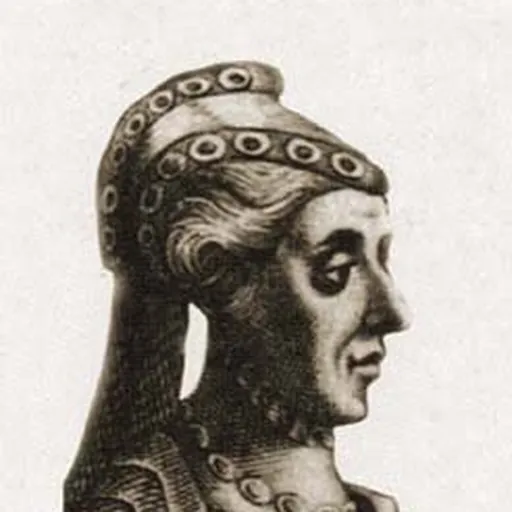
Mencia Lopez de Haro
Queen of Portugal
About Mencia Lopez de Haro
Lived 1215 – 1270 (aged 54–55).
Mécia Lopes de Haro or Mencía López de Haro (c. 1215–c. 1270) was a Castilian noblewoman, the wife successively of count Álvaro Pérez de Castro and of King Sancho II of Portugal. The subsequent annulment of her marriage by Pope Innocent IV has led to disagreement over whether she should be counted among the queens consort of Portugal. She played a central role in the Portuguese political crisis of 1245.
Birth Mécia Lopes was born in Biscay, the daughter of Lope Díaz II de Haro, lord of Biscay, and of Urraca Alfonso of León. Her mother was an illegitimate daughter of Alfonso IX of León. She was thus niece of the reigning king, Ferdinand III of Castile.
First Marriage Mécia was married on 29 September 1234 to Álvaro Pérez de Castro, a magnate involved in the expansion of the Castilian kingdom into the region of Cordoba, whose first marriage to Aurembiaix, Countess of Urgell had been annulled in 1228, while Mécia's sister Teresa married Nuño, Count of Rousillon, a kinsman of the powerful House of Lara.
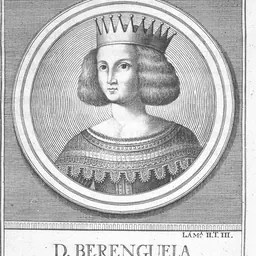
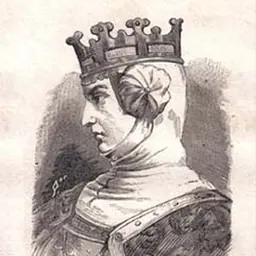
These consanguineous marriages were the cause of a dispute between Ferdinand III and Mécia's father Lope Díaz II Haro and husband, the monarch confiscating some of the groom's lands. It was peacefully resolved through the mediation of Queens Berengaria of Castile and Elisabeth of Hohenstaufen, Ferdinand's mother and wife, respectively.
While the marriage proved childless, it did place Mécia in the midst of the struggles on the Cordoban frontier. After taking Cordoba, the king returned to Toledo, leaving Álvaro in charge of the stronghold of Martos. The abandonment of agriculture due to the conflict led to a localized famine, and Álvaro was forced to journey to the royal court to plead for assistance. The king granted him the equivalent of viceregal powers, as well as monetary support. On hearing of the danger under which his wife had been placed, Álvaro made to return, but became ill and died of an unnamed disease at Orgaz in 1239, or as some have it, 1240.
Second Marriage Mecía married again to King Sancho II of Portugal, son of Afonso II of Portugal and his wife, Queen Urraca of Castile. The legitimacy of this union has been contested, first by Portuguese historian António Brandão, who has been followed by several subsequent scholars in considering her a mistress, but that they married is documented by the papal bull Sua nobis of Pope Innocent IV, and is accepted by most historians. The date and place of the marriage is uncertain. It does not appear in the work of Rodrigo of Toledo, completed in March 1243 but also omitting Portuguese royal marriages from the year before, while the papal bull mentions it in 1245, suggesting it should be placed between these dates. She was not a royal princess and had no direct connections in either Portugal or Castile, whose king abandoned her after the death of her husband. She exacerbated her political isolation by surrounding herself with Castilian-raised servants and maids, making it difficult for Portuguese courtiers to use Mécia as an avenue for approaching the king. She was thus quickly rejected by nobility and populace. The degree of the discontent can be seen in the oft-repeated claim that the king was "bewitched by the arts of D. Mécia de Haro."
Pope Innocent IV addressed a papal bull to Afonso, Count of Boulogne, brother to the king and aspirant to the throne, in which he requested that Afonso raise troops from Boulogne to assist the church in the Holy Land. Given the plans of the Portuguese clergy and the pope, this seems simply to have been a pretext to allow Afonso to bring armed men to Lisbon. Sancho refused to repudiate his wife, and the pope then carried through with his threat, annulling the marriage.
Deposition of the king and the kidnapping of the queen On 24 July and 1 August 1245, the chronicler of Sancho II, says that she left Ourém for Galicia, which seems unlikely. There is a surviving document, dated 24 February 1257, which while not specifying the location, reports Mécia and her relative Rodrigo González acting as executors to Theresa Aires, making certain gifts to the convent of Benavides, suggesting that at the time she resided in the area of Castile. An infante Ferdinand, who she adopted, became sole heir of Mécia, and also disputed Sancho's inheritance. According to tradition, Mécia died in 1270 at Palencia, where she held lands, and she was buried at Nájera in the Benedictine convent of Santa Maria, in the Chapel of the Cross. Her tomb, supported by four lions and bearing the arms of Portugal, features a woman dressed in a Biscay costume.
Don’t just read it —
keep it.
Full-length biographies made to live with: read them, listen on the way to work, watch them tonight.
- E-book
- Audio
- Video
Instant download · yours to keep · every purchase keeps this site free
Important facts
Family & relationships
People in Mencia Lopez de Haro's life
Named in this biography and alive at the same time
Contemporaries
People whose lives overlapped Mencia Lopez de Haro's




Frequently asked questions
Who was Mencia Lopez de Haro?
Queen of Portugal
When was Mencia Lopez de Haro born?
Mencia Lopez de Haro was born in 1215 in Biscay.
When did Mencia Lopez de Haro die?
Mencia Lopez de Haro died in 1270 in Palencia.
What nationality was Mencia Lopez de Haro?
Mencia Lopez de Haro's recorded nationality: Crown of Castile, Kingdom of Portugal.
Sources & further reading
· Wikipedia: Mencia Lopez de Haro
· DBpedia: Mécia Lopes de Haro
Cite this page
APA: Biography.guide. (2026). Mencia Lopez de Haro. https://biography.guide/mencia-lopez-de-haro/
MLA: "Mencia Lopez de Haro." Biography.guide, https://biography.guide/mencia-lopez-de-haro/.
Chicago: "Mencia Lopez de Haro." Biography.guide. https://biography.guide/mencia-lopez-de-haro/.
Data last updated: 2026-09-21 · Spot an error? Report a correction.
Portrait: Wikimedia Commons · author & licence
Page generated 2026-09-27 04:59 UTC