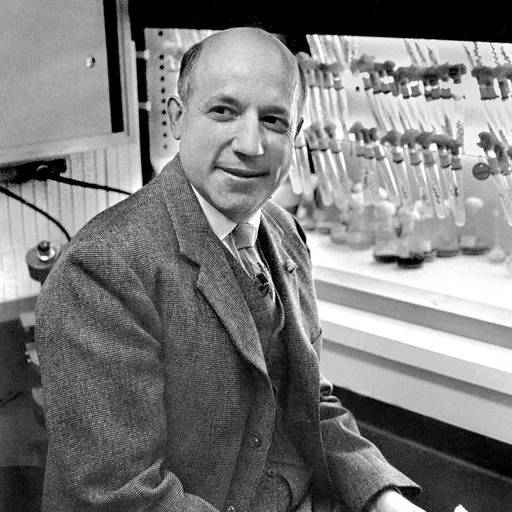
About Melvin Calvin
Lived 1911 – 1997 (aged 85). Melvin Calvin was an American chemist, biochemist, university teacher, biologist and engineer, known for Calvin cycle.
Melvin Ellis Calvin (April 8, 1911 – January 8, 1997) was an American biochemist known for discovering the Calvin cycle along with Andrew Benson and James Bassham. He was awarded the 1961 Nobel Prize in Chemistry "for his research on the carbon dioxide assimilation in plants". He spent most of his five-decade career at the University of California, Berkeley.
Early life and education Melvin Calvin was born in St. Paul, Minnesota, the son of Elias Calvin and Rose Herwitz, Jewish immigrants from the Russian Empire (now the countries of Lithuania and Georgia).
At an early age, Melvin Calvin’s family moved to Detroit, Michigan, where his parents ran a grocery store to earn their living. Calvin was often found satisfying his curiosity by looking through all of the products that made up their shelves.
After he graduated from Central High School in 1928, he went on to study at Michigan College of Mining and Technology (now known as Michigan Technological University) where he received the school’s first Bachelors of Science in Chemistry. He went on to earn his PhD at the University of Minnesota in 1935. While under the mentorship of George Glocker, he studied and wrote his thesis on the electron affinity of halogens. He was invited to join the lab of Michael Polanyi as a Post Doctoral student at the University of Manchester. The two years he spent at the lab were focused on studying the structure and behavior of organic molecules. In 1942, He married Marie Genevieve Jemtegaard,
Career On a visit to the University of Manchester, Joel Hildebrand, the director of UC Radiation Laboratory, invited Calvin to join the faculty at the University of California, Berkeley. This made him the first non-Berkeley graduate hired by the chemistry department in +25 years. He invited Calvin to push forward in radioactive carbon research because "now was the time". The process is part of the photosynthesis cycle. It was given the name the Calvin–Benson–Bassham Cycle, named for the work of Melvin Calvin, Andrew Benson, and James Bassham. There were many people who contributed to this discovery but ultimately Melvin Calvin led the charge (see below).
In 1963, Calvin was given the additional title of Professor of Molecular Biology. He was founder and Director of the Laboratory of Chemical Biodynamics, known as the “Roundhouse”, and simultaneously Associate Director of Berkeley Radiation Laboratory, where he conducted much of his research until his retirement in 1980. In his final years of active research, he studied the use of oil-producing plants as renewable sources of energy. He also spent many years testing the chemical evolution of life and wrote a book on the subject that was published in 1969.
The foundation of the Melvin Calvin laboratory The circular laboratory known as the “Roundhouse” was designed to facilitate collaboration between students and visiting scientists in Calvin’s lab. Benson himself has also mentioned being fired by Calvin, and has complained about not being mentioned in his autobiography.
Honours and legacy 1954 - Elected to the United States National Academy of Sciences
1955 - Awarded the Centenary Prize
1958 - Elected a foreign member of the Royal Netherlands Academy of Arts and Sciences
1958 - Elected to the American Academy of Arts and Sciences
1959 - Elected a Member of the German Academy of Sciences Leopoldina
1960 - Elected to the American Philosophical Society
1961 - Melvin Calvin received the Nobel Prize in Chemistry “for his research on the carbon dioxide assimilation in plants”
1964 - Awarded the Davy Medal of the Royal Society
1971 - Honorary Doctor of Laws (LL.D.) degree from Whittier College
1978 - Priestley medal of the American Chemical Society
Calvin was featured on the 2011 volume of the American Scientists collection of US postage stamps, along with Asa Gray, Maria Goeppert-Mayer, and Severo Ochoa. This was the third volume in the series, the first two having been released in 2005 and 2008.
Calvin was award 13 other honorary degrees.
Publications
Bassham, J. A., Benson, A. A., and Calvin, M. "The Path of Carbon in Photosynthesis VIII. The Role of Malic Acid.", Ernest Orlando Lawrence Berkeley National Laboratory, University of California Radiation Laboratory–Berkeley, United States Department of Energy (through predecessor agency the Atomic Energy Commission), (January 25, 1950). Badin, E. J., and Calvin, M. "The Path of Carbon in Photosynthesis IX. Photosynthesis, Photoreduction, and the Hydrogen-Oxygen-Carbon Dioxide Dark Reaction.", Ernest Orlando Lawrence Berkeley National Laboratory, University of California Radiation Laboratory–Berkeley, United States Department of Energy (through predecessor agency the Atomic Energy Commission), (February 1, 1950). Calvin, M., Bassham, J. A., Benson, A. A., Kawaguchi, S., Lynch, V. H., Stepka, W., and Tolbert, N. E."The Path of Carbon in Photosynthesis XIV.", Ernest Orlando Lawrence Berkeley National Laboratory, University of California Radiation Laboratory–Berkeley, United States Department of Energy (through predecessor agency the Atomic Energy Commission), (June 30, 1951). Calvin, M. "Photosynthesis: The Path of Carbon in Photosynthesis and the Primary Quantum Conversion Act of Photosynthesis.", Ernest Orlando Lawrence Berkeley National Laboratory, University of California Radiation Laboratory-Berkeley, United States Department of Energy (through predecessor agency the Atomic Energy Commission), (November 22, 1952). Bassham, J. A., and Calvin, M. "The Path of Carbon in Photosynthesis", Ernest Orlando Lawrence Berkeley National Laboratory, University of California Lawrence Radiation Laboratory-Berkeley, United States Department of Energy (through predecessor agency the Atomic Energy Commission), (October 1960). Calvin, M. "The Path of Carbon in Photosynthesis (Nobel Prize Lecture).", Ernest Orlando Lawrence Berkeley National Laboratory, University of California Radiation Laboratory-Berkeley, United States Department of Energy (through predecessor agency the Atomic Energy Commission), (December 11, 1961).
Don’t just read it —
keep it.
Full-length biographies made to live with: read them, listen on the way to work, watch them tonight.
- E-book
- Audio
- Video
Instant download · yours to keep · every purchase keeps this site free
Important facts
People in Melvin Calvin's life
Named in this biography and alive at the same time




Related people
Same field, nearest in time



Contemporaries
People whose lives overlapped Melvin Calvin's






Frequently asked questions
Who was Melvin Calvin?
American biochemist (1911–1997)
When was Melvin Calvin born?
Melvin Calvin was born on 8 April 1911 in Saint Paul.
When did Melvin Calvin die?
Melvin Calvin died on 8 January 1997 in Berkeley.
What was Melvin Calvin's occupation?
Melvin Calvin was a chemist, biochemist, university teacher, biologist and engineer.
What was Melvin Calvin known for?
Melvin Calvin was known for Calvin cycle.
What nationality was Melvin Calvin?
Melvin Calvin was American.
Sources & further reading
Cite this page
APA: Biography.guide. (2026). Melvin Calvin. https://biography.guide/melvin-calvin/
MLA: "Melvin Calvin." Biography.guide, https://biography.guide/melvin-calvin/.
Chicago: "Melvin Calvin." Biography.guide. https://biography.guide/melvin-calvin/.
Data last updated: 2026-09-23 · Spot an error? Report a correction.
Portrait: Wikimedia Commons · author & licence
Page generated 2026-09-27 05:07 UTC