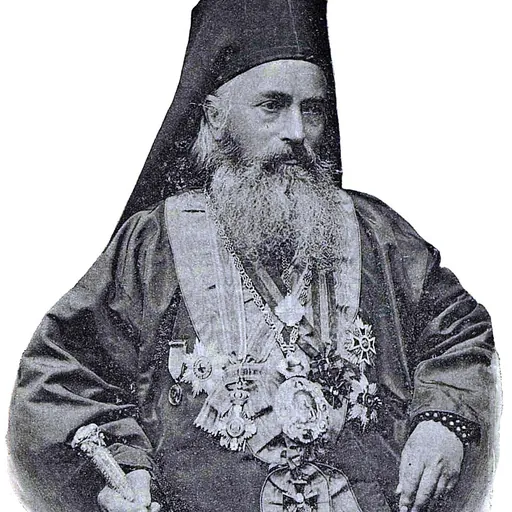
About Melchisedec Ștefănescu
Lived 1823 – 1892 (aged 69). Melchisedec Ștefănescu was a Romanian historian, translator and bishop.
The chapel in Roman dedicated to Ștefănescu; his statue is at left.
Melchisedec Ștefănescu (; born Mihail Ștefănescu ; – ) was a Moldavian, later Romanian historian and bishop of the Romanian Orthodox Church. A native of the Piatra Neamț area, he was educated at Iași and in Kiev. After a decade of teaching seminary, he became a bishop, serving at Huși, Ismail, briefly in Galați and then in Roman until his death. He was involved in politics, especially around the time the United Principalities came into being, and was a steadfast supporter of Alexandru Ion Cuza's reforms, including the secularization of monastic estates. A historian appreciated by his peers, Melchisedec published over sixty works. After his death, his property and money went toward setting up the Romanian Academy Library, sending students on scholarship to Imperial Russia and establishing a foundation that continues its activities in Roman.
Biography Born in Gârcina, near Piatra Neamț in Moldavia, he was descended from a line of priests. He studied at Socola Monastery's seminary in Iași, He subsequently became a monk at age twenty, taking on the name of Melchisedec.
In 1852, after returning home, Melchisedec was made deputy archimandrite, rising to archimandrite in 1856 and being consecrated bishop in 1862. The following year, already famous throughout Moldavia, he was elected as one of four clergy representatives to the ad-hoc divan, actively participating in the union process. Kogălniceanu responded by defending his right to serve as minister and carry out his mission of reorganizing the church and help the clergy. Nevertheless, Melchisedec resigned after a few days, wishing to avoid trouble for a cabinet that had won approval with much difficulty. However, he continued to back Cuza's modernization program as a historical necessity. In February 1868, Melchisedec and Ioan C. Cantacuzino were sent by Domnitor Carol I on a special mission to Saint Petersburg, to discuss the upgrading of Romania–Russia relations. They handed Tsar Alexander II a letter from Carol and asked to negotiate unresolved political matters—such as reducing the special protections of Russian subjects on Romanian soil. At Roman, he transformed the diocesan garden into a genuine park, with flowers and fruit trees, fountains and shelters; and financed most renovations himself. He also persuaded the state to build a new, spacious seminary. In all three dioceses he led, Melchisedec imposed discipline on the clergy and hired assistants based on merit. He managed to persuade wealthy ktitors to finance village churches or help in other ways. Although busy with research, he found time for pastoral visits, dispensing valuable advice. He encouraged young people to study, giving them books and money; sent the most promising to Czernowitz or Kiev, and persuaded the Holy Synod to grant scholarships.
As a member of the Holy Synod, Melchisedec worked hard to draft numerous important proposals for laws and regulations, and was essentially its key member. Indeed, the entire modern organization of the Romanian church and its religious institutes is almost entirely the work of Melchisedec. A particular preoccupation, and the subject of several reports, was the obtaining of autocephaly. He belonged ex officio to the Romanian Senate. The Synod sent him to Bonn in 1875 in order to attend the Old Catholic Church conference, an early ecumenist gesture. Melchisedec was nevertheless honored by the Russian establishment: in 1887, Russian monarch Alexander III, who referred to Melchisedec as "the most brilliant bishop of the Romanian kingdom", sent the latter greetings and an expensive egolpion (small icon worn by bishops as a necklace), in recognition of 45 years' service to church and country. he belonged to eight other scientific and cultural societies from Paris, Tarnovo, Kiev, Saint Petersburg, Athens and Constantinople. His most important historical and philological work was Cronica Hușilor. In all, he published over sixty works of history, theology and teaching during a period that saw a transition from the Romanian Cyrillic alphabet to the modern Latin alphabet. Melchisedec wrote mainly in the latter script, but preferred Cyrillic writing for religious books. In 1948, the new communist regime nationalized the foundation, which was revived following the Romanian Revolution.
Don’t just read it —
keep it.
Full-length biographies made to live with: read them, listen on the way to work, watch them tonight.
- E-book
- Audio
- Video
Instant download · yours to keep · every purchase keeps this site free
Important facts
Related people
Same field, nearest in time





Contemporaries
People whose lives overlapped Melchisedec Ștefănescu's



Frequently asked questions
Who was Melchisedec Ștefănescu?
Romanian bishop and historian (1823-1892)
When was Melchisedec Ștefănescu born?
Melchisedec Ștefănescu was born on 15 February 1823 in Gârcina.
When did Melchisedec Ștefănescu die?
Melchisedec Ștefănescu died on 16 May 1892 in Roman.
What was Melchisedec Ștefănescu's occupation?
Melchisedec Ștefănescu was a historian, translator and bishop.
What nationality was Melchisedec Ștefănescu?
Melchisedec Ștefănescu was Romanian.
Sources & further reading
· Wikipedia: Melchisedec Ștefănescu
· DBpedia: Melchisedec Ștefănescu
Cite this page
APA: Biography.guide. (2026). Melchisedec Ștefănescu. https://biography.guide/melchisedec-stefanescu/
MLA: "Melchisedec Ștefănescu." Biography.guide, https://biography.guide/melchisedec-stefanescu/.
Chicago: "Melchisedec Ștefănescu." Biography.guide. https://biography.guide/melchisedec-stefanescu/.
Data last updated: 2026-09-21 · Spot an error? Report a correction.
Portrait: Wikimedia Commons · author & licence
Page generated 2026-09-27 04:59 UTC