About Mel Powell
Lived 1923 – 1998 (aged 75). Mel Powell was an American pianist, composer, musicologist, music educator, jazz musician and musician.
Mel Powell (born Melvin Epstein) (February 12, 1923 – April 24, 1998) was an American Pulitzer Prize-winning composer, and the founding dean of the music department at the California Institute of the Arts. He served as a music educator for over 40 years, first at Mannes College of Music and Queens College, then Yale University, and finally at CalArts. During his early career he worked as a jazz pianist. His classic Big Band compositions include "Mission to Moscow", "My Guy's Come Back", "Clarinade", "The Earl", and "Bubble Bath".
Early life Mel Powell was born Melvin D. Epstein on February 12, 1923, in The Bronx, New York City, He began playing piano at age four, taking lessons from, among others, Nadia Reisenberg. Powell dreamed of life as a concert pianist until his older brother took him to see jazz pianist Teddy Wilson play,
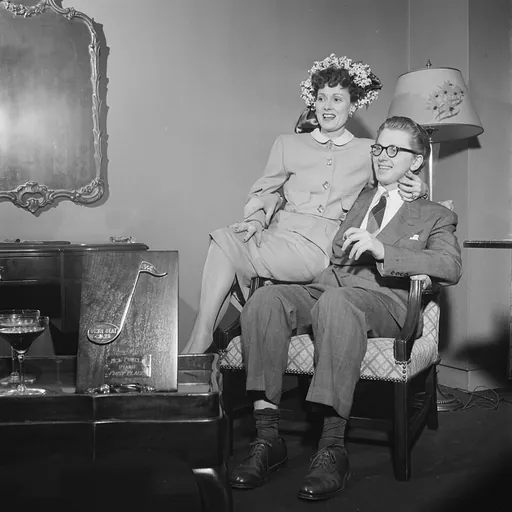
Career Powell and actress wife Martha Scott at home in 1947. An award to Powell from DownBeat magazine rests on the table. Powell's style was rooted in the stride style that was the direct precursor to swing piano. One composition from his Goodman years, The Earl, is perhaps his best known from that time. The song—dedicated to Earl "Fatha" Hines, one of Powell's piano heroes—was recorded without a drummer. prompting him to devote himself to composition rather than performance. In 1948 he enrolled at the Yale School of Music, where he studied with German composer and music theorist Paul Hindemith and received a B.M. degree in 1952.
Changing styles, careers At first sticking to neoclassical styles of composition, Powell increasingly explored atonality, or "non-tonal" music as he called it, In a Los Angeles Times interview, Powell expressed complete surprise: "Being out here on the coast, far away from the whole Eastern establishment to which the Pulitzer is connected – that made me a remote prospect. I just didn't expect it." "The musician's business is structure...The musician...is...therefore drawn to a profound science of structure. Looking closely at music itself, he is likely to ask: "What changes? When? By how much?"...he is...able to feel at home where logicians exhibit techniques for "isolating relevant structure." "It is true that the music I traffic in, along with Milton Babbitt, Elliott Carter and others, has never gained a great popularity. But that was true of the so-called difficult music of earlier centuries, too. And I must say that I have noticed, as we have held our ground, that there has been a softening of response. There are now those who are beginning to find expressive beauty in a music that was at first rejected entirely."
Don’t just read it —
keep it.
Full-length biographies made to live with: read them, listen on the way to work, watch them tonight.
- E-book
- Audio
- Video
Instant download · yours to keep · every purchase keeps this site free
Important facts
People in Mel Powell's life
Named in this biography and alive at the same time





Related people
Same field, nearest in time




Contemporaries
People whose lives overlapped Mel Powell's


Frequently asked questions
Who was Mel Powell?
American composer (1923-1998)
When was Mel Powell born?
Mel Powell was born on 12 February 1923 in The Bronx.
When did Mel Powell die?
Mel Powell died on 24 April 1998 in Sherman Oaks.
What was Mel Powell's occupation?
Mel Powell was a pianist, composer, musicologist, music educator, jazz musician and musician.
What nationality was Mel Powell?
Mel Powell was American.
Sources & further reading
Cite this page
APA: Biography.guide. (2026). Mel Powell. https://biography.guide/mel-powell/
MLA: "Mel Powell." Biography.guide, https://biography.guide/mel-powell/.
Chicago: "Mel Powell." Biography.guide. https://biography.guide/mel-powell/.
Data last updated: 2026-09-23 · Spot an error? Report a correction.
Portrait: Wikimedia Commons · author & licence
Page generated 2026-09-27 05:07 UTC