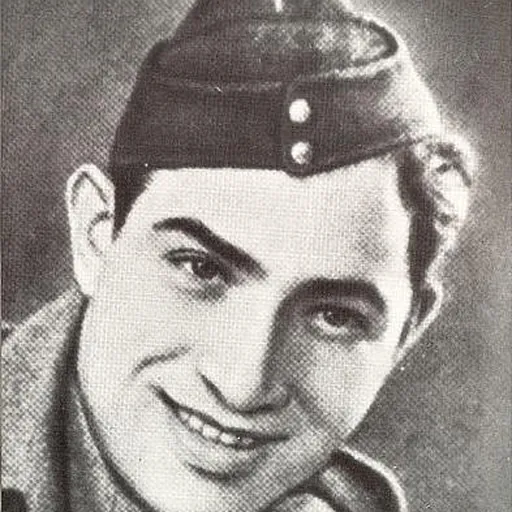
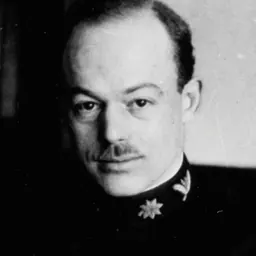
Meir Nakar
Iraqi Jewish paramilitary member
About Meir Nakar
Lived 1926 – 1947 (aged 21).
Meir Nakar (; July 26, 1926 – July 29, 1947) was a member of the Irgun in pre-state Mandatory Palestine and one of 12 Olei Hagardom.
Early life and army service Meir Nakar was born in Jerusalem to a poor Orthodox-Jewish family of Iraqi-Jewish origin, one of five brothers and a sister. His father was a shoemaker. At age 12, he left school and began working to support his family, and a year later, he joined the Betar Zionist youth movement.
The underground For the first five months of his Irgun service, Nakar was active in recruitment and propaganda, but then moved into the Irgun's Combat Corps. He participated in the Irgun attack on the Goldschmidt Officer's Club in Jerusalem, which killed 17 people.
Trial and execution The trial of the five captured Irgun fighters before a British military court in Jerusalem began on May 28, 1947. The defendants mostly refused to take part in the proceedings, denied the court's authority to try them, and when given the opportunity to defend themselves, gave defiant anti-British speeches. On June 16, the five were found guilty of discharging a firearm and possessing explosives. Nakar, Weiss, and Haviv were sentenced to death, while Michaelov and Zitterbaum, who were underage, received life sentences.
Subsequently, Nakar, Weiss, and Haviv were transferred to a condemned cell in Acre Prison, where they spent their time writing letters and studying the Book of Psalms. On July 8, the commander of British forces in Palestine confirmed the death sentences. On July 12, the Irgun abducted two British sergeants, Clifford Martin and Mervyn Paice, in Netanya, and threatened to hang them if the death sentences were carried out.
Despite the threat to the sergeants' lives, British High Commissioner Alan Cunningham ordered the executions to go ahead. In the early morning hours of July 29, 1947, Haviv, Weiss, and Nakar were hanged in Acre Prison. Each man sang Hatikvah on his way to the gallows, joined by the other Jewish prisoners.
Aftermath The day after the execution, the three men were buried in Safed.
Following the hangings, the Irgun carried out its threat and hanged the two sergeants in retaliation. Their bodies were found hanging from trees in a eucalyptus grove near Netanya, and were booby-trapped with a mine, which injured a British officer as he cut one of them down. The act deeply shocked and angered the British public, and is seen as a major catalyst in the British decision to withdraw from Palestine later that year.
Today, Nakar and the other Olei Hagardom are revered by Israel as national heroes, and streets have been named in his honor in Tel Aviv, Jerusalem, and Beersheba.
Don’t just read it —
keep it.
Full-length biographies made to live with: read them, listen on the way to work, watch them tonight.
- E-book
- Audio
- Video
Instant download · yours to keep · every purchase keeps this site free
Important facts
People in Meir Nakar's life
Named in this biography and alive at the same time

Contemporaries
People whose lives overlapped Meir Nakar's



Frequently asked questions
Who was Meir Nakar?
Iraqi Jewish paramilitary member (1926–1947)
When was Meir Nakar born?
Meir Nakar was born on 26 July 1926 in Jerusalem.
When did Meir Nakar die?
Meir Nakar died on 29 July 1947 in Acre.
What nationality was Meir Nakar?
Meir Nakar's recorded nationality: Mandatory Palestine.
Sources & further reading
Cite this page
APA: Biography.guide. (2026). Meir Nakar. https://biography.guide/meir-nakar/
MLA: "Meir Nakar." Biography.guide, https://biography.guide/meir-nakar/.
Chicago: "Meir Nakar." Biography.guide. https://biography.guide/meir-nakar/.
Data last updated: 2026-09-20 · Spot an error? Report a correction.
Portrait: Wikimedia Commons · author & licence
Page generated 2026-09-27 04:58 UTC