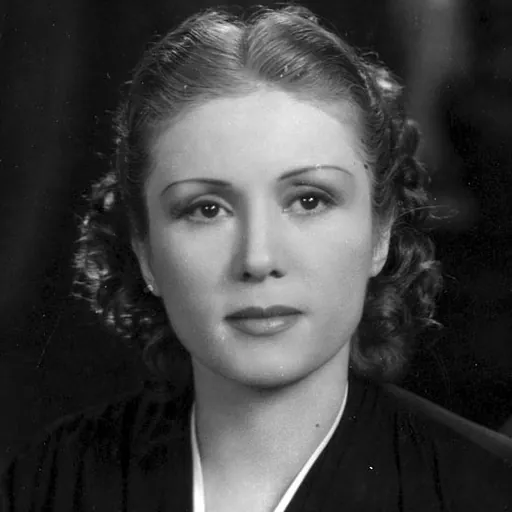
About Mecha Ortiz
Lived 1900 – 1987 (aged 87). Mecha Ortiz was an Argentine actor, autobiographer and film critic.
Mecha Ortiz (née María Mercedes Varela Nimo Domínguez Castro; 1900–1987) was an Argentine actress who appeared in films between 1937 and 1981, during the Golden Age of Argentine cinema. At the 1944 Argentine Film Critics Association Awards, Ortiz won the Silver Condor Award for Best Actress for her performance in Safo, historia de una pasión, and won it again in 1946 for her performance in El canto del cisne (1945). She was known as the Argentine Greta Garbo and for playing mysterious characters, who suffered by past misfortunes in love, mental disorders, or forbidden love. Safo, historia de una pasión was the first erotic Argentine film, though there was no nudity. She also played in the first film in which a woman struck a man and the first film with a lesbian romance. In 1981, she was awarded the Grand Prize for actresses from the National Endowment for the Arts.
Early life and background María Mercedes Varela Nimo Domínguez Castro, known as Mecha was born 24 September 1900. Until she was 29, Mecha, was married to a farmer and was busy being a wife and mother. She had enrolled for acting classes in the Conservatorio Nacional de Música y Declamación (National Conservatory of Music and Speech) in the inaugural class under the direction of Carlos López Buchardo and Enrique García Velloso. This first class of 1926, which included Ortiz, Miguel Mileo and Paulina Singerman, among others, sought to teach acting using a standardized manual. When her husband was thrown from a horse and had a serious back injury, she took a job in the prosecutor's office, refusing help from her well-to-do family. Her sister, Amanda Varela, was an established actress and got her a screen test with Paramount Studios of France. She was selected but no films were made, so her sister introduced her to a friend, influential film critic Chas de Cruz, who helped her find work. In 1933, she was in the production of Mirandolina by Carlo Goldoni which was put on by the Theater Company of Antonio Cunill Cabanellas. She had a theatrical season on the Smart Theater, in 1938 with "Mujeres", written by US actress and writer Clare Boothe Luce, and co-starring Amelia Bence.
In 1936 she had her first film role as "Rubia Mireya", with Florencio Parravicini, Irma Córdoba and Santiago Arrieta, in the classic Los muchachos de antes no usaban gomina directed by Manuel Romero. The role was the first of many wherein she played a character who could not be with the man she loved, but made personal sacrifices to be honorable. Mecha was often cast as mysterious characters, plagued by past misfortunes in love, mental disorders, or forbidden love and was frequently compared with Greta Garbo. She was also seen as a symbol of sophistication and was referred to in other works to denote the line between what was chic or provincial.
In 1938 she starred with Niní Marshall in Mujeres que trabajan, which was directed by Manuel Romero, Con las alas rotas directed by Orestes Caviglia and Maestro Levita with Pepe Arias. In 1943 Lumiton produced, Safo, historia de una pasión, adapted from Alphonse Daudet, directed by Carlos Hugo Christensen with Roberto Escalada. Safo was Argentina's first erotic film and was forbidden to minors. There was no nudity in the film, but the innuendo of a sexual encounter between the characters played by Ortiz and Escalada arose from their smoking a cigarette together. She won her first Silver Condor Award for Best Actress for Safo at the 1944 ceremony. The "forbidden" romance of an older woman and a younger man, was repeated in the 1945 sequel El canto del cisne as well as the Argentine Silver Condor Award for Best Actress. on 11 June 1953; " Tú el ángel y yo el demonio " by Maria Luz Regás and Juan Albornoz at the Versailles Theater on 6 April 1954; "Sandra" by Sixto Pondal Ríos and Carlos Olivari at the Versailles Theater on 6 April 1955; and "Ardelé (la margarita del amor) " by Jean Anouilh and translated by Maria Luz Regás at the Athenaeum Theatre on 23 May 1957. Las tres ratas (1946) by Carlos Schlieper with María Duval; Madame Bovary (1947), Cartas de amor (1951), and Mi vida por la tuya (1951) with Emma Gramatica, in which Ortiz's singing voice was dubbed by Nelly Omar; She played a prison guard in the 1952 film Deshonra by Daniel Tinayre with Fanny Navarro, which featured the first lesbian love affair on Argentine film. La sombra de Safo (1957) under the direction of Julio Porter, reunited Ortiz and Robert Escalada and she made Las Furias (1960) with Elsa Daniel, Aida Luz, Alba Mujica, and Olga Zubarry.
Between 1940 and 1950 she broadcast on the radio on the Teatro del Aire Palmolive with Orestes Caviglia, Pedro López Lagar, and Francisco Petrone. In 1976 along with other stars, like Arturo García Buhr, Mario Soffici, Bárbara Mujica and Narciso Ibáñez Menta, Ortiz plays in Los muchachos de antes no usaban arsénico. Piedra libre (1976) was her last film also directed by Leopoldo Torre Nilsson with Marilina Ross and Juan José Camero.
In 1981, she was awarded the Grand Prize for actresses from the National Endowment for the Arts. She wrote her memoirs under the title Mecha Ortiz by Mecha Ortiz. They were published in 1982.
Family Her husband, Julián Ortiz, was a farmer in Argentina. When she was 29, her husband was injured in a fall from a horse. Ortiz was dedicated to him and their privacy, which in many instances escalated the mystery and speculation about her. Their son, Julián, became a translator and playwright. Her brother, José, was a theatre director, and a sister, Amanda Varela, was also an actress.
Death She died on 20 October 1987 in Buenos Aires, Argentina.
Filmography
Movies
Los muchachos de antes no usaban gomina (La Rubia Mireya) (1937) Melgarejo (Clotilde Contreras) (1937) Maestro Levita (Elena Acevedo de Lerena) (1938) Con las alas rotas (Nelly Rover) (1938) Mujeres que trabajan (Ana María del Solar) (1938) Margarita, Armando y su padre (Margarita) (1939) Último refugio (Albareda) (1941) Joven, viuda y estanciera (Elena Ocampo) (1941) Vidas marcadas (Malena) (1942) El gran secreto (Alicia) (1942) Safo, historia de una pasión (Selva Moreno – Safo) (1943) Mi novia es un fantasma (1944) Una mujer sin importancia (Raquel Miramar) (1945) El canto del cisne (Flora Jordán) (1945) Road of Hell (Laura Simrok) (1945) The Three Rats (Mercedes de la Fuente) (1946) Madame Bovary (Emma Bovary) (1947) Vacaciones (Estela Arenal) (1947) El precio de una vida (Princesa Fedora Romanov) (1947) María de los Ángeles (Maria de los Angeles Ermosilla y Albarracín) (1948) La Rubia Mireya (Ana María Peña de Robles – La Rubia Mireya) (1948) Sangre en Castilla (Alcaldesa Teresa Marquesa de Pinorrey) (1950) Cartas de amor (Antonieta Lear) (1951) Mi vida por la tuya (Gloria Rivas) (1951) Deshonra (Directora Interventora) (1952) El Abuelo (Lucrecia Vélez) (1954) El mal amor (Marcela) (1955) Pájaros de cristal (Irina Galowa) (1955) Bendita seas (María) (1956) La sombra de Safo (Selva Moreno – Safo) (1957) Las furias (Madre) (1960) Bajo un mismo rostro (Madre Superiora) (1962) Las locas del conventillo (María y la otra) (Remedios) (1966) La señora Ana luce sus medallas (Ann Dewey) (1967) Boquitas pintadas (Gitana) (1974) La casa de las sombras (Mrs. Randall) (1976) Los muchachos de antes no usaban arsénico (Mara Ordáz) (1976) Piedra libre (Amalia Pradere/Amalia Grande) (1976)
Television
Los especiales de ATC -Ep: "Navidad en el año 2000" (Mercedes)- *ATC* (1981) Aventura '77 *Channel 9* (1977) Invitación a Jamaica (Victoria) *Channel 13* (1977) Dulce Anastasia (Gran Duquesa rusa) *Channel 13* (1977) Alta Comedia -Ep:"Mesas separadas (Sra Meacham)"- *Channel 9* (1974) Rolando Rivas, taxista (Malú) *Channel 13* (1972-1973) Ciclo de teatro argentino -Ep: "El organito" (Angiulina)- *Channel 7* (1970) La botica del ángel -Seg: "Setenta pecados siete"- *Channel 11* (1970) Estrellita, esa pobre campesina (Mercedes de Castro) *Channel 13* (1968-1969) Standard Electric Show *Channel 11* (1965) Anna Christie (Marty) (1965) La hora Fate -Ep: "Los acosados" *Channel 9* (1960) Elizabeth está muerta (Elizabeth I) *Channel 9* (1960) Los cuatro posters (Ana) *Channel 7* (1959) La esposa constante (Costanza) *Channel 7* (1959) Un tranvía llamado Deseo (Blanche Dubois) *Channel 7* (1956) El mar profundo y azul (Esther Collins) *Channel 7* (1956)
Theater
Los cien rejóvenes años (1973) Canción para un crepúsculo (1968) Así es la vida (1967) El proceso de Mary Duggan (1965-1966) Culpables (1963) Amantes en verano (1962) Lecho nupcial (1961) La esposa constante (1961) Jano (1961) Delito en la isla de las cabras (1961) Castillo en Suecia (1961) La visita de la anciana dama (1961) La esposa constante (1958) *Actor and director Frenesí (1956 ) Un tranvía llamado Deseo (Blanche Dubois) (1956) El mar hondo y azul (1955) Sandra (1955) Iremos a Valparaíso (1955) También las mujeres han perdido la guerra (1955) Tú, el ángel y el demonio (1954) La cama (1954) Anna Karenina (1953) Rueda de amantes (1953) La hechicera del Corinto (1953) Un tranvía llamado Deseo (Blanche Dubois) (1952) El mal amor (1951) El mago escondido (1949) La esposa constante (1949) Iremos a Valparaíso (1949) La señora Ana luce sus medallas (1945) Mujeres (1938 ) Corine (1933) Mirandolina (1933) El proceso de Mary Duggan (1929)
Autobiography Mecha Ortiz por Mecha Ortiz Moreno: Buenos Aires (1982) (In Spanish)
Don’t just read it —
keep it.
Full-length biographies made to live with: read them, listen on the way to work, watch them tonight.
- E-book
- Audio
- Video
Instant download · yours to keep · every purchase keeps this site free
Important facts
People in Mecha Ortiz's life
Named in this biography and alive at the same time





Related people
Same field, nearest in time


Contemporaries
People whose lives overlapped Mecha Ortiz's



Frequently asked questions
Who was Mecha Ortiz?
actress (1900-1987)
When was Mecha Ortiz born?
Mecha Ortiz was born on 24 September 1900 in Buenos Aires.
When did Mecha Ortiz die?
Mecha Ortiz died on 20 October 1987 in Buenos Aires.
What was Mecha Ortiz's occupation?
Mecha Ortiz was an actor, autobiographer and film critic.
What nationality was Mecha Ortiz?
Mecha Ortiz was Argentine.
Sources & further reading
Cite this page
APA: Biography.guide. (2026). Mecha Ortiz. https://biography.guide/mecha-ortiz/
MLA: "Mecha Ortiz." Biography.guide, https://biography.guide/mecha-ortiz/.
Chicago: "Mecha Ortiz." Biography.guide. https://biography.guide/mecha-ortiz/.
Data last updated: 2026-09-22 · Spot an error? Report a correction.
Portrait: Wikimedia Commons · author & licence
Page generated 2026-09-27 05:02 UTC