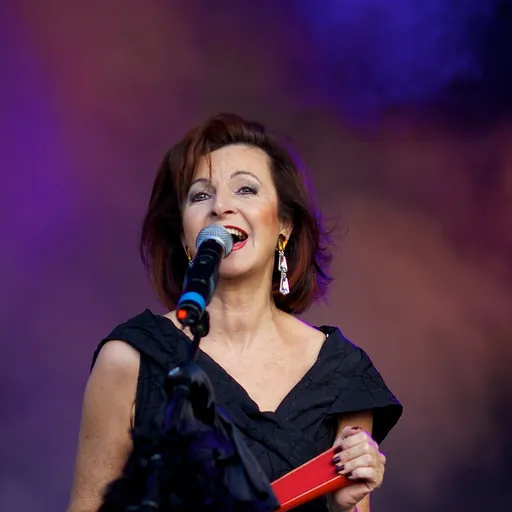
About Mayte Mateos
Born 1951. Mayte Mateos is a Spanish singer.
María Teresa "Mayte" Mateos Guillén
Career Early career In 1976, Mendiola proposed to Mateos the formation of a separate musical duo that involved singing and dancing, under the name "Venus". The pair thus left the ballet company and made their first television appearance with this stage name, on Enrique Martí Maqueda's program Palmarés.
The pair were engaged at a nightclub in the Aragon city of Zaragoza, which was a failed attempt to perform at the Cancela venue, when their contract was cancelled by the club manager, who thought that they were "too elegant" for the style of the show. The duo was invited to Hamburg by Deane, to do a voice test. After the test recording in the studio, they signed a record deal with RCA. It was also featured in the 1977 edition of the Guinness Book of Records as the female musical duo with the highest number of sales with a single. They were the first female duo to reach number one in the UK, and the first Spanish act to do so, followed by Julio Iglesias four years later.
A follow-up single, "Sorry, I'm a Lady', also became an international hit, peaking at the top of the charts in Germany, the Netherlands and Belgium and reaching the top ten in the UK, Sweden and Switzerland. Most of the duo's songs were sung in English, although they also recorded in Spanish, German and French.
Touring in Europe during the late 1970s helped the duo establish a firm fan base in Germany (where their records continued to be produced) and the Scandinavian countries, and their Spanish-inspired take on the disco sound earned them recognition in Japan and Russia. Baccara represented West Germany at the eighth World Popular Song Festival held in November 1977 – until it ended in 1989, it was the largest contest in the world. Their song "Mad in Madrid", came 14th out of the 37 participating countries.
In 1978, the second Baccara album, Light My Fire, was released across Europe. It did not achieve the same level of international success as their first album, however it spawned the single "Parlez-vous français?", a French song which was selected on a national final to represent in the Eurovision Song Contest 1978. Despite it receiving full marks in the contest from , , and the duo finished in seventh place.
Baccara received further recognition in 1978 when they were granted Germany's most prestigious media award, Burda Publishing Group's Bambi prize. The duo made regular television appearances, becoming weekly guests on Sacha Distel's show in the UK, and on Musikladen in Germany. 1978 marked the peak of Baccara's artistic and commercial success. Later that year they released the single "The Devil Sent You to Lorado" and the single "Somewhere in Paradise".
In 1979, the album Colours and the separately recorded single – "Eins plus eins ist eins", was released to mark the United Nations' International Year of the Child and to celebrate the 20th anniversary of the UN adoption of the Declaration of the Rights of the Child. It contains the European single "Colorado". This was the first album not to be produced by Rolf Soja. The album was produced by Graham Sacher in London. The typical sound from the early Baccara albums was gone, a more pop-rock album was the result. The album also did not include the original Baccara logo that was on the three albums produced before Bad Boys. The album was not a commercial success like the past three albums. This album was the last time Mendiola and Mateos would record together.
By this time, this disco sound had been overshadowed by newer music movements such as punk rock, new wave, and synth-pop in much of Europe and interest was largely confined to those countries where the duo had an established fan base, notably Germany. The album was not released in the UK or the United States; they never achieved any recognition in the US despite some of their songs being given significant airplay. One music critic suggested that the Baccara formula lacked artistic depth but had been "mined for all it was worth" over two years until public interest moved onto other things.
Split from Baccara The 1980 release of "Sleepy-Time-Joy" led to a disagreement within Baccara over the vocal mixes used. Mendiola was not satisfied because she argued her voice was not given sufficient prominence in the song’s arrangement and sued the RCA for breach of contract.
A court hearing in Munich resulted in 250,000 being recalled from the dealers and a revised recording with a new vocal mix issued in place of the original.
As a result of both members launching their own versions of Baccara, the two women did not perform together again. Their paths nearly crossed once when both were performing in Moscow. According to Mateos, Mendiola crossed the street to avoid her.
Following María Mendiola's death in 2021, Mateos became the sole surviving member of the original Baccara duo.
Solo career Following Baccara's dissolution in 1981, Mateos was now a solo singer, releasing three solo singles through the RCA-Victor label, "Souvenirs from Paradise", "Recuerdos del ayer" and "Malagueña", the first two were produced by Rolf Soja.
In 1982, Mateos represented Spain at the Korean Song Festival, with the songs "Temptation" and "Malagueña".
By 1988, she had released a series of singles and one studio album. Mateos released Spanish Dreams, under the name Mayte Matée, which saw moderate success among Baccara's original fan base. Spanish Dreams was re-released on CD in Germany in the 2004 under the title Noche Latina.
Return to Baccara (1983–present)
Mayte Mateos (left) and Paloma Blanco (right) performing in Skien, Norway, in 2010Re-forming as Baccara in 1983 with Marisa Pérez, a contemporary of Mateos and Mendiola at the Spanish TV ballet company, Mateos re-established the band on the European entertainment circuit. Pérez was followed by a succession of partners including Ángela Muro, Sole García, Jane Comerford, Carmen, Cristina Sevilla, Paloma Blanco, Isabel Patton, Romy Abradelo, Rose, Francesca Rodrigues and María Marín. Mateos' last singing partner was fellow Spaniard Paloma Blanco. Although they had no new hits to their name, Mateos' Baccara had remained in demand for television and live performances, performing the band's extensive back catalogue – versions of which have been released as compilations – as well as up-tempo interpretations of traditional Spanish songs.
In late 1999, Mateos and Sevilla released a new studio album through RCA-Victor/Sony-BMG, Baccara 2000, as well as an updated dance version of breakthrough hit "Yes Sir, I Can Boogie" as a single. The album was produced by Thorsten Brötzman. Eventually the duo dropped the "2000" in their name, and became known again as just "Baccara".
In 2004, Mateos was once again involved with Eurovision, when she took part (along with Cristina Sevilla) in the Swedish Melodifestivalen preselection contest to represent Sweden with the song "Soy tu Venus". However, Baccara failed to qualify to the final after placing 7th in their heat. A full-length studio album recorded in Sweden, Soy tu Venus, followed the same year. The album was released by Lionheart Records.
In 2005, Mateos replaced Cristina Sevilla with Paloma Blanco. Sevilla later became a singing partner with María Mendiola. A new Baccara album, recorded by Mateos and Blanco, entitled Satin... In Black & White and produced by the original Baccara team Rolf Soja and Frank Dostal, was released on 30 May 2008. This album contained remakes of original Baccara recordings from the late 1970s and some new songs.
In 2013 Mateos sang on a cover version of "Yes Sir, I Can Boogie" by the London indie rock band Sala & The Strange Sound.
In 2016 Mateos' Baccara collaborated with Fundacion Tony Manera with a cover song of "Dame un Poco de Tu Amor" by "Juan Carlos Calderón".
After the COVID-19 pandemic, Mateos' Baccara performed only 3 times. One show took place in 2022 in Mateos' hometown Logroño, while two other shows were held in the island of Mallorca. Mateos' Baccara performance on New Year's Eve 2023–2024 was broadcast by the local TV channel "Canal 4".
On the 3 August 2025, Mayte Mateos announced on the official Facebook page for her Baccara that Paloma Blanco had left the duo and she was continuing Baccara but as a solo act.
Personal life In a 2014 interview, Mateos stated that she had been in a 12-year relationship with a man from Norway and had helped raise his two sons as her own. She also said that she had wanted to become a mother herself, but that it had never worked out. At the time of the interview, she was recovering from the loss of her mother, whilst living alone.
Don’t just read it —
keep it.
Full-length biographies made to live with: read them, listen on the way to work, watch them tonight.
- E-book
- Audio
- Video
Instant download · yours to keep · every purchase keeps this site free
Important facts
People in Mayte Mateos's life
Named in this biography and alive at the same time







Related people
Same field, nearest in time





Contemporaries
People whose lives overlapped Mayte Mateos's


Frequently asked questions
Who is Mayte Mateos?
Spanish singer
When was Mayte Mateos born?
Mayte Mateos was born on 7 February 1951 in Logroño.
What is Mayte Mateos's occupation?
Mayte Mateos is a singer.
What nationality is Mayte Mateos?
Mayte Mateos is Spanish.
Sources & further reading
Cite this page
APA: Biography.guide. (2026). Mayte Mateos. https://biography.guide/mayte-mateos/
MLA: "Mayte Mateos." Biography.guide, https://biography.guide/mayte-mateos/.
Chicago: "Mayte Mateos." Biography.guide. https://biography.guide/mayte-mateos/.
Data last updated: 2026-09-21 · Spot an error? Report a correction.
Portrait: Wikimedia Commons · author & licence
Page generated 2026-09-27 05:00 UTC