About Maynard Harrison Smith
Lived 1911 – 1984 (aged 72). Maynard Harrison Smith was an American military personnel.
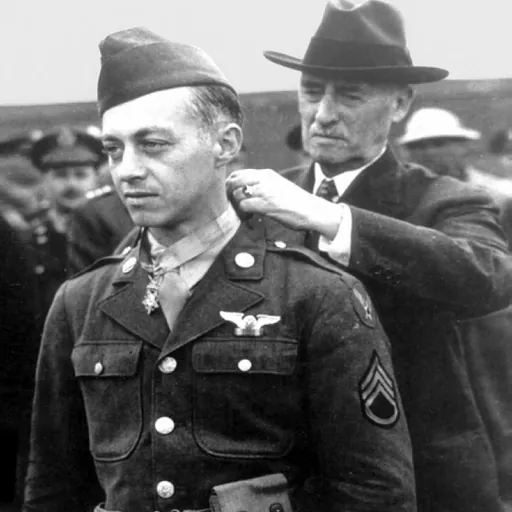
Maynard Harrison "Snuffy" Smith (May 19, 1911 – May 11, 1984) was a United States Army Air Forces staff sergeant and aerial gunner aboard a B-17 Flying Fortress bomber in World War II who received the Medal of Honor for his conduct during a bombing mission over France on 1 May 1943. Smith was the first enlisted member of the United States Army Air Forces to earn the Medal of Honor.
Early life
Maynard Harrison Smith was born on May 19, 1911, in Caro, Michigan. His father was a successful attorney, and his mother was a school teacher. As a child, he had a reputation of being a spoiled troublemaker, so his father sent him to the Howe Military Academy in Howe, Indiana. After graduating, Smith worked for the U.S. Treasury Department, and the Michigan Banking Commission. In 1929, Smith married Arlene McCreedy (1911–1997), but they divorced in 1932. Smith's father died in 1934, and he quit his job, choosing to live off of his father's inheritance. He married his second wife, Helen Gunsell (1921–2005), in 1941 and had one son, William. This marriage also ended in divorce in September 1942. Smith enlisted in the Army on August 31, 1942. An apocryphal story states that after Smith failed to make child support payments to Gunsell, he appeared before a judge who gave him the choice of serving a jail term or enlisting in the military, and he later appeared for a photo in the local newspaper with fellow inductees leaving for service still in handcuffs and escorted by the sheriff.
Military service
After completing basic training, he volunteered for aerial gunnery school. At the time, all aerial gunners were non-commissioned officers and the move to the school was a quick way for a private to gain rank and pay.
After completing aerial gunnery school, he was shipped overseas to Thurleigh, Bedfordshire, in south-central England, where he joined the 423rd Bombardment Squadron, 306th Bomb Group. Staff Sergeant Smith was short in stature, and quickly gained a reputation as a stubborn and obnoxious airman who did not get along well with the other airmen stationed there. He soon earned the nickname "Snuffy Smith", possibly after the character from a popular comic strip of the era, Barney Google and Snuffy Smith. Consequently, it was six weeks before he was assigned his first combat mission. Staff Sergeant Maynard Smith of the 306th Bombardment Group, is presented with the Medal of Honor by Secretary of War Henry L Stimson in front of a B-17 Flying Fortress at Thurleigh Airfield, USAAF Station 111, England. Several of the bombers failed to rendezvous as intended, and others had mechanical problems and had to turn back. The middle portion of the bombing mission went well, with no German fighters engaging the American aircraft until after they had released their bomb loads on target. As the fighters came up, the Americans managed to elude them by flying into a large cloud bank.
Staff Sergeant Smith's bomber was hit, rupturing a fuel tank and igniting a massive fire in the center of the fuselage. The damage was severe, knocking out communications and compromising the fuselage's integrity. Smith's ball turret lost power, and he scrambled out to assist the other crewmen. Three crewmen bailed out, while Smith tended to two others who were seriously wounded.
In between helping his wounded comrades, Smith also manned the .50 caliber machine guns and fought the raging fire. The heat from the fire was so intense that it began to melt the metal in the fuselage, threatening to break the plane in half.
For nearly 90 minutes, Smith alternated between shooting at attacking fighters, tending to the wounded, and fighting the fire. To starve the fire of fuel, he threw burning debris and exploding ammunition through the large holes that the fire had melted in the fuselage. After the fire extinguishers were exhausted, Smith finally managed to put the fire out, in part by urinating on it.
Smith's bomber reached England and landed at the first available airfield, where it broke in half as it touched down. It had been hit with more than 3,500 bullets and pieces of shrapnel. The three crewmen who bailed out were never seen again and were presumed lost at sea, but Smith's efforts undoubtedly saved the lives of the six others aboard his aircraft.
Smith was assigned to KP duty the week that he was awarded the Medal of Honor as punishment for arriving late to a briefing. U.S. Secretary of War Henry L. Stimson placed the medal around Smith's neck during a formation.
Later life and death
Smith flew four more combat missions after earning the Medal of Honor, but was then grounded as a result of combat stress reaction/Post-traumatic stress disorder and was reassigned to non-combat clerical work. On December 17, 1944, he was forced to accept a reduction in rank to private for poor job performance, and was shortly thereafter permanently grounded. Smith was sent home to the United States on February 2, 1945, and despite his transgressions, received a hero's welcome and a parade when he returned to his hometown. Smith was discharged from the U.S. Army on May 26, 1945. In his later years, he despised his time in the military and ran into legal troubles, but eventually retired quietly to Florida, dying of heart failure on May 11, 1984, in Saint Petersburg, at the age of 72. Maynard Harrison Smith is buried in Arlington National Cemetery, in Arlington, Virginia.
Medal of Honor citation Citation text:
For conspicuous gallantry and intrepidity in action above and beyond the call of duty. The aircraft of which Sgt. Smith was a gunner was subjected to intense enemy antiaircraft fire and determined fighter aircraft attacks while returning from a mission over enemy-occupied continental Europe on 1 May 1943. The aircraft was hit several times by antiaircraft fire and cannon shells of the fighter aircraft, 2 of the crewmen were seriously wounded, the aircraft's oxygen system shot out, and several vital control cables severed when intense fires were ignited simultaneously in the radio compartment and waist sections. The situation became so acute that 3 of the crewmen bailed out into the comparative safety of the sea. Sgt. Smith, then on his first combat mission, elected to fight the fire by himself, administered first aid to the wounded tail gunner, manned the waist guns, and fought the intense flames alternately. The escaping oxygen fanned the fire to such intense heat that the ammunition in the radio compartment began to explode, the radio, gun mount, and camera were melted, and the compartment completely gutted. Sgt. Smith threw the exploding ammunition overboard, fought the fire until all the firefighting aids were exhausted, manned the workable guns until the enemy fighters were driven away, further administered first aid to his wounded comrade, and then by wrapping himself in protecting cloth, completely extinguished the fire by hand. This soldier's gallantry in action, undaunted bravery, and loyalty to his aircraft and fellow crewmen, without regard for his own personal safety, is an inspiration to the U.S. Armed Forces.
Awards and Decorations SSG Smith was awarded the following for his service
Don’t just read it —
keep it.
Full-length biographies made to live with: read them, listen on the way to work, watch them tonight.
- E-book
- Audio
- Video
Instant download · yours to keep · every purchase keeps this site free
Important facts
People in Maynard Harrison Smith's life
Named in this biography and alive at the same time


Related people
Same field, nearest in time



Contemporaries
People whose lives overlapped Maynard Harrison Smith's






Frequently asked questions
Who was Maynard Harrison Smith?
Air Force Medal of Honor recipient
When was Maynard Harrison Smith born?
Maynard Harrison Smith was born on 19 May 1911 in Caro.
When did Maynard Harrison Smith die?
Maynard Harrison Smith died on 11 May 1984 in St. Petersburg.
What was Maynard Harrison Smith's occupation?
Maynard Harrison Smith was a military personnel.
What nationality was Maynard Harrison Smith?
Maynard Harrison Smith was American.
Sources & further reading
· Wikipedia: Maynard Harrison Smith
· DBpedia: Maynard Harrison Smith
Cite this page
APA: Biography.guide. (2026). Maynard Harrison Smith. https://biography.guide/maynard-harrison-smith/
MLA: "Maynard Harrison Smith." Biography.guide, https://biography.guide/maynard-harrison-smith/.
Chicago: "Maynard Harrison Smith." Biography.guide. https://biography.guide/maynard-harrison-smith/.
Data last updated: 2026-09-22 · Spot an error? Report a correction.
Portrait: Wikimedia Commons · author & licence
Page generated 2026-09-27 05:03 UTC