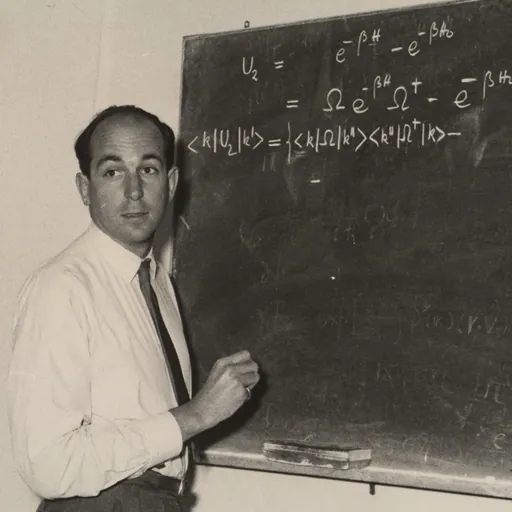
Max Robert Schafroth
Dr. math. ETH Zürich 1949
About Max Robert Schafroth
Lived 1923 – 1959 (aged 36).
Max Robert Schafroth (8 February 1923 in Burgdorf, Switzerland – 29 May 1959 in North Queensland, Australia) was a Swiss theoretical physicist who made important contributions to the theory of superconductivity. In 1954, he proposed that electron pairing was the physical mechanism responsible for superconductivity. Working together with John Markus Blatt and Stuart Thomas Butler at the University of Sydney in the 1950s, Schafroth developed a theory that explained superconductivity as a Bose-Einstein condensation of electron pairs, the idea relevant to high-temperature superconductivity.
Early life and education Schafroth was born in Burgdorf, Switzerland to Colonel Max F. Schafroth and Lydia Schafroth-Oberholzer. He was educated at public schools in Burgdorf and Bern, graduating from the Stadtisches Gymnasium Bern in 1941. His tertiary studies were interrupted by a two-year service in the Swiss army. In 1948, Schafroth received a Diploma in Mathematics and Physics from the Federal Institute of Technology in Zurich. In 1949, he was awarded the title of Doctor of Natural Sciences for his work in theoretical physics under Professor Wolfgang Pauli.
From 1949 to 1953, Schafroth worked as Pauli's assistant, mainly on Quantum Field Theory and the Theory of Superconductivity. In 1953–1954, funded by a two-year overseas grant from the Schweizer Arbeitsgemeinschaft für Mathematik und Physik, Schafroth was a Research Fellow at the University of Liverpool, working with Herbert Fröhlich on superconductivity.
University of Sydney and theory of superconductivity John Blatt, Robert Schafroth and Stuart Butler at the University of Sydney on November 21, 1954 In late 1953, Schafroth accepted the Lecturer position in the then newly expanded School of Physics at the University of Sydney. he proved that an ideal Bose gas would exhibit Meissner effect, one of the two main hallmarks of superconductivity. A paper by Blatt and Butler on superfluidity of a (charge-neutral) Bose gas was published in the same issue. After the papers were published, School of Physics's head Harry Messel called a press conference highlighting the group's success. In the second paper, but his paper was not noticed by the physics community. Schafroth was not aware of and did not cite Ogg's work. Later, Ogg's contribution was acknowledged by Blatt.
These early results led to the development of Quasichemical Equilibrium Theory and later in November 1955. According to Blatt, during those visits Schafroth had "long and detailed discussions" about his ideas with Leon Cooper who had just joined Bardeen's group. Cooper later recalled
Schafroth, Butler and Blatt had considered a system of charged electron pair molecules whose size was less than the average distance between them so they could be treated as a charged Bose-Einstein gas. They had shown that such a system displayed a Meissner effect and a critical temperature condensation. Schafroth, as I recall, gave a colloquium at Illinois presenting his ideas. I am not sure when that colloquium was given: whether it was before or after my own pair idea. However I was aware of Schafroth's argument by the time I submitted my letter to Physical Review in September 1956.
The Quasichemical Equilibrium theory Instead of making extensive amendments requested by a sole referee, the paper was sent to Helvetica Physica Acta "in the interest of speedy publication". The manuscript was received on 16 October 1956 and published in June 1957, ahead of the rival theory by Bardeen, Cooper and Robert Schrieffer. After the BCS theory was published, Schafroth criticized its handling of the Meissner effect and a lack of gauge invariance. The underlying difficulty was later removed by Philip Anderson and other researchers,
The plane crashed after take-off from the station which is 150 miles north-west of Townsville. Those killed were: Leonard Frederick Holland, 25, married, pilot, of Cairns. Dr. M.R. Schafroth, of Geneva, Switzerland, Reader in Physics at Sydney University and his wife, Kathy. The plane was a four-seater Auster Autocar, owned by Bush Pilots Airways Ltd., of Cairns. Mr. J.H. Atkinson, owner of Green Vale Station, said tonight that he was standing in front of his homestead watching the plane take off. It had risen to 200 feet and 400 yards away when the engine started to flutter. "I could see they were in trouble," he said. "Suddenly the motor stopped. The pilot tried to steer the plane back on to the runway but it swerved and nose-dived into the ground. There was a terrifying crumbling – I knew they were all dead." The bodies of the three victims will be flown to Ingham tomorrow. The aircraft left Cairns at 7 a.m. on the normal mail run to Charters Towers. Dr. and Mrs. Schafroth, who were holidaying in the north, were on their way to Hillgrove station. Pilot Holland joined Bush Pilots last July and had flown about 1000 hours.
Don’t just read it —
keep it.
Full-length biographies made to live with: read them, listen on the way to work, watch them tonight.
- E-book
- Audio
- Video
Instant download · yours to keep · every purchase keeps this site free
Important facts
People in Max Robert Schafroth's life
Named in this biography and alive at the same time






Contemporaries
People whose lives overlapped Max Robert Schafroth's

Frequently asked questions
Who was Max Robert Schafroth?
Dr. math. ETH Zürich 1949
When was Max Robert Schafroth born?
Max Robert Schafroth was born on 8 February 1923.
When did Max Robert Schafroth die?
Max Robert Schafroth died on 29 May 1959.
Sources & further reading
· Wikipedia: Max Robert Schafroth
· DBpedia: Max Robert Schafroth
Cite this page
APA: Biography.guide. (2026). Max Robert Schafroth. https://biography.guide/max-robert-schafroth/
MLA: "Max Robert Schafroth." Biography.guide, https://biography.guide/max-robert-schafroth/.
Chicago: "Max Robert Schafroth." Biography.guide. https://biography.guide/max-robert-schafroth/.
Data last updated: 2026-09-22 · Spot an error? Report a correction.
Portrait: Wikimedia Commons · author & licence
Page generated 2026-09-27 05:04 UTC