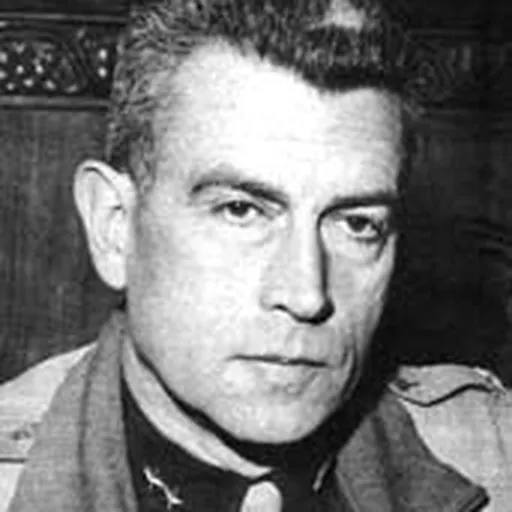
About Maurice Rose
Lived 1899 – 1945 (aged 45). Maurice Rose was an American military officer and soldier.
Maurice Rose (November 26, 1899 – March 30, 1945) was a career officer in the United States Army who attained the rank of major general. A veteran of World War I and World War II, Rose was commanding the 3rd Armored Division when he was killed in action in Germany during the closing days of the Second World War becoming the highest-ranking American killed by enemy fire during the war in Europe.
Rose was the son and grandson of rabbis from Poland; at the time of his death he was the highest-ranking Jewish person in the U.S. Army. He was not especially religious, did not publicize his faith, and stated in his Army records that he was Protestant. Rose was married twice and had two sons.
The 3rd Armored Division's official history of World War II memorialized Rose by stating "He was over six feet tall, erect, dark haired, and had finely chiseled features. He was firm and prompt of decision, brooking no interference by man, events or conditions in order to destroy the enemy."
Early life Rose was born in Middletown, Connecticut, on November 26, 1899, the son of Rabbi Samuel Rose and Katherin "Katy" (Bronowitz) Rose. In 1902, the Rose family relocated to Denver, Colorado, where Rose was raised and educated. He attended East High School, where he was editor of the school newspaper and graduated with honors in 1916. His desire for a military career became well known among his classmates; in the school yearbook, a cartoon illustrating the newspaper staff depicted him carrying a rifle.
Rose lied about his age to enlist in the Colorado National Guard as a private after graduating from high school, hoping to serve in the Pancho Villa Expedition. However, he was discharged six weeks later when his commander was informed that he was underage.
Rose was raised in a Jewish household; his father was a businessman who operated a dress design shop with Rose's mother and later became a rabbi. Rose had a bar mitzvah and could speak Yiddish and read Hebrew. Though brought up Jewish, and identified as Jewish in post-World War I newspaper articles that recorded the bravery of Jewish U.S. Army soldiers, he began to identify himself as Protestant in military records soon afterwards. After graduating from Officer Candidate School (OCS) at Fort Riley, Kansas in August 1917, Rose was commissioned as a Reserve second lieutenant of Infantry.
With American entry into World War I having occurred in April 1917, after receiving his commission, Rose was assigned to command a platoon in the 353rd Infantry Regiment, a unit of the 89th Division. The division was organized and trained at Camp Funston to prepare for service in France, and in December 1917 he was promoted to temporary first lieutenant. In May 1918, the division traveled by train to Camp Mills, New York, and it departed for Europe by ship in June. Later that month, the 89th Division arrived in Liverpool, England and a week later they arrived in France.
The 89th Division completed additional training until August, when it relieved the 82nd Division in the Lucey sector, near the city of Toul. Rose's battalion of the 353rd Infantry took up defensive positions near Metz, where they began preparations to participate in the Meuse–Argonne offensive. Rose took part in combat throughout the offensive, and was wounded at St. Mihiel, including being hit by shrapnel during a German mortar and artillery barrage, as well as sustaining a concussion. He initially refused to be evacuated, but he collapsed from exhaustion. Medics removed him from the battlefield, and he was taken to the 89th Division's hospital near the village of Flirey.
After a few days of convalescence, Rose left the hospital against medical advice and returned to his unit. With medical officials unsure of his whereabouts, the Army reported to Rose's parents that he been killed, an error which took several days to correct. Rose continued to serve with the 353rd Infantry until the war ended with the Armistice of 11 November 1918. He remained in Germany as part of the Army of Occupation, and was discharged in June 1919.
Inter War period After leaving the Army, Rose accepted a position as a traveling salesman with Hendrie & Bolthoff, makers of mining and manufacturing equipment and supplies. His territory included Utah, and he rented a room in Salt Lake City. During a visit to the post quartermaster at nearby Fort Douglas, Rose learned that while the army carried out a post-war reorganization, it was accepting a limited number of lieutenants and captains for return to active duty.
On July 1, 1920, Rose re-joined the peacetime army as a second lieutenant, which was then adjusted to first lieutenant in recognition of his wartime rank. On the following day, he was promoted to captain. Rose served initially with the 20th, 21st, 53rd and 38th Infantry Regiments at Fort Douglas. In 1924, he was the adjutant of the 38th Infantry. While stationed at Fort Douglas, his duties included organizing and overseeing annual Citizens Military Training Camps, which were designed to expose young men without military service to the experiences of Army life.
In 1927, Rose was assigned to Kansas State University as a Reserve Officers' Training Corps instructor, and his additional duties included coaching rifle marksmanship for both men's and women's teams. In 1931 and 1932, he was serving with the 8th Cavalry Regiment at Fort Bliss, Texas. In the summer of 1932, Rose was one of the Army officers assigned to provide instruction at the annual training encampment of the New Mexico National Guard. Rose was assigned to duty as adjutant of the Corozal Military Post on the Pacific side of the Panama Canal Zone beginning in February 1933. He served with the 6th Cavalry Regiment at Fort Oglethorpe, Georgia, from August 1935 to August 1936. From 1937 to 1939 he was an observer and advisor for the Pennsylvania National Guard. In 1939 Rose was posted to Fort George G. Meade, Maryland, as an instructor at the Third Corps Area Command and Staff School.
In addition to his completion of Officer Candidate School in 1917, Rose graduated from the Infantry Company Officer Course (1926) and the Cavalry Officer Course (1931). He was a 1937 graduate of the Command and General Staff College, and he graduated from the Army Industrial College in 1940. After observing the brigade in action, newspaper reporter Keyes Beech referred to Rose as "probably the best looking man in the army." When German forces in Tunisia were reduced to combat ineffectiveness, Rose negotiated with their commander, Fritz Krause, on the details of their unconditional surrender. 3rd Armored helped stem the German offensive in the Ardennes during the Battle of the Bulge, and was the first armor unit to enter Cologne. The German tank commander then opened fire, with 14 rounds hitting Rose, including several in the head.
Personal life In 1920, Rose married Venice Hanson (1895–1962) of Salt Lake City. They separated in 1928 or 1929, and divorced in 1931.
Legacy Plaque marking Rose's birthplace. The Rose home is part of the Main Street Historic District, which is listed on the National Register of Historic Places J. Lawton Collins, Rose's superior as commander of the VII Corps, regarded Rose "as the top notch division commander in the business at the time of his death." However, Rose never gained the prominence of many of his contemporaries, for reasons including the fact that he did not survive the war, and as an intensely private man, he rarely if ever sought personal publicity. The Armed Forces Reserve Center in Middletown is also named for Rose, as is the Connecticut Route 9 bridge over Union Street in Middletown.
Rose Terrace and Rose Hall at Fort Knox were named for Rose. The army transport , the Rose Medical Center in Denver, Colorado, and the primary school in Margraten, Netherlands were named in his honor. In addition, the now-closed Maurice Rose Army Airfield near Frankfurt, Germany and Rose Barracks near Vilseck, Germany were also named for him. The commanding general of the division is not named, but is presumed to be Rose based on the film's timeline and the fact that the character was portrayed by Roy Roberts, an actor who physically resembled Rose.
Don’t just read it —
keep it.
Full-length biographies made to live with: read them, listen on the way to work, watch them tonight.
- E-book
- Audio
- Video
Instant download · yours to keep · every purchase keeps this site free
Important facts
People in Maurice Rose's life
Named in this biography and alive at the same time



Related people
Same field, nearest in time



Contemporaries
People whose lives overlapped Maurice Rose's


Frequently asked questions
Who was Maurice Rose?
United States Army general (1899–1945)
When was Maurice Rose born?
Maurice Rose was born on 26 November 1899 in Middletown.
When did Maurice Rose die?
Maurice Rose died on 30 March 1945 in Paderborn.
What was Maurice Rose's occupation?
Maurice Rose was a military officer and soldier.
What nationality was Maurice Rose?
Maurice Rose was American.
Sources & further reading
Cite this page
APA: Biography.guide. (2026). Maurice Rose. https://biography.guide/maurice-rose/
MLA: "Maurice Rose." Biography.guide, https://biography.guide/maurice-rose/.
Chicago: "Maurice Rose." Biography.guide. https://biography.guide/maurice-rose/.
Data last updated: 2026-09-23 · Spot an error? Report a correction.
Portrait: Wikimedia Commons · author & licence
Page generated 2026-09-27 05:06 UTC