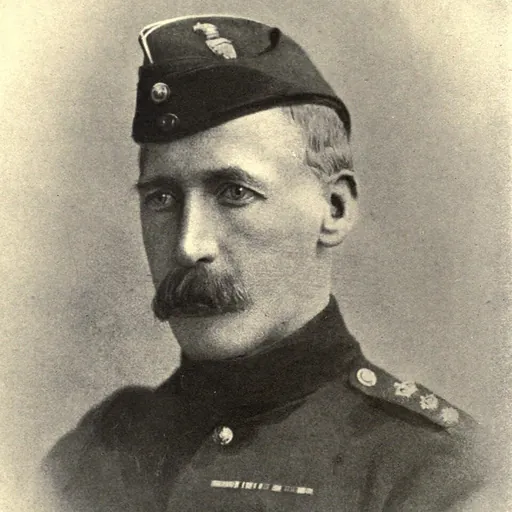
About Maurice George Moore
Lived 1854 – 1939 (aged 85). Maurice George Moore was a British and Irish author, politician and army officer.
Maurice George Moore, (10 August 1854 – 8 September 1939) was an Irish author, soldier and politician.
Early life Moore was the second of four sons born to George Henry Moore of Moore Hall, County Mayo, and Mary Blake of Ballinafad, County Galway. He saw action in the Xhosa Wars in the late 1870s and the Anglo-Zulu War in 1879, was promoted to captain on 1 November 1882, and major 8 February 1893.
During the Second Boer War he was present at the battles of Ladysmith (October 1899), Colenso (December 1899), Spion Kop (January 1900) and Vaal Krantz (February 1900). He was highly regarded and decorated.
For his service in the war he was promoted a brevet lieutenant colonel on 29 November 1900, and was appointed a Companion of the Order of the Bath (CB) in the South Africa honours list published on 26 June 1902.
Following the end of the war in June 1902, he left Cape Town on the SS Canada and returned to Southampton in late July. He was appointed in command of the 1st Battalion of his regiment with the substantive rank of lieutenant colonel on 16 July 1902, and later in 1902 received the rank of brevet colonel.
Nationalist activities
However, his horror at the creation of concentration camps in South Africa and ill-treatment of Boer civilians by the British military led to him writing anonymous articles which were published in the Freeman's Journal, which brought attention to the matters. He retired from the British Army on 16 July 1906. Moore was a fluent Irish language speaker and had spoken it with fellow members of the Connaught Rangers Regiment. He was a supporter of the Gaelic League.
A member of the provisional committee of the Irish Volunteers in 1913, he was made the organisation's Inspector General, spending much of 1914 organising the troops in Ireland. He was a very reluctant supporter of John Redmond's takeover of the Volunteers and was ultimately the leader of the National Volunteers after the Volunteer split.
Moore finally broke with Redmond in 1916 after the Easter Rising. In that year he collected a petition with Agnes O'Farrelly asking for a reprieve of the death sentence against Roger Casement. From 1917 on, he was a member of Sinn Féin, which led to his Dublin home being raided a number of times by the authorities during the Irish War of Independence. In 1920 he was appointed as Irish envoy to the Union of South Africa.
His most important role as a diplomat was to persuade the South African Prime Minister General Smuts to support Irish independence, but he also understood that Smuts did not have the power to recognise the Irish Republic. Moore and Jennie Wyse Power were the only two senators to oppose the election of Lord Glenavy as Cathaoirleach as he had been a former prominent Unionist.
He and Wyse Power would both become increasingly vocal in opposition to Cumann na nGaedheal governmental policies. He was a vocal critic of the Boundary Agreement which was made between Ireland and the United Kingdom in 1925 and this persuaded him to join Clann Éireann which had been founded by Professor William Magennis. When the Ultimate Financial Settlement was signed he proposed a motion that it was prejudicial in the interests in the country. He famously said: "We have been burgled and we have bribed the burglar."
In 1928 six Fianna Fáil candidates were elected to the Seanad under the leadership of Joseph Connolly and Moore immediately joined the party (Clann Éireann had already folded and encouraged its members to join Fianna Fáil). He was nominated as a candidate for Leas-Chathaoirleach (vice-chairman) of the Seanad in 1928 but was defeated by Senator Patrick W. Kenny of Cumann na nGaedheal by twenty-seven votes to twenty-one. He was re-elected as a Fianna Fáil Senator at the 1931 Seanad Election for nine years and served until the abolition of the Seanad. He was again nominated for Leas-Chathaoirleach that year but again defeated. Moore would ultimately vote against the bill to which called for the abolition of the Seanad, though remained a member of the party.
After the passage of Constitution of Ireland in 1937, Moore was nominated by the Taoiseach Éamon de Valera as one of his eleven nominees to the new Seanad. He remained a senator there until his death in Dublin in 1939, aged 85.
Family He married Evelyn Handcock, daughter of John Stradford Handcock of Dunmore, County Galway in 1889, and they had two sons, Maurice and Ulick. His son, Ulick Moore, served with the Sixth Battalion, Connaught Rangers during World War I, and was killed in action at Sainte-Emilie on 22 March 1918. Maurice Moore wrote a biography about his father entitled An Irish Gentleman, George Henry Moore: His Travel, his Racing, his Politics which was published in 1913, with a preface by his writer brother George.
Don’t just read it —
keep it.
Full-length biographies made to live with: read them, listen on the way to work, watch them tonight.
- E-book
- Audio
- Video
Instant download · yours to keep · every purchase keeps this site free
Important facts
Family & relationships
People in Maurice George Moore's life
Named in this biography and alive at the same time




Related people
Same field, nearest in time




Contemporaries
People whose lives overlapped Maurice George Moore's


Frequently asked questions
Who was Maurice George Moore?
Irish politician
When was Maurice George Moore born?
Maurice George Moore was born on 10 August 1854 in Moore Hall.
When did Maurice George Moore die?
Maurice George Moore died on 8 September 1939 in Dublin.
What was Maurice George Moore's occupation?
Maurice George Moore was an author, politician and army officer.
What nationality was Maurice George Moore?
Maurice George Moore was British and Irish.
Sources & further reading
· Wikipedia: Maurice George Moore
· DBpedia: Maurice George Moore
Cite this page
APA: Biography.guide. (2026). Maurice George Moore. https://biography.guide/maurice-george-moore/
MLA: "Maurice George Moore." Biography.guide, https://biography.guide/maurice-george-moore/.
Chicago: "Maurice George Moore." Biography.guide. https://biography.guide/maurice-george-moore/.
Data last updated: 2026-09-20 · Spot an error? Report a correction.
Page generated 2026-09-27 05:09 UTC