
Mastor
Indian musician and trumpeter
About Mastor
Lived 1928 – 2011 (aged 83).
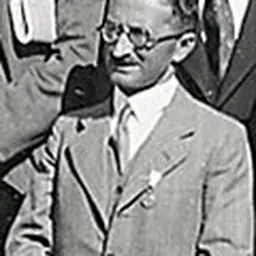
João Santana Rebello (né Rebêlo; 9 February 1928 – 2 December 2011), known mononymously as Mastor, was an Indian musician, double bass player, and former trumpeter known for his work in khell tiatr and zomnivoile khell (street play) productions.
Early life João Santana Rebêlo was born on 9 February 1928 in Benaulim, Goa, which was part of Portuguese India during the Portuguese Empire (now in India), to palm tree farmer Joaquim Peidade Rebelo and homemaker Pascoela Gomes, into a Goan Catholic family. He was the third of three children, with an elder brother João Caetano (born 1917) and a sister Jacinta (born 1924).
Career Rebello was a musician known for his contributions to the cultural scene. Originally a trumpet player in zomnivoile khells (street plays), he eventually shifted his focus due to health concerns and became actively involved in organizing khell competitions. Rebello played a pioneering role in bringing zomnivello khell to the stage, organizing the first-ever ticketed khell competitions. One of his significant accomplishments was the organization of the inaugural khell tiatr in Benaulim, Goa, featuring a competition between the works of mestri Anton Marie and Konkani playwright A. Moraes. In the late 1960s to the early 1980s, Rebello embraced the double bass and showcased his musical prowess as a member of the popular dance band, Luis and his Melodians, for 12 years. Additionally, Rebello actively supported drama shows by providing essential amenities such as pandal facilities and organized parking spaces for the convenience of the attendees.
Rebello's typed letter about organizing the first khell on the stage in 1956. Rebello played a crucial role in nurturing his son Luis's musical career, imparting drumming skills to him during his formative years. Concurrently, Rebello himself was an adept drummer. Additionally, Rebello was recognized as a proponent and patron of khells, a traditional Goan theatrical performance. Fostering an innovative idea, Rebello conceived the notion of hosting a zomnivoile khell competition on a stage akin to those employed in tiatrs, a popular form of Goan theater. To realize this vision, Rebello reached out to two khell maestros, Anton Moraes (A. Moraes) from Benaulim and Anton Marie from Orlim, who eagerly embraced the opportunity to showcase their zomnivoile khells on a stage, a novel prospect for them. Assuming the primary role in organization, Rebello meticulously coordinated the event. On an Easter evening of 1 April 1956, when several khells were already captivating audiences across Goan villages, Rebello collaborated with Manuel João Costa, a pandal decorator (mattoukar) from Varca, to erect a stage at Tolleabandh, Benaulim. The structure featured a mattou (pandal) housing a stage at one end, complemented by chairs arranged in front to accommodate the audience, akin to a tiatr setting. Unlike tiatrs, there were no elaborate curtains or intricate stage settings. Rather, the zomnivoile khell performed on this stage retained its original essence, with the actors directed to face the audience and deliver their performances upon request.
On that particular occasion, two distinct khells, which were popular forms of theatrical performances, were showcased. The first khell, titled Zolmachi Khomptti, was presented by A. Moraes, followed by Anton Marie's rendition of Bhau-Bhau (Brother-Brother). Rebello, the organizer of the event, had set aside an open space within the mattou (pandal) where spectators could stand and observe the performances. The event operated on a ticketed system, offering seating tickets priced at 1 rupee and 2 annas, while standing tickets were available for 10 annas. All tickets were sold out, indicating the event's triumph. It is worth noting that the intention of the event was not to foster competition, but rather to provide public entertainment. The audience thoroughly relished the performances, although no official awards were distributed. Nevertheless, the packed auditorium likely led attendees to form their own conclusions regarding which khell was superior, or perhaps perceive both as equally favourable. The significance of this day lies in the decision to bring the zomnivoilo khell, traditionally performed at ground level, onto the stage. This moment marked the initial stride towards the establishment of the khell tiatr, a theatrical tradition that would assume diverse names and forms, eventually even posing a challenge to the dominant Konkani tiatr in the entertainment realm. Rebello, A. Moraes, and Anton Marie Pereira were recognised for their collective efforts in propelling this significant advancement. "Without their collaboration, this groundbreaking leap forward would not have been conceivable", writes author Wilson Mazarello. Their three sons, Luis, Agnelo,
Don’t just read it —
keep it.
Full-length biographies made to live with: read them, listen on the way to work, watch them tonight.
- E-book
- Audio
- Video
Instant download · yours to keep · every purchase keeps this site free
Important facts
People in Mastor's life
Named in this biography and alive at the same time


Contemporaries
People whose lives overlapped Mastor's





Frequently asked questions
Who was Mastor?
Indian musician and trumpeter (1928–2011)
When was Mastor born?
Mastor was born on 9 February 1928.
When did Mastor die?
Mastor died on 2 December 2011.
Sources & further reading
Cite this page
APA: Biography.guide. (2026). Mastor. https://biography.guide/mastor/
MLA: "Mastor." Biography.guide, https://biography.guide/mastor/.
Chicago: "Mastor." Biography.guide. https://biography.guide/mastor/.
Data last updated: 2026-09-20 · Spot an error? Report a correction.
Page generated 2026-09-27 05:21 UTC