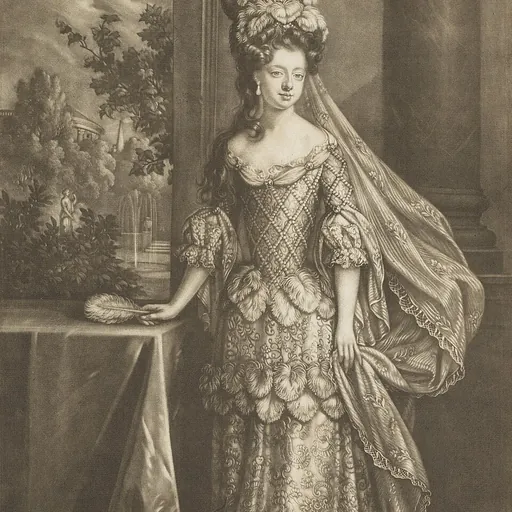
Mary Tudor, Countess of Derwentwater
Noblewoman; illegitimate child of English king
About Mary Tudor, Countess of Derwentwater
Lived 1673 – 1726 (aged 53). Mary Tudor, Countess of Derwentwater was an actor.
Lady Mary Tudor (16 October 1673 – 5 November 1726), by marriage Countess of Derwentwater, was an actress and illegitimate daughter of King Charles II of England by his mistress, Mary "Moll" Davies, an actress and singer. The King's fourteenth child, she was also his last.
Early life and precedence
Mary grew up in a house on the south-west side of St James Square, close to St James's Park and Whitehall palace, and from an early age she was surrounded by the high society of The Restoration. Mary followed in her mother's footsteps, and began acting at a young age. She was a part of the many performances put on at Charles II's elaborate court. At age nine, she sang the part of the Roman god of desire, erotic love, attraction and affection, Cupid, alongside her mother, who was starring as Venus, in the play Venus and Adonis.
On 10 December 1680, seven-year-old Mary was, in recognition of her paternity, In September 1683, she was issued an annuity of £1,500 (roughly ), and five months later, on 21 February, her precedence was heightened to that of a daughter of a Duke.
Marriages and issue
First marriage On 18 August 1687, Lady Mary married Edward Radclyffe, 2nd Earl of Derwentwater (9 December 1655 – 29 April 1705), son of Francis Radclyffe, 1st Earl of Derwentwater by his wife Catherine Fenwick, daughter of Sir William Fenwick.
James Radclyffe, 3rd Earl of Derwentwater (1689–1716) Lady Mary Tudor Radclyffe, who married 1720 to William Petre, Esq. with no issue. Charles Radclyffe (3 September 1693 – 8 December 1746) Hon. Francis Radclyffe
The marriage was unhappy, however, and Mary formally separated from Lord Derwentwater on 6 February 1700. The exact reason remains unclear; it could be due to her unwillingness to convert to Roman Catholicism or because she was unfaithful, as Thomas Seccombe writes in the Dictionary of National Biography. Edward Radclyffe died on 29 April 1705 at Arlington Street and was buried at Dilston.
Lady Mary Tudor supported her son, James Radclyffe, 3rd Earl of Derwentwater, during and after the 1715 rising by joining petitions for clemency and corresponding with his wife, Anna Maria Webb, as the family managed the aftermath of his conviction and execution. She later sought parliamentary guardianship of her grandchildren to ensure a Protestant upbringing, a move that prompted Anna Maria to remove them to the Continent. The marriage caused Graham great trouble, both with his family and with others. Before it, Graham had held an office in the household of Prince George of Denmark, the husband of Queen Anne, but as a result of the wedding he was dismissed from it. Graham died on 7 January 1707. No mention of her is made in her husband's will. '''
Third marriage A few months later, on 26 August 1707 at Twickenham, Middlesex, Lady Mary married Major James Rooke, with whom she had one daughter. Margaret Frances Disney Rooke (ca. 1708-1766), married a William Sheldon and had issue.
Death Lady Mary died in Paris on 5 November 1726, aged 53. Her widowed husband long survived her.
Don’t just read it —
keep it.
Full-length biographies made to live with: read them, listen on the way to work, watch them tonight.
- E-book
- Audio
- Video
Instant download · yours to keep · every purchase keeps this site free
Important facts
Family & relationships
Related people
Same field, nearest in time



Contemporaries
People whose lives overlapped Mary Tudor, Countess of Derwentwater's



Frequently asked questions
Who was Mary Tudor, Countess of Derwentwater?
noblewoman; illegitimate child of English king
When was Mary Tudor, Countess of Derwentwater born?
Mary Tudor, Countess of Derwentwater was born on 16 October 1673.
When did Mary Tudor, Countess of Derwentwater die?
Mary Tudor, Countess of Derwentwater died on 5 November 1726 in Paris.
What was Mary Tudor, Countess of Derwentwater's occupation?
Mary Tudor, Countess of Derwentwater was an actor.
Sources & further reading
· Wikipedia: Mary Tudor, Countess of Derwentwater
Cite this page
APA: Biography.guide. (2026). Mary Tudor, Countess of Derwentwater. https://biography.guide/mary-tudor-countess-of-derwentwater/
MLA: "Mary Tudor, Countess of Derwentwater." Biography.guide, https://biography.guide/mary-tudor-countess-of-derwentwater/.
Chicago: "Mary Tudor, Countess of Derwentwater." Biography.guide. https://biography.guide/mary-tudor-countess-of-derwentwater/.
Data last updated: 2026-09-24 · Spot an error? Report a correction.
Portrait: Wikimedia Commons · author & licence
Page generated 2026-09-27 05:08 UTC