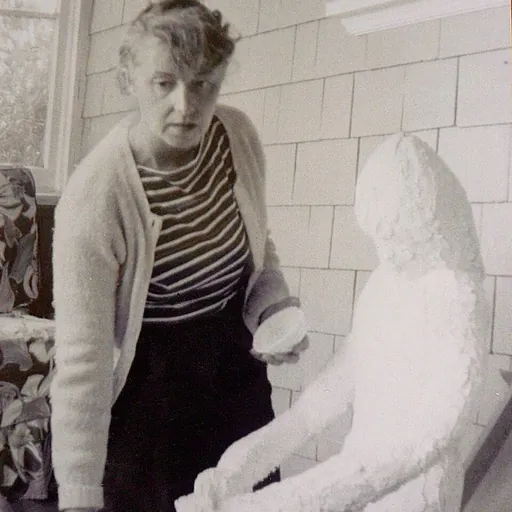
About Mary Perry Stone
Lived 1909 – 2007 (aged 97–98). Mary Perry Stone was an American painter, sculptor and muralist.
Mary Perry Stone (May 9, 1909 – June 6, 2007) was an American painter, sculptor, and muralist. She is best known for her social protest artwork. Her archives are held in the Smithsonian's Archives of American Art.
Early life and education Mary Perry was born on May 9, 1909, in Jamestown, Rhode Island. At the age of 15, she went to New York City to study art at the Art Students League of New York. After high school, she completed her art training at Traphagen School of Fashion and Design in New York. At the same time, she studied sculpture at the New School for Social Research with sculptor Aaron J. Goodelman. Recalling this time in a taped interview for the Smithsonian Archives,
Early work After graduating from Traphagen at the outset of the Great Depression, Perry stayed in New York. In addition, Perry's watercolors were exhibited in the lobby during the performance. In 1935, she participated in a sculpture exhibition put on by the Artists Union,
Work for the New York Federal Art Project, 1937-41
To keep artists employed during the Great Depression, the Works Progress Administration (WPA) established the Federal Art Project (FAP) in 1935. The New York City Federal Art Project, a group within FAP, hired Perry in 1937, initially as an art teacher. She was one of forty women sculptors in the New York Division. She sculpted in direct plaster as well as in stone, producing The Bowery and War. The 500-pound marble War was shown in the United American Sculptors First Annual Exhibition held at the New School For Social Research in 1939. Perry's oil painting “All for Money,” also created at this time, expressed her concern with fascism, racism, and the disparity between the rich and poor. These would remain themes of her work throughout her life. The painting was shown at the American Contemporary Art (ACA) Galleries in New York in 1939. In 1940, the Federal Art Project hired Perry to assist sculptor Cesare Stea in preparing his sculpture for installation at West Point. much of the free standing sculpture that had not been allocated to particular sites was warehoused, and with the termination of the WPA, it was destroyed. It was possibly thrown in the East River by order of an administrator. None of Perry's WPA sculptures remain. She exhibited in various galleries in the San Francisco area, including Telegraph Hill Gallery, the Artists Cooperative, and Grodsky's. In 1962 Stone and fellow artist Richard Van Wingerden exhibited together at Neville's. Mary Perry Stone, Comment on Vietnam. Oil on canvas, 180 x 34 inches In the 1960s and 1970s, Stone began working primarily as a painter. As a reaction to the Civil Rights struggles and Vietnam war, she began creating social protest murals and paintings, including “disturbing images of the innocent victims, especially women and children.” She had a solo anti-Vietnam-war exhibition at Dominican College's San Marco Gallery in 1968 and became part of the Sausalito Teahouse group founded by Ross Curtis, an artist and political progressive. A 2016 documentary, I Paint, I Protest She exhibited artists including Ross Curtis, Eileen Curtis, Richard Van Wingerden and Russell Chatham.
Stone was divorced from her husband Ed in 1975.
Oregon, 1992-2007 Mary Perry Stone, Thanksgiving - Thank You Slaves. Oil on canvas, 63 x 78 inches, 1998. Stone moved from the Bay Area to Ashland, Oregon, in 1992. In Ashland she focused on painting social protest murals. A solo show, “A Lifetime of Art,” at the Grants Pass Museum of Art in 2001 included the painting Corporate Predator. The last solo show of Stone's lifetime was in 2006 at the Thorndike Gallery at the University of Southern Oregon.
After's Stone's death, the Jega Gallery and Madashell Galleries exhibited her paintings; the Madashell show was entitled “Working for a Just World – A Collection of Protest Murals.” Her murals, War, Thanksgiving – Thank You Slaves, and Tickertape-Wall Street-Feast of the Bulls were also reprinted in the magazine Arts Politic (2009). On February 5, 2010, the inaugural exhibit at “The Mary Perry Stone Women’s Art Gallery” at the Missing Peace Art Space opened in Dayton, Ohio. This exhibit, entitled “Art Makes Us Human,” showed Stone's social protest work.
Mary Perry Stone died at the age of 98 on June 6, 2007, in Ashland, Oregon.
Don’t just read it —
keep it.
Full-length biographies made to live with: read them, listen on the way to work, watch them tonight.
- E-book
- Audio
- Video
Instant download · yours to keep · every purchase keeps this site free
Important facts
People in Mary Perry Stone's life
Named in this biography and alive at the same time



Related people
Same field, nearest in time


Contemporaries
People whose lives overlapped Mary Perry Stone's

Frequently asked questions
Who was Mary Perry Stone?
American artist (1909–2007)
When was Mary Perry Stone born?
Mary Perry Stone was born in 1909 in Jamestown.
When did Mary Perry Stone die?
Mary Perry Stone died in 2007.
What was Mary Perry Stone's occupation?
Mary Perry Stone was a painter, sculptor and muralist.
What nationality was Mary Perry Stone?
Mary Perry Stone was American.
Sources & further reading
Cite this page
APA: Biography.guide. (2026). Mary Perry Stone. https://biography.guide/mary-perry-stone/
MLA: "Mary Perry Stone." Biography.guide, https://biography.guide/mary-perry-stone/.
Chicago: "Mary Perry Stone." Biography.guide. https://biography.guide/mary-perry-stone/.
Data last updated: 2026-09-23 · Spot an error? Report a correction.
Portrait: Wikimedia Commons · author & licence
Page generated 2026-09-27 05:05 UTC