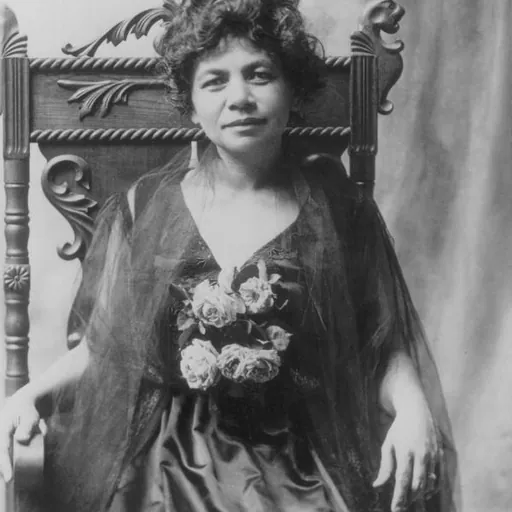
About Mary Haʻaheo Atcherley
Lived 1874 – 1933 (aged 58). Mary Haʻaheo Atcherley was a linguist, entrepreneur, suffragist and politician.
Mary Haʻaheo Atcherley (born Mary Ha'aheo Kinimaka, April 24, 1874 – March 8, 1933) was a Hawaiian activist. She was one of the first native Hawaiian women to run for public office in the Territory of Hawaii.
Early life Mary Ha'aheo Kinimaka was born on King Street in Honolulu in 1874 to David Leleo Kinimaka, a Hawaiian noble, and Hannah Keolaokalaau (also known as Hanakeola, or Hana Keola Allen-Kinimaka, 1854–1893).
She attended Kawaiaha'o Seminary for Girls between 1879 and 1881 or 1882. Mary Kinimaka married John Atcherley in 1894 in Kawaiae, Hawaii. The couple had four sons, one of whom did not survive to adulthood, and three daughters.
In 1897, Atcherley became the sole owner of two ahapua'a in Kona, Hawaii. She was involved in legal disputes relating to land throughout 1915, including one decided by the United States Supreme Court.
The family moved around often. In 1908, they lived in Honolulu, and, after a series of legal disputes relating to John Atcherley's confinement in an insane asylum, they moved to San Francisco in 1910 and to Vancouver in 1911 (where their youngest daughter, the goddaughter of Queen Lili'uokalani, was born). Dr. Atcherley worked for the Canadian Pacific Railway Company before joining the Royal Canadian Navy when World War I began in 1914. On the home front, Atcherley hosted Hawaiian-themed fundraisers for the war effort, often leading her children in performing Hawaiian music.
The family moved back to the Hawaiian Islands to Molokai (where Dr. Atcherley was the county physician) before settling in Honolulu in 1928. Atcherley is buried at Diamond Head Memorial Park on the island of Oahu with her husband.
Politics Starting with letters to the editor in 1908, Atcherley became an outspoken activist for the rights of native Hawaiians, especially in regards to public health and mistreatment by government officials. In 1919, Atcherley attended demonstrations in support of women's suffrage.
In 1920, Atcherley ran as a Democratic Party candidate from Oahu in the primary election for the territory's senate. A 1920 article about her states: "Mrs. Atcherley stands for an act for the minimum standard [wage] and a living salary for all working girls and women, and for the amendment of the workingmen's compensation act." Section 34 reads as follows:SEC . 34. That in order to be eligible to election as a senator a person shall-
Be a male citizen of the United States;
Have attained the age of thirty years;
Have resided in the Hawaiian Islands not less than three years and
be qualified to vote for senators in the district from which he is elected. The women were therefore legally allowed to remain on the ballot, but if they had been elected, would not have been able to hold office. The Attorney General suggested another citizen propose a test case for submission to the Supreme Court.
Atcherley ran again in 1922, but was only expected to receive 800 votes. The issue of eligibility remained unclear: women were allowed to run for territorial offices, but the question of whether they were allowed to hold territorial offices would be determined by the members of the United States Congress. In September 1922, a bill passed allowing women to hold elected office in the territory of Hawaii: newspapers specifically mentioned that Atcherley's campaign had brought attention to this issue.
Throughout the 1920s, she petitioned the government regarding various issues, including land use.
One obituary notes, "Mrs. Atcherley never achieved any outstanding political honors although she aspired to many places of public service" though "in her efforts on behalf of her own people, the Hawaiians, her steps never lagged, her voice was never stilled. She was an uncompromising champion of what she regarded were their rights."
Linguistic contributions Atcherley, who grew up speaking Hawaiian with the royal family, taught classes in Hawaiian language in Molokai and Oahu during the 1920s and wrote her own textbooks.
Don’t just read it —
keep it.
Full-length biographies made to live with: read them, listen on the way to work, watch them tonight.
- E-book
- Audio
- Video
Instant download · yours to keep · every purchase keeps this site free
Important facts
People in Mary Haʻaheo Atcherley's life
Named in this biography and alive at the same time

Related people
Same field, nearest in time


Contemporaries
People whose lives overlapped Mary Haʻaheo Atcherley's


Frequently asked questions
Who was Mary Haʻaheo Atcherley?
Hawaiian activist
When was Mary Haʻaheo Atcherley born?
Mary Haʻaheo Atcherley was born on 24 April 1874 in Honolulu.
When did Mary Haʻaheo Atcherley die?
Mary Haʻaheo Atcherley died on 8 March 1933.
What was Mary Haʻaheo Atcherley's occupation?
Mary Haʻaheo Atcherley was a linguist, entrepreneur, suffragist and politician.
Sources & further reading
· Wikipedia: Mary Haʻaheo Atcherley
· DBpedia: Mary Haʻaheo Atcherley
Cite this page
APA: Biography.guide. (2026). Mary Haʻaheo Atcherley. https://biography.guide/mary-ha-aheo-atcherley/
MLA: "Mary Haʻaheo Atcherley." Biography.guide, https://biography.guide/mary-ha-aheo-atcherley/.
Chicago: "Mary Haʻaheo Atcherley." Biography.guide. https://biography.guide/mary-ha-aheo-atcherley/.
Data last updated: 2026-09-20 · Spot an error? Report a correction.
Portrait: Wikimedia Commons · author & licence
Page generated 2026-09-27 04:57 UTC