
Mary Anderson
Labor activist and an advocate for women in the workplace
About Mary Anderson
Lived 1872 – 1964 (aged 91–92). Mary Anderson was a British and Swedish trade unionist, writer and factory worker.
Mary Anderson (August 27, 1872 – 1964) was a Swedish-born American labor activist and an advocate for women in the workplace. A feminist, she rallied support to ratify many new laws to support women and equal rights. Throughout her lifetime, Anderson held a large range of roles, rising from a factory worker to the Director of the Women's Bureau in the United States Department of Labor. Anderson's work to protect the rights of women in the workplace made no small impact on the lives of working women across the country.
Biography
Introduction
Mary Anderson was born in Lidköping, Sweden 1872, daughter of Magnus and Matilda (Johnson) Anderson. She emigrated to the United States when she was sixteen in 1888. Once in America she worked as a dishwasher at a lumberjacks' boarding house in Ludington, Michigan. She moved to Chicago where she worked in a garment factory and as a shoe stitcher in West Pullman. She joined the Boot and Shoe Workers Union and was elected president of the women's stitchers Local 94 in 1900.
Woman's Trade Union League 1900–1919
The main goal of this league was to organize women and to gain support for a union. This union would strive to get safer factory conditions for women workers. Mary Anderson had first hand experience of the very dangerous working conditions of the factory floor and knew things had to be improved.
It was during Anderson's time in the WTUL that's she began a friendship with Jane Addams who would greatly influence Anderson's views on helping all people, not just women. In Anderson's eulogy to Addams she tells of how, "'She was not one of those feminist who are for women alone. Her heart and her brilliant mind recognized that as long as one group could be exploited society as a whole must suffer'". Anderson too believed that the work of feminists should not be constrained to only women's issues but more importantly address broader social concerns.
40,000 garment workers went on strike in Chicago in 1910. This was Anderson's and the WTUL chance to organize these women and to use the tactics of the male unions to gain better pay for pant makers and better working conditions. During the strike the main goal of the WTUL was to relieve distress of families by donating food clothes and coal to those who were not getting paid and had very little money saved up.
The strike seemed to be working as employers were beginning to give in to the demands for collective bargaining of the garment workers. However the strike was abruptly called off by the United Garment Workers without any forewarning. Anderson was disappointed and shocked. She felt that for how much people endured through the strike they gained very little from their suffering. This failure of the method of collective organization to achieve the WTUL's goals in the garment strike would affect Anderson's views later on in her political career. She defiantly rejected of the National Woman's Party proposed Equal Rights Amendment and embraced the idea of Social Justice Feminism.
Women's Bureau vs. National Woman's Party and the Equal Rights Movement
Once the 19th Amendment was ratified and women received the vote the National Woman's Party set its sights on a new goal, an Equal Rights Amendment that would end all discrimination against women. This included the social justice legislation that Anderson and the Women's Bureau had gathered all that data and filed reports to enact in order to protect women. The NWP thought women should get equality in the work place by organizing into unions like men do. Anderson opposed this idea because of the anticlimactic end to the Chicago garment worker strike. The chasm here is one of ideal versus reality. The NWP had very strong ideological views of what it viewed as women's equality i.e. the ERA. However, the reality of the situation, as Anderson knew from scores of data collected by the Women's Bureau, was that not just women but all workers needed protection from harsh conditions allowed to exist in the factory. Mary Anderson would do all she could to prevent an Equal Rights Amendment from being ratified. Not because she thought women were weaker, but only because there was a real societal need for protective legislation.
Thus, through some tactical political maneuvering Mary Anderson was able to select who would head the NWP committee to study the effects of women specific labor legislation. She chose her close friend and committed social justice advocate Mary van Kleeck to be the technical advisor of the committee. Leaders on the NWP and Kleeck bickered and debated on every point making it virtually impossible for the committee to do anything. Eventually members on the committee who supported the ERA left the group, and the Women's Bureau and Mary Anderson successfully defended the policies they had worked so hard to enact.
Mary Anderson was the first "'up from the ranks" labor woman to head an executive department of the federal government. She served under five U.S. presidents during her tenure at the Women's Bureau. During this time, there was more than a doubling of the number of women working. She did everything in her, the Bureau's, and legislative power to protect the rights of working women.
Autobiography Woman At Work: The Autobiography of Mary Anderson as Told to Mary N. Winslow (Minneapolis, MN: Minnesota Historical Society Press. 1951)
Don’t just read it —
keep it.
Full-length biographies made to live with: read them, listen on the way to work, watch them tonight.
- E-book
- Audio
- Video
Instant download · yours to keep · every purchase keeps this site free
Important facts
People in Mary Anderson's life
Named in this biography and alive at the same time
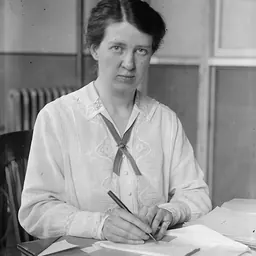

Related people
Same field, nearest in time


Contemporaries
People whose lives overlapped Mary Anderson's



Frequently asked questions
Who was Mary Anderson?
Labor activist and an advocate for women in the workplace (1872-1964)
When was Mary Anderson born?
Mary Anderson was born on 27 August 1872 in Lidköping.
When did Mary Anderson die?
Mary Anderson died in 1964 in Washington, D.C..
What was Mary Anderson's occupation?
Mary Anderson was a trade unionist, writer and factory worker.
What nationality was Mary Anderson?
Mary Anderson was British and Swedish.
Sources & further reading
· DBpedia: Mary Anderson (labor leader)
Cite this page
APA: Biography.guide. (2026). Mary Anderson. https://biography.guide/mary-anderson-trade-unionist/
MLA: "Mary Anderson." Biography.guide, https://biography.guide/mary-anderson-trade-unionist/.
Chicago: "Mary Anderson." Biography.guide. https://biography.guide/mary-anderson-trade-unionist/.
Data last updated: 2026-09-20 · Spot an error? Report a correction.
Page generated 2026-09-27 05:29 UTC