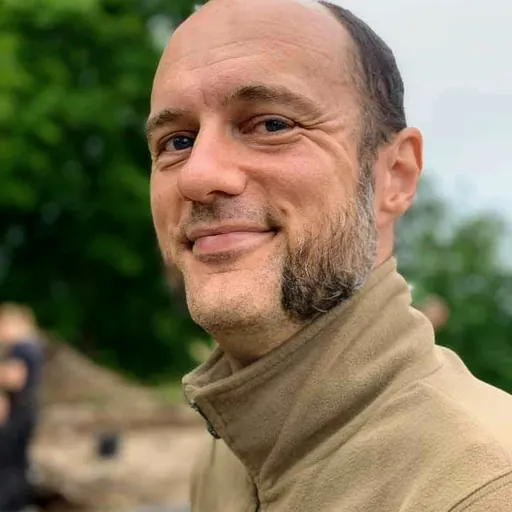
About Martin Rundkvist
Born 1972. Martin Rundkvist is a Swedish archaeologist and translator.
Martin Rundkvist (born 4 April 1972) is a Swedish archaeologist, translator, and associate professor at the University of Łódź in Poland. His research focuses on the Bronze, Iron, and Middle Ages of Scandinavia, including significant excavations in the province of Östergötland.
Rundkvist has studied and excavated various sites in Sweden, particularly in the country's south. In 2003 and 2004, he published a three-volume work which doubled as his PhD dissertation, cataloguing the finds from , the largest prehistoric cemetery on the Swedish island of Gotland. A subsequent book identified nine possible regional power centres in Östergötland, and attempted to determine where the "Beowulfian mead halls" of the day once stood. Excavating years later at one of these sites, , Rundkvist uncovered the foundations of a large mead hall, and 30 ornate gold figures that might have represented gods or royals. In other works, Rundkvist has excavated a Viking boat grave, and analysed both the placement of deposited artefacts in the landscape and the lifestyles of the Scandinavian élite during the Middle Ages.
Rundkvist has worked in archaeology since 1992, including research and lecture posts at the universities of Exeter, Chester, Linnaeus, and Tallinn. He spent two decades as managing editor of , a journal on archaeology and medieval art, and authors the blog Aardvarchaeology, which the James Randi Educational Foundation termed "the most-read archaeology blog on the Internet". Other than living in Connecticut from 1976 to 1978 while his father worked in advertising at Young & Rubicam in New York, and received his PhD from the same institution in 2003. Rundkvist has frequently featured in the news media. In 2011, Sweden's national newspaper and other outlets repeatedly covered a controversy between Rundkvist and the amateur archaeologist Bob Lind about excavations at the Ale's Stones stone ship, with Rundkvist noting that Lind's theories of the Stones' date and use were at odds with the scientific consensus. A companion volume, Barshalder 2, included essays placing the site in its wider context, and the following year Barshalder 3 detailed the Stone Age finds from the site. The topic was suggested by Jan Peder Lamm, who discovered important unpublished finds from the cemetery while organising the Swedish History Museum's stores, and declared that it would take "a foolish and stubborn person" to gather and publish the artefacts and notes from nearly two centuries of excavation. The works were reviewed in Antiquity as "a good thorough contextual study", and noted for offering "an elegant explanation" for clustered Viking Age graves, which Rundkvist argued represented grandparents and their grandchildren rather than a nuclear family.
In 2005, Rundkvist and Williams directed the excavation of a Viking boat grave at Skamby, in the province of Östergötland. The site's surface features suggested a cemetery comprising ten boat graves, making it exceptional for the area. The excavation was the first of a boat burial in Östergötland. Two years later, Rundkvist published a widely cited paper on Scandinavian domed oblong brooches from the Vendel Period. The article catalogued nearly 600 such brooches, as well as transitional types through to the Early Viking Age, and was termed "comprehensive" by the Danish archaeologist . The work was also praised by the Swedish archaeologist Birgitta Hårdh for demonstrating, among other things, how Uppåkra functioned as an innovation centre for new types of fibulae.
In 2011, Rundkvist published a fourth book, Mead-halls of the Eastern Geats. It analysed the regional political geography of Östergötland, and attempted to identify the region's "Beowulfian mead halls", the large buildings that housed the Late Iron Age élite.
Rundkvist's fifth book, In the Landscape and Between Worlds: Bronze Age Deposition Sites Around Lakes Mälaren and Hjälmaren in Sweden, was published in 2015. It analysed sites around lakes Mälaren and Hjälmaren where Bronze Age metalwork and stone implements had been found outside of burial and settlement contexts, and sought to identify traits that could be used to find new deposition sites. Given the region's comparatively humble finds, and the diffuse nature of Rundkvist's landscape descriptions—such as to look for where water "does something interesting"—several reviewers wrote that it would be difficult to translate his heuristic principles to the field, as intended; one termed it a "curate's egg". and its 2020 Swedish translation , were published by the Östergötland County Administrative Board. It built on Rundkvist's two decades of fieldwork in the area, including excavations of four of its twenty-five castles, Accordingly, one reviewer wrote that it "fluently combines archaeological evidence and historical textual sources". Several reviewers suggested the book worked better for a non-technical than an academic audience, though one termed it a "work of synthesis" that "puts into international reach some recent archaeological work on castles" in Östergötland. and a collection of E. Nesbit's ghost stories for adults.
Aska mead hall
Rundkvist began investigating the area around , a large hamlet near the town of Vadstena, in 2006. Known primarily for a rich 10th-century burial excavated in 1920 by , In his 2011 work on mead halls, he had termed Aska one of "the best candidates for elite settlements". In April 2013, Rundkvist and his colleague Andreas Viberg surveyed the mound with ground-penetrating radar, discovering evidence of a mead hall measuring long and up to wide. The mound, they determined, was a platform for the hall. Quoted in Archaeology, Rundkvist compared the hall to other contemporaneous élite sites in Fornsigtuna and Lejre, and particularly Gamla Uppsala. The dig uncovered part of the foundations of the mead hall from around 700 AD, and the East Cemetery, discovered near the platform mound in 2006. Their survey reported finds to the west, suggesting the presence of both a settlement site and burials, including five brooches from the Early Vendel Period and fragmented copper-alloy jewellery from the Middle Viking Age. To the east, the survey reported further finds from the Vendel and Viking periods, along with an undisturbed inhumation, which they left for future excavation.
Swedish Skeptics' Association Rundkvist has been active in the skeptical movement, having chaired the Swedish Skeptics' Association and edited its quarterly .
Secondary
Don’t just read it —
keep it.
Full-length biographies made to live with: read them, listen on the way to work, watch them tonight.
- E-book
- Audio
- Video
Instant download · yours to keep · every purchase keeps this site free
Important facts
People in Martin Rundkvist's life
Named in this biography and alive at the same time


Related people
Same field, nearest in time


Contemporaries
People whose lives overlapped Martin Rundkvist's

Frequently asked questions
Who is Martin Rundkvist?
Swedish archaeologist and translator (born 1972)
When was Martin Rundkvist born?
Martin Rundkvist was born on 4 April 1972 in Stockholm.
What is Martin Rundkvist's occupation?
Martin Rundkvist is an archaeologist and translator.
What nationality is Martin Rundkvist?
Martin Rundkvist is Swedish.
Sources & further reading
Cite this page
APA: Biography.guide. (2026). Martin Rundkvist. https://biography.guide/martin-rundkvist/
MLA: "Martin Rundkvist." Biography.guide, https://biography.guide/martin-rundkvist/.
Chicago: "Martin Rundkvist." Biography.guide. https://biography.guide/martin-rundkvist/.
Data last updated: 2026-09-22 · Spot an error? Report a correction.
Portrait: Wikimedia Commons · author & licence
Page generated 2026-09-27 05:03 UTC