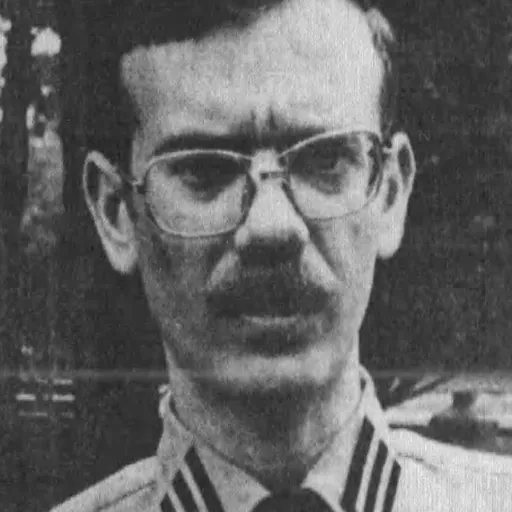
Martin Kerr
American neo-Nazi
About Martin Kerr
Born 1952. Martin Kerr is an American.
Martin Kerr (born 1952), formerly known as David Kerr, is an American neo-Nazi activist who is the third and current leader of the New Order, formerly the American Nazi Party. Kerr became a neo-Nazi as a teenager and joined the National Socialist White People's Party. In 1972, during his time at Hofstra University, he placed a Nazi flag in his dorm window, which resulted in media coverage and protests from Jewish organizations. He was ultimately ordered to take the flag down.
After his neo-Nazi propaganda distribution in the 1980s resulted in publicity, Kerr became the national spokesman for the NSWPP, but left only a year later after it had become the New Order. He rejoined in 2007. He assumed leadership of the New Order in 2014, following the death of its longtime leader Matt Koehl. He has written or edited several neo-Nazi publications.
Early life Kerr was born in 1952 in Pennsylvania. His family moved to New Jersey when he was aged three or four, where he was raised. His mother was a high school physical education teacher and his father was a public relations man. His family was Protestant, but he stated at age 20 that he no longer believed in organized religion. He had a sister two years his junior.
Politics
In 1969, Kerr joined the National Renaissance Party, editing their newsletter, but left in 1971. He afterwards joined the National Socialist White People's Party (formerly the American Nazi Party) in 1971. He was in its Los Angeles branch, under Joseph Tommasi. After Tommasi formed the National Socialist Liberation Front, Kerr stayed in the NSWPP; Tommasi's old unit kept their location, and claimed that in retaliation NSLF members had "beat the daylights" out of NSWPP members, including Kerr. Kerr denied this telling of events, saying that the NSLF members had quickly been chased away. In 1972, he became the second-in-command, as well as a general spokesman during Koehl's absence. He became an organizer for the party in Washington by 1976, and in 1977, he became the editor for their periodical White Power, and their quarterly National Socialist. In 1980, he began editing a neo-Nazi journal, The National Socialist, which was similar to the prior, defunct National Socialist World in its attempt to foster a more revolutionary approach to Nazism; articles, largely by members of the World Union of National Socialists, included ones on Hans F. K. Günther and Friedrich Nietzsche.
In 1982, as a result of his neo-Nazi literature distribution, the Maryland state legislature considered a bill that would make purveying "defamatory material" a crime punishable by a year of jail and an $1000 fine; this ultimately failed, but the resulting attention got Kerr promoted to national spokesman of the party. He announced the party's move to Wisconsin in December 1982, along with a name change to the New Order; he said the group would have more support there and the name would be a "better reflection" of the group. Kerr then denied the group was anti-black or antisemitic, and claimed the group aimed to curb pollution, nuclear armament, and raise funding for diseases that largely affected those of Northern European ancestry. At this time, the party was small and extremely fringe; a writer on fringe movements disputed his claim that the group was not racist.
In 2007, Kerr rejoined the organization. Kerr assumed leadership of the New Order in 2014 after the death of Matt Koehl, the previous commander. He wrote a work titled "History of American National Socialism", an 8-part study of the American far-right's history. After the Unite the Right rally in Charlottesville, he was interviewed by The Washington Post, where he called Rockwell "the grandfather of the white racialist movement as it exists today", and said Rockwell would have been "very pleased" by the rally. In 2017, he and the New Order commemorated George Lincoln Rockwell in Arlington, Virginia. in a gathering, which Kerr said was to test the community's "commitment to diversity". Under Kerr, the group is based in New Berlin, Wisconsin. He donated $500 to Simon Darby to support an election campaign by the party. British far-right activist John Bean wrote a book largely consisting of an interview with himself and Kerr, Many Shades of Black. Reviewing Mr Evil, a book about neo-Nazi murderer David Copeland, Kerr accused the authors of political bias and said "the unpleasant reality is that there will be more David Copleands in the future", but that the movement could not be held responsible for "undisciplined members on its fringes". He also reviewed one of Colin Jordan's books for a white power website; he endorsed violence at some point, but disagreed with Jordan's ideas on the time when it would be appropriate to carry it out, saying "we think that now is not the time for armed insurrection". He was a personal friend of Danish neo-Nazi Povl Riis-Knudsen.
Don’t just read it —
keep it.
Full-length biographies made to live with: read them, listen on the way to work, watch them tonight.
- E-book
- Audio
- Video
Instant download · yours to keep · every purchase keeps this site free
Important facts
People in Martin Kerr's life
Named in this biography and alive at the same time







Contemporaries
People whose lives overlapped Martin Kerr's


Frequently asked questions
Who is Martin Kerr?
American neo-Nazi
When was Martin Kerr born?
Martin Kerr was born in 1952 in Pennsylvania.
What nationality is Martin Kerr?
Martin Kerr is American.
Sources & further reading
Cite this page
APA: Biography.guide. (2026). Martin Kerr. https://biography.guide/martin-kerr/
MLA: "Martin Kerr." Biography.guide, https://biography.guide/martin-kerr/.
Chicago: "Martin Kerr." Biography.guide. https://biography.guide/martin-kerr/.
Data last updated: 2026-09-21 · Spot an error? Report a correction.
Portrait: Wikimedia Commons · author & licence
Page generated 2026-09-27 04:59 UTC