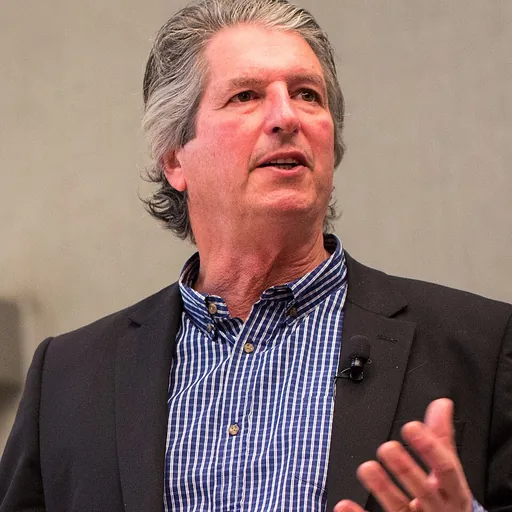
About Martin Green
Born 1948. Martin Green is an Australian engineer, environmentalist and university teacher.
Martin Andrew Green (born 20 July 1948) is an Australian engineer who specialises in photovoltaics. He is a Scientia professor of Photovoltaic and Renewable Energy Engineering at the University of New South Wales (UNSW), where he directs the Australian Centre for Advanced Photovoltaics. Green is best known for his development of the Passivated Emitter and Rear Cell (PERC) in 1983, a technology that significantly increased the conversion efficiency of silicon solar cells, reduced the cost of solar energy and powers over 90% of all solar panels globally today. and has won many prizes and awards achievements such as Pawsey Medal in 1981, and holds fellowships with the Royal Society of London, the Australian Academy of Science, the Australian Academy of Technology and Engineering and the Royal Society of New South Wales.
Early life and education Martin Andrew Green was born in Camp Hill, Queensland on 20 July 1948.
He was educated at the selective Brisbane State High School, where he graduated as dux of the school in 1965. At the University of Queensland, he completed a Bachelor of Engineering in1970 and a Master of Engineering in 1972. He then completed his PhD on a Commonwealth Scholarship at McMaster University in Canada,
Research In 1974, at the University of New South Wales, he set up the Australia's first solar research lab, the Solar Photovoltaics Group, which worked on the development of silicon solar cells. As of 2021, his PERC solar cell that he invented accounts for 91.2% of worldwide silicon solar module production. produced 30% more energy than competing technologies and 20% cheaper to produce. In the 1990s, the technology was the largest manufactured solar cell technology in Europe.
Andrew Blakers who helped develop the first 18% efficient silicon cell Ximing Dai, Chief Technology Officer for JA Solar Holdings Xiaojing Hao, Professor of Photovoltaics and Renewable Energy Engineering at UNSW
Green is currently the editor-in-chief of the academic journal Progress in Photovoltaics. 1981: Edgeworth David Medal 1988: Award for Outstanding Achievement in Energy Research 1990: IEEE William R. Cherry Award 1991: Eureka Prize for "outstanding contribution to the development of high efficiency photovoltaic solar cells" 1992: CSIRO External Medal, alongside Dr Stuart Wenham 1994: Clunies Ross Technology Innovation Award 1994 M. A. Sargent Medal 1995: IEEE J.J. Ebers Award for "sustained technical leadership in the field of silicon photovoltaic solar energy conversion" 1999: Australia Prize in the energy science and technology theme with Dr Stuart Wenham 1999: Sir Lionel Hooke Award 1999: World Federation of Engineering Organizations Medal of Engineering Excellence (inaugural award) 2000: Gold Medal from the Spanish Engineering Academy 2000: Millennium Award from the World Renewable Congress 2001: Centenary Medal "for service to Australian society and science in photovoltaics 2002: Right Livelihood Award for "his dedication and outstanding success in the harnessing of solar energy, the key technological challenge of our age." 2003: Karl Böer Solar Energy Medal of Merit Award from the University of Delaware 2004: World Technology Network Award for Energy 2006: Finalist, European Inventor of the Year, together with Dr Stuart Wenham 2007: SolarWorld Einstein Award 2008: New South Wales Scientist of the Year Award 2008: New South Wales Science & Engineering Award in the category of Environment, Water and Climate Change Sciences 2009: Zayed Future Energy Prize finalist, recognised at the award ceremony for his groundbreaking research in photovoltaic (PV) technology that will result in increased efficiencies, bringing solar energy closer to grid parity. 2010: CSIRO Eurkea Prize for Leadership in Science 2012: Collaborative Innovation Award, together with Dr Stuart Wenham 2012: Member of the Order of Australia "for service to science education as an academic and researcher, particularly through the development of photovoltaic solar cell technology, and to professional associations." 2013: Fellow of the Royal Society of London
His nomination for the Royal Society reads: centred Professor Green is cited for his extensive and distinguished contributions to photovoltaic science and technology. These include identifying the fundamental limits upon silicon solar cell performance and then leading his team to demonstrate experimental devices approaching this limit, with 25% cell efficiency now demonstrated. This is over 50% relatively higher in performance than at the beginning of his work. He has also developed innovative commercial versions of these high performance devices and pioneered the field of "third generation" photovoltaics, investigating advanced photovoltaic device concepts targeting Carnot-like solar conversion efficiencies. 2016: Ian Wark Medal and Lecture 2018: The Global Energy Prize for research, development and educational activities in the field of photovoltaics that have revolutionized the efficiency and costs of solar photovoltaics, making this now the lowest cost option for bulk electricity supply 2021: Japan Prize for "development of high-efficiency silicon photovoltaic devices" 2022: Millennium Technology Prize for his invention of Passivated Emitter and Rear Cell (PERC) 2023: Leigh Ann Conn Prize by the University of Louisville, for low-cost, high efficiency silicon solar cells 2023: Queen Elizabeth Prize for Engineering for his invention of PERC solar photovoltaic technology, alongside Andrew Blakers, Aihua Wang, and Jianhua Zhao. 2023: VinFuture Prize along with M. Stanley Whittingham, Rachid Yazami, and Akira Yoshino for "pioneering the breakthrough in green energy production with the invention of solar cells enhanced by Passivated Emitter and Rear Contact (PERC) technology" 2024: Sydney Ferries named a brand new Parramatta River-class ferry after Martin Green 2025: IET Faraday Medal for "his outstanding and sustained work in the field of renewable energy"
Honours Green is also a fellow at many academic institutes including:
1989: Fellow of the Institute of Electrical and Electronics Engineers
Don’t just read it —
keep it.
Full-length biographies made to live with: read them, listen on the way to work, watch them tonight.
- E-book
- Audio
- Video
Instant download · yours to keep · every purchase keeps this site free
Important facts
People in Martin Green's life
Named in this biography and alive at the same time




Related people
Same field, nearest in time


Contemporaries
People whose lives overlapped Martin Green's

Frequently asked questions
Who is Martin Green?
Australian scientist
When was Martin Green born?
Martin Green was born on 20 July 1948 in Brisbane.
What is Martin Green's occupation?
Martin Green is an engineer, environmentalist and university teacher.
What nationality is Martin Green?
Martin Green is Australian.
Sources & further reading
· DBpedia: Martin Green (professor)
Cite this page
APA: Biography.guide. (2026). Martin Green. https://biography.guide/martin-green-engineer/
MLA: "Martin Green." Biography.guide, https://biography.guide/martin-green-engineer/.
Chicago: "Martin Green." Biography.guide. https://biography.guide/martin-green-engineer/.
Data last updated: 2026-09-22 · Spot an error? Report a correction.
Portrait: Wikimedia Commons · author & licence
Page generated 2026-09-27 05:04 UTC