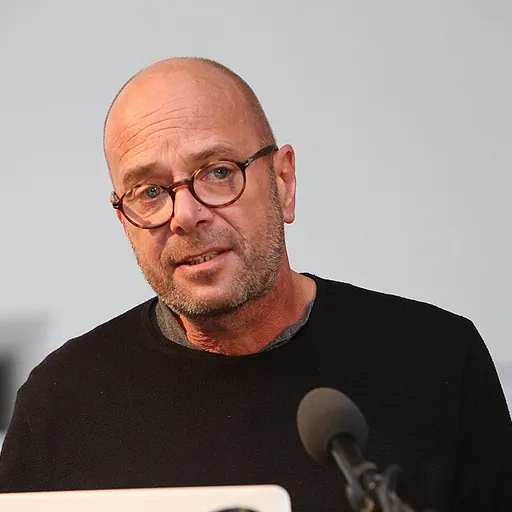
Martin Arnold
Austrian film maker (born 1959)
About Martin Arnold
Born 1959. Martin Arnold is an Austrian film director, film producer, television producer, director and artist.
Martin Arnold (born 1959 in Vienna, Austria) is an experimental filmmaker known for his obsessive deconstruction of found footage.
Career Arnold's films are intensely cut sequences in which several seconds of old movie clips are taken and stretched out into much longer works. The figures on the screen flip back and forth between frames, as the motion is repeated and reversed, and numerous single frame cuts are made. His intent is to create, or possibly unearth, narratives concealed within the mundane films from which he samples. In films such as Pièce Touchée (1989) and Passage à l'acte (1993) for example he uses several seconds of the films The Human Jungle and To Kill a Mockingbird, the latter to create a bizarre story of aggression and tension within a traditional American family.
Later works In a later group of short film loops such as Soft Palate (2010) and Whistle Stop (2014), Arnold seems to discover psychoanalytic underbellies in the most popular form of post-war family entertainment, animation, and its most iconic characters such as Mickey Mouse (using two of Mickey's shorts, one of them Mickey's Delayed Date), Tom And Jerry, Daffy Duck (Draftee Daffy) and Goofy (How To Play Golf).
Accolades His work has been shown at 168 international film festivals, including Cannes, Rotterdam and New York. At these festivals he has won 34 awards, such as the Golden Gate Award at the San Francisco International Film Festival (1990), the Primo Premio at the Arco Madrid's Week of Experimental Cinema (1994) and the Main Award at the International Short Film Festival Oberhausen (1998). For his entire oeuvre he was awarded for Honors for Art in Cinema by the State of Austria (1994) and the Province of Lower Austria (1995). In addition to festival screenings, Arnolds's films have been shown at various cinematheques such as the Cinematheque in Paris, the Cinematheque Royale in Brussels, the National Film Theatre in London, the San Francisco Cinematheque, and the Cinematheque of the MoMA in NYC. Arnold's work was also included in museum exhibitions at places such as the Witte de With in Rotterdam, the Bozar in Brussels, the Barbican Art Center in London, the Kunsthaus Zürich and the Hamburger Kunstverein, among others. Essays on his work and at-length interviews have appeared in several film and art magazines including Afterimage, Film Quarterly, Frieze Magazine, Cahiers du Cinéma, and Semiotiques, and in catalogues and books such as Martin Arnold – Gross Anatomies by Martin Janda and Martin Arnold – Deanimated by Gerald Matt and Thomas Miessgang, A Critical Cinema 3 by Scott MacDonald, L’Art du mouvement by Jean-Michel Bohours for the Centre Georges Pompidou. Reviews of his film and installation works were published in numerous papers including The New York Times, The Village Voice, The Chicago Weekly Reader, L. A. Weekly, The Guardian, Le Monde, La Liberation and Die Neue Zürcher Zeitung.
Personal life He taught at several American universities and art schools such as the University of Wisconsin, Milwaukee (1995), the San Francisco Art Institute (1996/97), Bard College (2000/01), Binghamton University (2004–2007) and CalArts (2008). In Europe Arnold had guest professorships at the Städelschule in Frankfurt (1999), the FAMU in Prague (2009/10) and the University of Art and Design in Linz (1998).
Selected filmography
2014 Whistle Stop, format variable, color, sound, 3:30 loop
2013 Charon, format variable, color, silent, 00:08 loop Hydra, format variable, color, silent, 00:21 loop Nix, format variable, color, silent, 00:05 loop Tooth Eruption, format variable, color, sound, 5:20 loop
2011 Haunted House, format variable, color, sound, 3:00 loop Self Control, format variable, color, sound, 2:00 loop
2010 Soft Palate, format variable, single screen, color, sound, 3:10 loop Shadow Cuts, format variable, color, sound, 4:20 loop
2007 Coverversion, format variable, color, sound, 7:30 loop Cloudy Insulin, format variable, 2 screens, color, sound, 6:00 loops
2005 Silent Winds, format variable, 3 screens, color, sound, 12:00 loops
2003 Jeanne, quicktime data, b/w, silent, endless loop
2002 Deanimated, format variable, b/w, sound, 60:00 loop Dissociated, format variable, 2 screens, b/w, sound, 8:00 loops Forsaken, format variable, 2 screens, b/w, 9:00 loops
1998 Alone. Life Wastes Andy Hardy, format variable, b/w, sound, 15:00
1997 Psycho. Viennale Spot, 35mm, b/w, sound, 1:00
1996 Don’t - The Austrian Film, 35mm, b/w, sound, 3:00
1994 Kunstraum Remise. Spot, 35mm, color, sound, 1:00
1993 passage à l’acte, format variable, b/w, sound, 12:00
1989 pièce touchée, format variable, b/w, sound, 16:00
Don’t just read it —
keep it.
Full-length biographies made to live with: read them, listen on the way to work, watch them tonight.
- E-book
- Audio
- Video
Instant download · yours to keep · every purchase keeps this site free
Important facts
People in Martin Arnold's life
Named in this biography and alive at the same time


Related people
Same field, nearest in time


Contemporaries
People whose lives overlapped Martin Arnold's



Frequently asked questions
Who is Martin Arnold?
Austrian film maker (born 1959)
When was Martin Arnold born?
Martin Arnold was born in 1959 in Vienna.
What is Martin Arnold's occupation?
Martin Arnold is a film director, film producer, television producer, director and artist.
What nationality is Martin Arnold?
Martin Arnold is Austrian.
Sources & further reading
· DBpedia: Martin Arnold (filmmaker)
Cite this page
APA: Biography.guide. (2026). Martin Arnold. https://biography.guide/martin-arnold/
MLA: "Martin Arnold." Biography.guide, https://biography.guide/martin-arnold/.
Chicago: "Martin Arnold." Biography.guide. https://biography.guide/martin-arnold/.
Data last updated: 2026-09-21 · Spot an error? Report a correction.
Portrait: Wikimedia Commons · author & licence
Page generated 2026-09-27 04:59 UTC