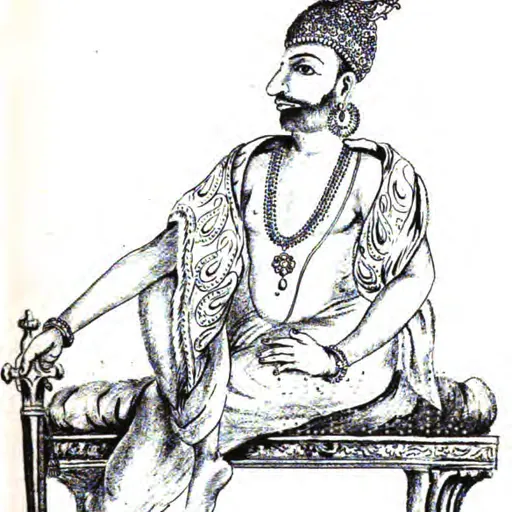
Marthanda Varma
Marthanda Varma was the Maharajah of Travancore from 1729 to 1758.
About Marthanda Varma
Lived 1706 – 1758 (aged 51–52).
Anizham Thirunal Marthanda Varma (; 1706 – 7 July 1758), was the founding monarch of the southern Indian Kingdom of Travancore (previously Venadu) from 1729 until his death in 1758. He was succeeded by Rama Varma ("Dharma Raja") (1758–98).
Raja Marthanda Varma defeated the Dutch East India Company forces at the Battle of Colachel in 1741. He also put an end to the Nair-Brahmin Administrative setup, Ettuveetil Pillamar and the Ettara yogam council and took the full power as the king. Pillai's and Yogakkar aligned with the Quilon royal family of Kulashekara Perumal, does not accept southern branches of the Venadu royal family as the legitimate rulers of Venadu, Southern Travancore (Thiruvananthapuram and Kanyakumari) branches of the Venadu royal family trace their patrilineal origin to the Chera dynasty and are maternally related to the Kolathiri of the Mushika dynasty and the Ay royal lineage. The Yogakars and Pillamars were always against the Royal Family to which Raja Marthanda Varma belonged. (Padmanabhaswamy Temple Judgement page :16). He then adopted a European mode of discipline for his army and expanded his kingdom northward (to what became the modern state of Travancore). He undertook many irrigational works, built roads and canals for communication and gave active encouragement to foreign trade. In January, 1750, Marthanda Varma decided to "donate" his kingdom to the last Tiruvadi Sri Padmanabha (Vishnu) and thereafter rule as the deity's "vice-regent" (Sri Padmanabha Dasa). The Thampi brothers, sons of Rama Varma, immediately revolted against Marthanda Varma (who was the legitimate successor on the basis of the Nair matrilineal system) with the assistance of a Tamil army. After reducing the power of the Ettuveetil Pillamar, the Nair aristocracy, and their associates, the Yogakkars, Marthanda Varma turned his attention to central Kerala. He realised that Dutch power in Kerala stemmed from their flourishing spice trade at the port of Kochi. He set out to conquer the major spice-producing areas supplying cargo to Kochi. After declaring a state monopoly on pepper in Travancore in 1743, between then and 1752, the king annexed Quilon, Kayamkulam, Thekkumkur, Vadakkumkur and Purakkad to Travancore (thereby delivering a serious blow to the commerce of the Dutch).
In 1731, the port of Kollam (Quilon) - which was ruled by a branch of the Venadu family to which Marthanda Varma also belonged - was defeated and its last chief was made to sign a treaty allowing the annexation of his chiefdom by Travancore after his death. The chief was brought to Thiruvananthapuram and lodged almost as a state prisoner in the Valikoikkal Palace. A contingent of the Travancore army under Dalavay Arumukham Pillai was stationed at Kollam. Following this, Ambalapuzha, Kottayam and Changanassery were also annexed to Travancore by 1753. The principality of Meenachil was also annexed.
The ascent of Travancore seems to have been particularly rapid after about 1749. Therefore, he inherited his mother's caste the Mushika lineage of Nair caste, wanting the status of a (Samantha Kshatriya), he performed a set of elaborate and expensive Mahadana rituals as which included the Hiranyagarbha. Marthanda Varma started normalising the relationship between the royal family (the ruler) and the Padmanabhaswamy Temple (the administrative body of the temple) as soon as he came to the throne. He undertook the Prayaschittam retribution that was long overdue from the earlier Venadu kings.
Thiruvananthapuram became a prominent city in Kerala under Marthanda Varma.
Purpose of Thrippadidanam
Separation of the newly formed "unitary kingship" (and political power) from the disputes and frictions in the civil society. He was succeeded by his nephew Rama Varma ("Dharma Raja"). Marthanda Varma's policies were continued in large measure by Dharma Raja (1758–98). He also went on to successfully defend Travancore against the aggression of the Kingdom of Mysore. Marthanda Varma's legacy involved a major restructuring of the medieval political and economic relations of southern Kerala.
Don’t just read it —
keep it.
Full-length biographies made to live with: read them, listen on the way to work, watch them tonight.
- E-book
- Audio
- Video
Instant download · yours to keep · every purchase keeps this site free
Important facts
People in Marthanda Varma's life
Named in this biography and alive at the same time

Contemporaries
People whose lives overlapped Marthanda Varma's





Frequently asked questions
Who was Marthanda Varma?
Marthanda Varma was the Maharajah of Travancore from 1729 to 1758.
When was Marthanda Varma born?
Marthanda Varma was born in 1706 in Attingal.
When did Marthanda Varma die?
Marthanda Varma died on 7 July 1758 in Padmanabhapuram.
Sources & further reading
Cite this page
APA: Biography.guide. (2026). Marthanda Varma. https://biography.guide/marthanda-varma/
MLA: "Marthanda Varma." Biography.guide, https://biography.guide/marthanda-varma/.
Chicago: "Marthanda Varma." Biography.guide. https://biography.guide/marthanda-varma/.
Data last updated: 2026-09-22 · Spot an error? Report a correction.
Portrait: Wikimedia Commons · author & licence
Page generated 2026-09-27 05:02 UTC