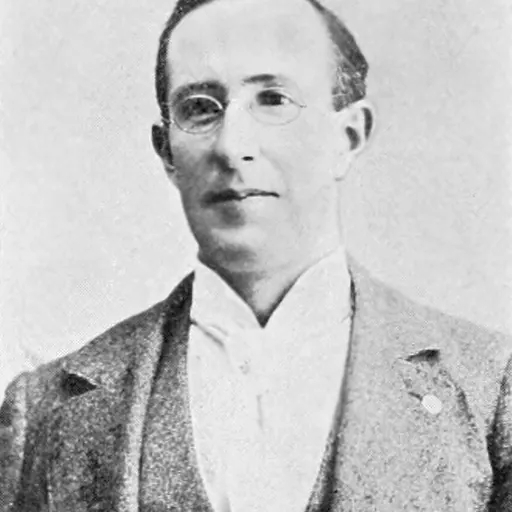
Marshall S. Cornwell
American newspaper publisher and editor, journalist, writer, and poet
About Marshall S. Cornwell
Lived 1871 – 1898 (aged 26). Marshall S. Cornwell was an American editor, journalist and poet.
Marshall Silas Cornwell (October 18, 1871 – May 26, 1898) was a 19th-century American newspaper publisher and editor, writer and poet in the U.S. state of West Virginia. Cornwell was a younger brother of railroad and timber executive William B. Cornwell (1864–1926) and West Virginia Governor John Jacob Cornwell (1867–1953).
He was born on his family's farm on South Branch Mountain near Springfield, West Virginia in 1871 and received his education at home and in nearby rural schools. He left his family's farm and became editor and publisher of the South Branch Gazette newspaper in Petersburg, West Virginia in 1893. The newspaper prospered under his leadership and his editorials received the attention of United States Senator Stephen Benton Elkins. He was briefly the editor of The Mountain Breeze newspaper in Petersburg in 1894. At the invitation of Elkins, Cornwell began operating The Inter-Mountain newspaper in Elkins, West Virginia that same year, and its circulation increased under his leadership. During his tenure there, Cornwell served as an assistant clerk of the West Virginia House of Delegates under Chief Clerk William M. O. Dawson, who later served as Governor of West Virginia. In 1896 Cornwell represented Randolph County as a delegate to the West Virginia Republican Party 2nd Congressional District convention.
Cornwell's health declined in 1896, possibly due to tuberculosis, and he subsequently resigned as the editor of The Inter-Mountain to concentrate on improving his health. During the winter of 1896–97, Cornwell traveled to the eastern shore of Florida and wrote poetry. He returned to Hampshire County in 1897, where he was appointed secretary of the West Virginia Schools for the Deaf and Blind Board of Regents. He also wrote a column in his brothers' Hampshire Review newspaper entitled "Wheat and Chaff." Cornwell traveled to the Rio Grande in southwest Texas throughout the winter of 1897–98 to improve his health in the warmer climate. He continued writing short essays about his travels and the places he encountered. Cornwell returned to his home in Romney in 1898 where he died from tuberculosis at age 26. Following his death, his brothers William and John Jacob published a collection of his poetry in 1899 in a volume entitled Wheat and Chaff. After this, newspapers across the United States, including the St. Louis Globe-Democrat, The Baltimore Sun, The Morning Post in Raleigh and The Railroad Trainman republished his poem "Success".
Early life and education Marshall Silas Cornwell was born on his family's farm on South Branch Mountain (also known as "Jersey Mountain") near Springfield, from Romney, in Hampshire County, West Virginia on October 18, 1871. He was the third-eldest son and child of Jacob H. Cornwell and his wife Mary Eleanor Taylor Cornwell. Cornwell's older brothers were railroad and timber executive William B. Cornwell (1864–1926) and John Jacob Cornwell (1867–1953), who served as the 15th Governor of West Virginia (1917–21). As an autodidact in various subjects, he was well-read, exhibited an "insatiable thirst for knowledge" and possessed a remarkable memory.
Career as newspaper editor and publisher In 1890 Cornwell's elder brothers William and John Jacob Cornwell purchased The Review newspaper in Romney. Later that year, the Cornwell brothers purchased The Reviews rival newspaper in Romney, the South Branch Intelligencer. When he became managing editor of the South Branch Gazette, The Clarksburg Telegram praised Cornwell "as one of the rising young men of the Little Mountain State." In 1894, Cornwell became the editor of The Mountain Breeze newspaper in Petersburg.
Elkins invited Cornwell to take charge of The Inter-Mountain newspaper in Elkins in Randolph County. The circulation of The Inter-Mountain increased under his leadership. In July 1895, Cornwell and Tygart's Valley News editor Z. F. Collett jointly published an eight-page, eight-columned illustrated paper celebrating the notable businesspersons and industries of Elkins and other towns along the West Virginia Central Railroad. This special edition paper earned praise from the Cumberland Evening Times newspaper in nearby Cumberland, Maryland.
In addition to his newspaper work, Cornwell also became active in the West Virginia Republican Party. In 1895, he served as an assistant clerk of the West Virginia House of Delegates under Chief Clerk William M. O. Dawson during a session of the West Virginia Legislature. Dawson later served as the 12th Governor of West Virginia (1905–09). On June 23, 1896, Cornwell represented Randolph County as a delegate to the West Virginia Republican Party 2nd Congressional District convention in Morgantown.
Writing and poetry career Cornwell's health began to fail, possibly as a result of tuberculosis, and he resigned from his position as editor of The Inter-Mountain in 1896. J. Slidell Brown, president of the West Virginia Editorial Association, asked Cornwell compose a special poem to commemorate the association's annual meeting in Elkins in 1896. "The Editor Man" was later published in the Buffalo Evening News in August 1897.
Cornwell traveled to the eastern coast of Florida in search of a cure for his worsening illness in late 1896. In a letter dated March 12, 1897, from Indianapolis, Riley commended Cornwell on a collection of his poems with special attention given to his poem "Success". Gravestone at the interment site of Marshall S. Cornwell at Indian Mound Cemetery in Romney. In June 1897 the Board of Regents of the West Virginia Schools for the Deaf and Blind selected Cornwell to serve as its secretary. While in Romney, Cornwell wrote a column for his brothers' Hampshire Review newspaper, entitled "Wheat and Chaff."
During the winter of 1897–98 Cornwell again traveled to a warmer climate to recuperate from his illness; this time to El Paso, Texas and other locations along the Rio Grande in Texas. Cornwell returned to his home in Romney, and died at his home in Romney on the morning of May 26, 1898, at age 26. Cornwell was interred in Indian Mound Cemetery in Romney. During his graveside service, Reverend Washburn read Cornwell's poem "Some Day."
Literary works Cornwell addressed a variety of topics in his writing. Author Kenneth R. Bailey described the poem as "a sensitive piece about a less fortunate man whose story would never be known but whose life was not to be scorned". William and John Jacob published a collection of Cornwell's poetry in 1899 entitled Wheat and Chaff. Wheat and Chaff, the name of his column in the Hampshire Review, was a pocket-sized volume of around 95 pages, containing poetry, letters and extracts from correspondence written throughout the course of Cornwell's journeys. The Baltimore Sun (1904) along with an abbreviated biography, and The Railroad Trainman (1906).
Don’t just read it —
keep it.
Full-length biographies made to live with: read them, listen on the way to work, watch them tonight.
- E-book
- Audio
- Video
Instant download · yours to keep · every purchase keeps this site free
Important facts
People in Marshall S. Cornwell's life
Named in this biography and alive at the same time

Related people
Same field, nearest in time


Contemporaries
People whose lives overlapped Marshall S. Cornwell's

Frequently asked questions
Who was Marshall S. Cornwell?
American newspaper publisher and editor, journalist, writer, and poet (1871-1898)
When was Marshall S. Cornwell born?
Marshall S. Cornwell was born on 18 October 1871 in Springfield.
When did Marshall S. Cornwell die?
Marshall S. Cornwell died on 26 May 1898 in Romney.
What was Marshall S. Cornwell's occupation?
Marshall S. Cornwell was an editor, journalist and poet.
What nationality was Marshall S. Cornwell?
Marshall S. Cornwell was American.
Sources & further reading
· Wikipedia: Marshall S. Cornwell
· DBpedia: Marshall S. Cornwell
Cite this page
APA: Biography.guide. (2026). Marshall S. Cornwell. https://biography.guide/marshall-s-cornwell/
MLA: "Marshall S. Cornwell." Biography.guide, https://biography.guide/marshall-s-cornwell/.
Chicago: "Marshall S. Cornwell." Biography.guide. https://biography.guide/marshall-s-cornwell/.
Data last updated: 2026-09-22 · Spot an error? Report a correction.
Portrait: Wikimedia Commons · author & licence
Page generated 2026-09-27 05:04 UTC