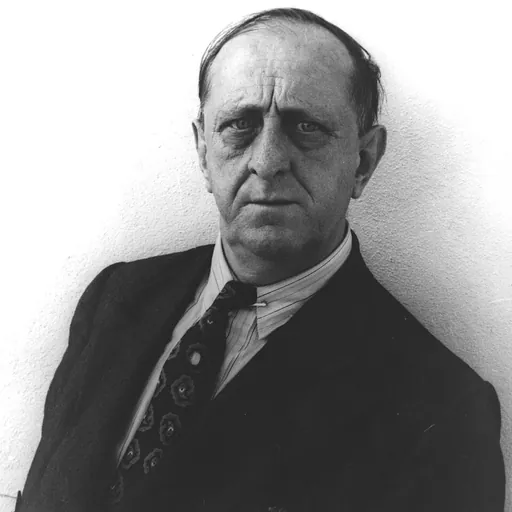
About Marsden Hartley
Lived 1877 – 1943 (aged 66). Marsden Hartley was an American painter, poet, journalist, draftsperson, writer and architectural drafter.
Marsden Hartley (January 4, 1877 – September 2, 1943) was an American Modernist painter, poet, and essayist. Hartley developed his painting abilities by observing Cubist artists in Paris and Berlin.
Early life and education Front row, left to right: Jo Davidson, Edward Steichen, Arthur B. Carles, John Marin; back row: Marsden Hartley, Laurence Fellows, c. 1911, Bates College Museum of Art Hartley was born in Lewiston, Maine, where his English parents had settled. He was the youngest of nine children. His mother died when he was eight, and his father remarried four years later to Martha Marsden. His birth name was Edmund Hartley; he later assumed Marsden as his first name when he was in his early twenties. These bleak occurrences led Hartley to recall his New England childhood as a time of painful loneliness, so much so that in a letter to Alfred Stieglitz, he once described the New England accent as "a sad recollection [that] rushed into my very flesh like sharpened knives".
After he joined his family in Cleveland, Ohio, in 1892, Hartley began his art training at the Cleveland School of Art, where he held a scholarship.
In 1898, at the age of 22, Hartley moved to New York City to study painting at the New York School of Art under William Merritt Chase, and then attended the National Academy of Design. Hartley wanted to live within the noiseless countryside and an invigorating city.
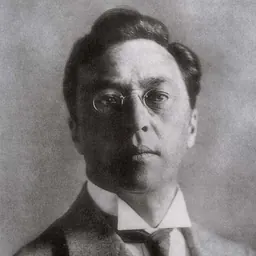
Germany In April 1913 Hartley relocated to Berlin, the capital of the German Empire where he continued to paint, and became friends with the painters Wassily Kandinsky and Franz Marc. His work during this period was a combination of abstraction and German Expressionism, fueled by his personal brand of mysticism. Freyburg's subsequent death during the war hit Hartley hard, and he afterward idealized their relationship.
Hartley returned to the U.S. from Berlin as a German sympathizer following World War I. In 1930 he spent the summer and fall painting mountains in New Hampshire, and in 1931 at what is known as Dogtown Common, near Gloucester, Massachusetts. which he spent in Mexico from 1932 to 1933, followed by a year in the Bavarian Alps (1933–34). After a few months in Bermuda (1935), he traveled north by ship where he discovered a small fishing village in Blue Rocks, Nova Scotia and lived for two summers with the Francis Mason family of fishermen. In September 1936 the two Mason brothers drowned in a hurricane—an event that deeply affected Hartley and would later inspire an important series of portrait paintings and seascapes. He finally returned to Maine in 1937, after declaring that he wanted to become "the painter of Maine" and depict American life at a local level. For the remainder of his life, he worked in such Maine locations as Georgetown, Vinalhaven, Brooksville, Corea, and Mt. Katahdin until his death from congestive heart failure in Ellsworth in 1943. His ashes were scattered on the Androscoggin River.
Hartley was not overt about his homosexuality, often redirecting attention towards other aspects of his work. Works such as Portrait of a German Officer and Handsome Drinks are coded. The compositions honor lovers, friends, and inspirational sources. Hartley no longer felt unease at what people thought of his work once he reached his sixties. His figure paintings of athletic, muscular males, often nude or garbed only in briefs or thongs, became more intimate, such as Flaming American (Swim Champ), 1940 or Madawaska--Acadian Light-Heavy--Second Arrangement (both from 1940). As with Hartley's German officer paintings, his late paintings of virile males are now assessed in terms of his affirmation of his homosexuality.
Important works
Portrait of a German Officer (1914)
In a personal memoir that was not finished, Hartley wrote "I began somehow to have curiosity about art at the time when sex consciousness is fully developed and as I did not incline to concrete escapades. I of course inclined to abstract ones, and the collecting of objects which is a sex expression took the upper hand." Hartley's use of object abstraction became the motif for his paintings that commemorate his "love object", Karl von Freyburg. According to Meryl Doney, Hartley conveyed his emotions regarding his friend's traits in his paintings through everyday items. In this painting the Iron Cross, the Flag of Bavaria and the German flag are attributes to Karl von Freyburg, along with the yellow '24', the age he was when he died.
Selected paintings
Writing In addition to being considered one of the foremost American painters of the first half of the 20th century, Hartley also wrote poems, essays, and stories and published during his lifetime in many of the little magazines of the day, including one book of essays (Adventures in the Arts: Informal Chapters on Painters, Vaudeville and Poets. New York: Boni, Liveright, 1921; reprinted New York: Hacker Books, 1972) and three volumes of poetry (Twenty-five Poems, published by Robert McAlmon in Paris in 1923; Androscoggin, 1940; and Sea Burial, 1941). Posthumous collections of his writings include: Selected Poems. Edited by Henry W. Wells, New York: Viking Press, 1945; The Collected Poems of Marsden Hartley, 1904–1943. Edited and with an introduction by Gail R. Scott and a foreword by Robert Creeley. Santa Rosa, Calif.: Black Sparrow Press, 1987; On Art. Edited and with an introduction by Gail R. Scott. New York: Horizon Press, 1982; and his autobiography, Somehow a Past: The Autobiography of Marsden Hartley. Edited, with an introduction by Susan Elizabeth Ryan. Cambridge, Massachusetts and London: 1995.
Cleophas and His Own: A North Atlantic Tragedy is a story based on two periods he spent in 1935 and 1936 with the Mason family in the Lunenburg County, Nova Scotia, fishing community of East Point Island. Hartley, then in his late 50s, found there both an innocent, unrestrained love and the sense of family he had been seeking since his unhappy childhood in Maine. The impact of this experience lasted until his death in 1943 and helped widen the scope of his mature works, which included numerous portrayals of the Masons. He wrote of the Masons, "Five magnificent chapters out of an amazing, human book, these beautiful human beings, loving, tender, strong, courageous, dutiful, kind, so like the salt of the sea, the grit of the earth, the sheer face of the cliff." In Cleophas and His Own, written in Nova Scotia in the fall of 1936 and re-printed in Marsden Hartley and Nova Scotia, Hartley expresses his immense grief at the tragic drowning of the Mason sons. The independent filmmaker Michael Maglaras made a feature film, Cleophas and His Own, released in 2005, which uses a personal testament by Hartley as its screenplay.
Scholarship Since the artist's death in 1943, there have been several research projects to catalogue all of his paintings and drawings. An inventory begun by representatives of his Estate and carried out by the American Art Research Council under the auspices of the Whitney Museum of American Art and later enlarged upon by scholar and art critic, Elizabeth McCausland (but never published) A catalogue raisonné project of Hartley's work was begun in the mid-1980s by art historian Gail Levin, Distinguished Professor at Baruch College, and The Graduate Center of The City University of New York (as yet unpublished) In 2020, Bates College Museum of Art in Lewiston, Maine, has partnered with leading Hartley scholar, Gail R. Scott, on The Marsden Hartley Legacy Project: The Complete Paintings and Works on Paper which will be an online, publicly accessible, searchable collection of all known works by the artist.
Don’t just read it —
keep it.
Full-length biographies made to live with: read them, listen on the way to work, watch them tonight.
- E-book
- Audio
- Video
Instant download · yours to keep · every purchase keeps this site free
Important facts
People in Marsden Hartley's life
Named in this biography and alive at the same time





Related people
Same field, nearest in time


Contemporaries
People whose lives overlapped Marsden Hartley's

Frequently asked questions
Who was Marsden Hartley?
American artist (1877–1943)
When was Marsden Hartley born?
Marsden Hartley was born on 4 January 1877 in Lewiston.
When did Marsden Hartley die?
Marsden Hartley died on 2 September 1943 in Ellsworth.
What was Marsden Hartley's occupation?
Marsden Hartley was a painter, poet, journalist, draftsperson, writer and architectural drafter.
What nationality was Marsden Hartley?
Marsden Hartley was American.
Sources & further reading
Cite this page
APA: Biography.guide. (2026). Marsden Hartley. https://biography.guide/marsden-hartley/
MLA: "Marsden Hartley." Biography.guide, https://biography.guide/marsden-hartley/.
Chicago: "Marsden Hartley." Biography.guide. https://biography.guide/marsden-hartley/.
Data last updated: 2026-09-22 · Spot an error? Report a correction.
Portrait: Wikimedia Commons · author & licence
Page generated 2026-09-27 05:02 UTC