
Marmaduke Johnson
Person involved in the 17th century publishing trade
About Marmaduke Johnson
Lived 1629 – 1674 (aged 44–45). Marmaduke Johnson was a bookseller and printer.
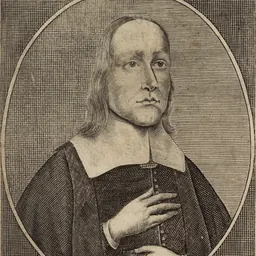
Marmaduke Johnson (1628 – December 25, 1674) was a London printer who was commissioned and sailed from England to Massachusetts Bay Colony in 1660 to assist Samuel Green in the printing of The Indian Bible, which had been laboriously translated by John Eliot into the Massachusett Indian language, which became the first Bible printed in America. Johnson printed several further works for Eliot containing religious material translated for the Indian nations of Massachusetts. Johnson was the first highly skilled letterpress printer in America. When he attempted to open his own printing house in Boston, without an official license from the Crown, the Massachusetts General Court interceded and censured his operation, disallowing printing outside of Cambridge. This started one of the first 'Freedom of the Press' disputes in colonial America. After several appeals the Court conceded and Johnson moved to Boston, set up and outfitted his printing shop, and became the first printer allowed to operate his own private printing press in the colony.
Early years
Marmaduke Johnson was born in Rothwell, West Riding of Yorkshire, England, the son of a tailor. Beginning January 9, 1646, he served the customary seven years as an apprentice under John Field in London. He completed his apprenticeship on October 4, 1652. Little else is known of his years in London, other than he was once served a term in jail for debt. He subsequently wrote the anonymous Ludgate, What It Is: Not What It Was, a critical essay condemning the British debtors' prison system, which was printed by his brother Thomas.
Printing career Johnson is widely noted for printing the Eliot Indian Bible with Samuel Green. in an attempt to teach Christianity to the Indian nations in Massachusetts. The project to print the Bible in the Algonquin-Massachusett language began with missionary John Eliot who came to the Massachusetts Bay Colony from England in 1631. One of his primary missions was to teach and convert the Massachusett to Christianity. To effect this he studied the Algonquin Indian language and then, with the assistance of James Printer translated various Christian scriptures from English to the Massachusett Indian language, rather than trying to teach the Indians English and then have them study scriptures. This was an effort that took him fourteen years to complete before he took on the task of printing the translation of various Christian scriptures into Algonquin. He commissioned Green in the printing of the Gospel of Matthew, Book of Genesis, and Psalms, and presented these works to the corporation as examples of what a completed Algonquin Bible would look like.
The Corporation approved Elliot's work and in 1660 sent Marmaduke Johnson, an accomplished printer, to the American colonies on board the Prudent Mary and he arrived at Boston with a new printing press, one hundred reams of paper and eighty pounds of new type for the printing The agreement, outlining Johnson's terms of service and his duties as a printer, was drawn up and signed by Johnson on April 21, 1660. Thomas Bell of the Corporation paid Johnson £5 for his passage across the Atlantic, and 18 shillings for a rug, boulster and blanket for his accommodation during the voyage.
Johnson arrived in New England sometime during the summer of 1660 with another printing press to assist in the printing of Elliot's Indian Bible. Before Johnson's arrival Green had only managed to produce a few sheets of the New Testament. After Johnson's arrival both printing presses were now committed to the enormous task that lay before them. By 1661, Johnson, Green, and with the assistance of John Eliot and James Printer in the translation of English to the Massachusett language, printed 1,500 copies of the New Testament. By 1663, Marmaduke and Green had printed 1,180 volumes of the Old and New Testaments translated from English to the Massachusett language. The two books were bound together to make one complete Bible, to which were attached a Catechism, and the Psalms of David in Indian verse. This was the first Bible in any language that was printed in America. Thus completed, a copy of The Indian Bible, in elegant binding, was presented to Charles the Second, which included a dedication of thanks and gratitude for his support.
Johnson was considered a good worker, however, during the printing production of the Indian Bible he would sometimes take leave of absence for extended periods of time, leaving Green to take on the huge task by himself, subsequently slowing down the rate of printing production. As soon as his printing contract had been completed Johnson was dismissed, and in 1664 returned to England. When he arrived there he was appointed the official printer for the New England Company, replacing Green, which by some accounts occurred at the insistence of John Eliot. As a subsequence of Johnson's return Green lost much of his income from the sale of the Indian tracts. Before May, 1665, Massachusetts lacked any privately owned commercial printing press. His reputation for disorderly conduct notwithstanding and with the Insistence of John Elliot and the corporation, Johnson was allowed to remain in Cambridge so he could complete his commission to print the Indian Bibles, or until August, 1664. When Johnson returned from England with his own printing press and type, with the intention of starting up his own privately operated printing press, the first to ever do so, the Act requiring printing licenses was reinstated on May 27, 1765, by the Court, with Johnson specifically in mind. The Act mandated, "that there shall be no printing presses allowed ... but in Cambridge". When the Licensing of the Press Act 1662 became law its effect in the colonies was hard felt, that any printing press outside of Cambridge, location of the only sanctioned press in Massachusetts, was prohibited, which proved to be a serious hindrance to the business interests of Boston printers. On January 21, 1662, Johnson had his premises searched where a number of Poor Robin's Almanacks he had printed without license were confiscated. The Act, however, was repealed in 1663.
Having moved to and operating in Boston, Johnson in 1668 printed The Isle of Pines, for which he was fined £5. Johnson made several attempts to repeal these restriction by addressing the General Court with his own petitions, which initially failed. Johnson maintained that the restrictions placed upon him would have prevented him to make enough income to support himself, and would also prevent him from printing tracts that would be beneficial to the court and the commonwealth. Prompted by the insistence of John Eliot, the General Court finally concurred and accepted Johnson's petitions, with certain restrictions, and permitted him to set up his printing house in Boston on, May 30, 1674, becoming the first printer to run his own press in the American colonies. and didn't live long enough to enjoy the favorable decision the Court handed down to him, and lived there until his death, December 25, 1674, shortly thereafter.
Works printed From 1669 to 1671 Johnson, sometimes in cooperation with Green, produced works that were of special significance to trends in American publishing, during which time they printed four books which proved important for their historical and literary content. In 1669 they printed a work by Nathaniel Morton, entitled, New-England's Memoriall, the first non-religious work authored in America. The work contains the history of the Plymouth Colony and relies almost entirely on the original chronicles of the Plymouth Plantation that was written by Morton's uncle, Governor William Bradford, possibly the most handsome book produced in American colonies at the time. In 1670 two volumes of poetry: Meat out of the Eater, by Michael Wigglesworth, a lengthy work about the benefits of afflictions, and Philip Pain's Daily Meditations, originally printed by Johnson, but no copies are known to exist. The 1670 edition contains a poetical introduction written by Johnson. Both works were made available for purchase. The fourth work, which is considered the most important book printed by Johnson and Green, was Increase Mather's informative biography of his father, The Life and Death of That Reverend Man of God, Mr. Richard Mather printed in 1670. Eliot, John. The Indian Grammar Begun, Cambridge, 1666 Brès, Guy de, The rise, spring and foundation of the Anabaptists, or re-baptized of our time, 1668 Pain, Phillip, Daily Meditations: Or, Quotidian Preparations for and Considerations of Death and Eternity, 1670 A Platform of Church-Discipline Gathered out of the Word of God, Cambridge, 1671 Eliot, John. The Logick Primer. Some Logical Notions to initiate the Indians in the Knowledge of the Rule of Reason, Cambridge, 1672. Mather, Increase, Wo to Drunkards Two Sermons by Mather, "Testifying against the Sin of Drunkenness", Cambridge, 1673 Mather, Increase. The Day of Trouble is near. Two Sermons preached on the December 11, 1673. Cambridge, 1674.
Later years and legacy Johnson married late in life to Ruth Cane of Cambridge on April 28, 1670, and had a daughter who died young. In 1672 Johnson printed a work by William Dyer, entitled, Christ's Famous Titles, for Joseph Farnham and Edmund Ranger. John Foster, with likely encouragement of Increase Mather, the newly appointed licenser of the press, bought Johnson's printing press and wares. It is unknown whether Johnson had printed any works in Boston, having died almost immediately after he set up shop there. In all, Johnson printed about sixty works during his career as a printer. Johnson became seriously ill from an undisclosed ailment
The contributions of Marmaduke Johnson as a publisher and printer are significant in the development of publishing and printing in that early era of colonial America. The number of books he printed, by himself, or with Samuel Green, are historically significant, and serve to reveal the changing reading habits in colonial New England. It is said that Johnson's life provides a good example of an American success story, about a man with humble beginnings who rose to independence and prominence. Johnson brought to Massachusetts the technical knowledge of printing that was in short supply and badly needed, helping to make publishing take root and flourish in the colonies.
Don’t just read it —
keep it.
Full-length biographies made to live with: read them, listen on the way to work, watch them tonight.
- E-book
- Audio
- Video
Instant download · yours to keep · every purchase keeps this site free
Important facts
People in Marmaduke Johnson's life
Named in this biography and alive at the same time





Related people
Same field, nearest in time



Contemporaries
People whose lives overlapped Marmaduke Johnson's



Frequently asked questions
Who was Marmaduke Johnson?
person involved in the 17th century publishing trade
When was Marmaduke Johnson born?
Marmaduke Johnson was born in 1629 in Rothwell, West Yorkshire, West Riding of Yorkshire.
When did Marmaduke Johnson die?
Marmaduke Johnson died in 1674 in Boston, Massachusetts.
What was Marmaduke Johnson's occupation?
Marmaduke Johnson was a bookseller and printer.
Sources & further reading
· Wikipedia: Marmaduke Johnson
Cite this page
APA: Biography.guide. (2026). Marmaduke Johnson. https://biography.guide/marmaduke-johnson/
MLA: "Marmaduke Johnson." Biography.guide, https://biography.guide/marmaduke-johnson/.
Chicago: "Marmaduke Johnson." Biography.guide. https://biography.guide/marmaduke-johnson/.
Data last updated: 2026-09-20 · Spot an error? Report a correction.
Page generated 2026-09-27 05:08 UTC