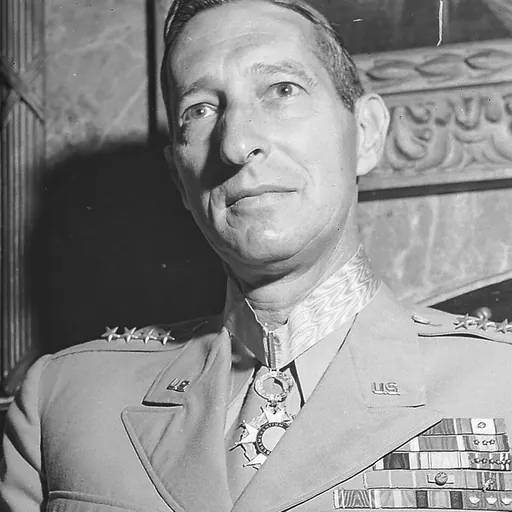
Mark W. Clark
United States Army general
About Mark W. Clark
Lived 1896 – 1984 (aged 87). Mark W. Clark was an American military officer, president of the United States and the Citadel.
Early life and career Clark was born in Madison Barracks, Sackets Harbor, New York, on May 1, 1896, but spent much of his youth in Highland Park, Illinois, while his father, Charles Carr Clark, a career infantry officer in the United States Army, was stationed at Fort Sheridan. His mother, Rebecca "Beckie" Ezekkiels, was the daughter of Romanian Jews; Mark Clark was baptized Episcopalian as a cadet at the United States Military Academy at West Point, New York.
Clark gained an early appointment to the USMA in June 1913 at the age of 17, but lost time from frequent illnesses. Known as "Contraband" by his classmates, because of his ability to smuggle sweets into the barracks, He graduated alongside young men such as Matthew Ridgway, J. Lawton Collins, (both of whom later became U.S. Army Chief of Staff) Ernest N. Harmon, William W. Eagles, Norman Cota, Laurence B. Keiser, John M. Devine, Albert C. Smith, Frederick A. Irving, Charles H. Gerhardt, Bryant Moore and William K. Harrison. All of these men would, like Clark himself, rise to high command and become generals.
World War I Clark, like his father, decided to join the Infantry Branch. He was assigned to the 11th Infantry Regiment, which later became part of the 5th Division when it was activated in December, where he became a company commander in Company 'K' of the 3rd Battalion, 11th Infantry, with First Lieutenant John W. O'Daniel serving as a platoon commander in his company. Arriving with his company at the French port of Brest on 1 May, his 22nd birthday, the next few weeks were spent in training in trench warfare under the tutelage of the French Army and soon afterwards the division was inspected by General John J. Pershing, the AEF's Commander-in-Chief (C-in-C).
Captain Clark recovered from his injuries within six weeks, but was graded unfit to return to the infantry, He stayed in this post until the end of hostilities on 11 November 1918. He then served with the Third Army in its occupation duties in Germany and returned to the United States in June 1919, just over a year after he was sent overseas. On 4 August 1941, Clark, skipping the rank of colonel, was promoted two grades to the temporary rank of brigadier general as the U.S. Army geared up for entry into World War II, and made Assistant Chief of Staff for Operations and Training (G-3) at General Headquarters, United States Army, in Washington, D.C.
Service in Europe and North Africa Negotiations at Algiers, 13 November 1942. From left to right: Lieutenant General Dwight D. Eisenhower, Admiral François Darlan, Lieutenant General Mark W. Clark, and Mr. Robert D. Murphy of the US. State Department.
On 17 April 1942, Clark was temporarily promoted to the two-star rank of major general. along with General Sir Alan Brooke, the Chief of the Imperial General Staff (CIGS, the professional head of the British Army), and Lieutenant General Bernard Montgomery, then commander of the South Eastern Command.
After a cross-channel invasion was ruled out for 1942, attention was turned to planning for an Allied invasion of French North Africa, given the codename of Operation Gymnast, later Operation Torch. In October, Clark was assigned to the Mediterranean Theater of Operations (MTO) as deputy to Eisenhower, who was now the Supreme Allied Commander in the theater, relinquishing command of II Corps. Clark's duty was to prepare for Operation Torch. Clark also made a covert visit to French North Africa (see Operation Flagpole) to meet with pro-Allied officers of the Vichy French forces.
Fifth Army and service in Italy
Eisenhower greatly appreciated Clark's contributions. Clark, at the age of 46, was promoted to the temporary rank of lieutenant general on 11 November 1942,
In the presence of senior commanders Patton and Clark were friendly, although Patton, in his journal, wrote "I think that if you treat a skunk nicely, he will not piss on you—as often", referring to Clark after both he and General Marshall, the Army Chief of Staff, visited Patton's headquarters as the latter explained his plans for the upcoming invasion of Sicily. Clark, for his part, claimed he found it difficult to command men who had been his senior, and he proved reluctant to remove those commanders if they failed in battle. The Fifth Army's initial mission was preparing to keep a surveillance on Spanish Morocco.
His permanent rank was upgraded to brigadier general on 1 September 1943. Despite this Clark was later awarded the Distinguished Service Cross (DSC), the citation for which reads:
The Fifth Army, by now composed of five American divisions (the 3rd, 34th, 36th and 45th Infantry, along with the 82nd Airborne) and three British divisions (7th Armoured, 46th and 56th Infantry, all serving under McCreery's X Corps), operating alongside the British Eighth Army, under General Bernard Montgomery, subsequently advanced up the spine of Italy, and captured the Italian city of Naples on 1 October 1943, and crossed the Volturno Line in mid-October. Progress, however, soon began to slow down, due to German resistance, lack of Allied manpower in Italy, and the formidable German defenses known as the Winter Line, which was to hold the Allies up for the next six months.
Lieutenant General Mark W. Clark riding in a jeep through the recently liberated Italian capital of Rome, June 1944. Sat behind Clark is Major General Alfred Gruenther while to Gruenther's left is Major General Harry H. Johnson.
During the Battle of Monte Cassino, Clark ordered the bombing of the Abbey on 15 February 1944. This was under direct orders from his superior, British General Sir Harold R. L. G. Alexander, Commander-in-Chief (C-in-C) of the Allied Armies in Italy (AAI). Clark and his chief of staff, Major General Alfred Gruenther, remained unconvinced of the military necessity of the bombing. When handing over the U.S. II Corps position to the New Zealand Corps, under Lieutenant General Sir Bernard Freyberg, the assistant division commander of the U.S. 34th Division, Brigadier General Frederic B. Butler, claimed "I don't know, but I don't believe the enemy is in the convent. All the fire has been from the slopes of the hill below the wall." The commander of the veteran 4th Indian Infantry Division (which was transferred from the Eighth Army to Clark's Fifth Army), Major General Francis Tuker, urged the bombing of the entire massif with the heaviest bombs available. Clark finally pinned down the British commander-in-chief in Italy, Alexander, recounting that "I said, 'You give me a direct order and we'll do it' and he did."
From left to right, Alfred Gruenther, Donald W. Brann, Mark W. Clark, and Guy Garrod
Clark's conduct of operations in the Italian campaign is controversial, particularly during the actions around the German Gustav Line, such as the U.S. 36th Infantry Division's assault on the Gari river in January 1944, which failed with 1,681 casualties in the 36th Infantry Division. American military historian Carlo D'Este called Clark's choice to take the undefended Italian capital of Rome, after Operation Diadem and the breakout from the Anzio beachhead, in early June, rather than focusing on the destruction of the German 10th Army, "as militarily stupid as it was insubordinate". Although Clark described a "race to Rome" and released an edited version of his diary for the official historians, his complete papers became available only after his death. James Holland in his book Cassino '44 argues that by turning to face Armeeoberkommando (AOK) 14 at the Caesar Line head-on Clark almost certainly destroyed more of AOK 14 than he would have done otherwise. Rather than annihilating AOK 10, as has been Alexander's original plan, the Allies seriously mauled the former and virtually annihilated the latter. On balance, that was a better outcome than had been originally envisioned. It is unfair to suggest that the Allies failed to annihilate AOK 10 south of Rome because of Clark's decision to change his line of attack, and it is a myth that seems to have originated with Raleigh Trevelyan, a former British second lieutenant who had served in Anzio and wrote a book in 1981 called Rome '44. In it, Trevelyan cited a claim by Harold Macmillan than Alexander had been furious when he'd heard that Clark had turned away from Valmontone. This single quote had been repeated by almost every historian who has written about this period over the course of the intervening year. There is no footnote for the source of this quote. In any case, Clark did send troops to Valmontone, it was captured, US forces did use the Via Casilina to advance on Rome and the city fell before D-Day. It was just that no German troops were cut off here, - because none of them were using it as a route of escape.
One of Clark's commanders, Lucian Truscott wrote that on receiving new orders from Clark to turn towards Rome ...I was dumbfounded. This was no time to drive to the north-west where the enemy was still strong; we should pour our maximum power into the Valmontone Gap to ensure the destruction of the retreating German Army. I would not comply with the order without first talking to General Clark in person. ... [However] he was not on the beachhead and could not be reached even by radio... such was the order that turned the main effort of the beachhead forces from the Valmontone Gap and prevented destruction of the German Tenth Army. On the 26th the order was put into effect.
He went on to write,
There has never been any doubt in my mind that had General Clark held loyally to General Alexander's instructions, had he not changed the direction of my attack to the north-west on 26 May, the strategic objectives of Anzio would have been accomplished in full. To be first in Rome was a poor compensation for this lost opportunity.
Lieutenant General Mark W. Clark looks toward the shoreline from the PT boat carrying him to the beachhead near Anzio, Italy, 22 January 1944
Clark led the Fifth Army, now much reduced in manpower, having given up both the U.S. VI Corps and the French Expeditionary Corps (CEF) for Operation Dragoon, the Allied invasion of Southern France (which Clark had always opposed), throughout the battles around the Gothic Line. For the offensive, Clark's Fifth Army (now composed only of the II Corps—with the 34th and 85th Infantry Divisions—under Major General Geoffrey Keyes, and the IV Corps—with the 88th and 91st Infantry Divisions—under Major General Willis D. Crittenberger and the 1st Armored Division in reserve) was reinforced by the British XIII Corps, under Lieutenant General Sidney Kirkman. The initial stages went well until the autumn weather began and, as it did the previous year, the advance bogged down.
Lieutenant General Mark W. Clark inspecting members of the 34th Infantry Division of the II Corps, shortly after the liberation of Rome, June 1944
Early on the morning of 28 January 1944, a PT boat carrying Clark to the Anzio beachhead, six days after the Anzio landings, was mistakenly fired on by U.S. naval vessels. Several sailors were killed and wounded around him. Next month, during the air raid he ordered on Monte Cassino abbey, 16 bombs were mistakenly dropped at the Fifth Army headquarters compound then 17 miles (27 km) away from there, exploding yards from his trailer while he was at his desk inside. A few months later, on 10 June, he again narrowly escaped death when, while flying over Civitavecchia in a Stinson L-5, his pilot, Major John T. Walker, failed to see the cable of a barrage balloon, which embedded itself into one of the wings, forcing the plane into a rapid downward spiral around the cable. The plane broke free after the third time around, leaving the outer section of the wing behind. Miraculously, Walker managed to crash-land in an open meadow and the two men escaped uninjured. "I never had a worse experience" wrote Clark to his wife.
15th Army Group Generalleutnant Fridolin von Senger und Etterlin (foreground), the commander of XIV Panzer Corps, meets (from left to right:) Lieutenant General Lucian K. Truscott Jr., General Clark, and Lieutenant General Sir Richard McCreery at 15th Army Group Headquarters, where the Germans received instructions regarding the unconditional surrender of German forces in Italy and West Austria, May 1945
In December 1944 Clark succeeded Alexander as commander of the AAI, renamed the 15th Army Group, and Alexander was made the Supreme Commander of the AFHQ in the Mediterranean, replacing Field Marshal Sir Henry Maitland Wilson, who himself was called to Washington to replace Field Marshal Sir John Dill as head of the British Joint Chiefs of Staff. Succeeding Clark as commander of the Fifth Army was Lieutenant General Lucian Truscott, who had previously commanded VI Corps and, before that, the 3rd Division. Clark was promoted to the four-star rank of acting general on 10 March 1945, aged 48, the youngest in the United States Army. His permanent rank was upgraded to major general on 7 October 1944.
Congressional inquiry
It was announced on 20 January 1946 that the 36th Infantry Division Veterans' Association had unanimously called for a congressional inquiry into Clark's actions during the 36th Infantry Division's disastrous crossing of the Gari River (erroneously identified as the Rapido) on the night of 20 January 1944. The petition read:
Be it resolved, that the men of the 36th Division Association petition the Congress of the United States to investigate the river Rapido fiasco and take the necessary steps to correct a military system that will permit an inefficient and inexperienced officer, such as General Mark W. Clark, in a high command to destroy the young manhood of this country and to prevent future soldiers being sacrificed wastefully and uselessly.
Two resolutions were heard in the House of Representatives, one of which claimed the incident was "one of the most colossal blunders of the Second World War... a murderous blunder" that "every man connected with this undertaking knew... was doomed to failure."
Clark was absolved of blame by the House of Representatives but never commented on the Rapido River episode. He also served as Commander of the Far East Command in Tokyo overseeing all U.S. forces in Japan. He retained his position as FEC commander and governor of the Ryukyu Islands until 7 October, when he was succeeded by John E. Hull. Clark formally retired from the Army on 31 October.
Post-Army career From 1954 to 1965, after retiring from the Army, Clark served as president of The Citadel, the Military College of South Carolina in Charleston.
From 1954 to 1955, Clark was head of the Clark Task Force to study and make recommendations on all intelligence activities of the Federal government. The task force had been created in 1953 by the second Commission on Organization of the Executive Branch of the Government, or the Hoover Commission, which had been chaired by Herbert Hoover.
Members of the Clark Task Force were Admiral Richard L. Conolly, a former Deputy Chief of Naval Operations; Ernest F. Hollings, the speaker pro tempore of South Carolina's House of Representatives; California businessman Henry Kearns; Edward V. Rickenbacker, World War I flying ace and president of Eastern Air Lines; and Donald S. Russell, a former Assistant Secretary of State. The staff director was Major General James G. Christiansen. The task force first met in early November 1954 and in May 1955 submitted a top-secret report for the president and another that was unclassified for the Hoover Commission and Congress.
Clark wrote two memoirs: Calculated Risk (1950) and From the Danube to the Yalu (1954). His wife, Maurine, also wrote a memoir: Captain's Bride, General's Lady (1956).
In 1962, Clark was elected an honorary member of the South Carolina Society of the Cincinnati in recognition of his outstanding service to his country.
Retirement and death General Clark retired in 1965 when he stepped down as president of The Citadel. He lived in Charleston, South Carolina, in retirement and died there on April 17, 1984, at age 87. He was the last surviving American officer who had held four-star rank during World War II. He was buried on the campus of The Citadel.
Racial views He associated un-Americanism and communism with unassimilated immigrants, whose "less desirable qualities of their former nationalities" had not been erased by the "melting pot." He said World War I had provided the country with a valuable lesson on "undigested groups" with "no knowledge of and respect for American institutions." At the same time, Clark was an ardent Germanophobe who thought Nazi war crimes reflected the inherent "cruelty ... of the German people." At one point, he said U.S. troops had to abandon "soft ideas of sportsmanship and fair play" when fighting Germany."Our men must kill Germans as they would kill rattlesnakes or scorpions."
Major assignments Deputy Commander, Allied Force Headquarters – October 1942 to 4 January 1943 Commanding General, Fifth Army – 5 January 1943 to 15 December 1944 Commanding General, 15th Army Group – 16 December 1944 to 26 June 1945 Commander, US Occupation Forces in Austria – 27 June 1945 to June 1947 Commanding General, Sixth Army – June 1947 to 30 September 1949 Chief, Army Field Forces – 1 October 1949 to 5 May 1952 Commander in Chief, United Nations Command in Korea – 12 May 1952 to 7 October 1953 Commander in Chief, Far East Command – 12 May 1952 to 7 October 1953
Awards and decorations Distinguished Service CrossArmy Distinguished Service Medal with three oak leaf clustersNavy Distinguished Service MedalLegion of MeritBronze Star MedalPurple HeartWorld War I Victory MedalArmy of Occupation of Germany MedalAmerican Defense Service MedalEuropean-African-Middle Eastern Campaign Medal with 7 campaign starsWorld War II Victory MedalArmy of Occupation MedalNational Defense Service MedalKorean Service Medal with 3 campaign starsLégion d'honneur, Grand Cross (France)Order of the White Lion, First Class (Czechoslovak Socialist Republic)Order of Saints Maurice and Lazarus, Grand Cross (Italy)Military Order of Savoy, Grand Cross (Italy)Order of Ouissam Alaouite, Grand Cross – First Class (Morocco)Order of Suvorov First Class (Union of Soviet Socialist Republics) Knight Commander of the Order of the Bath (United Kingdom)Knight Commander of the Order of the British Empire (United Kingdom)Order of the Crown, Grand Officer (Belgium)Order of the Southern Cross, Grand Officer (Brazil)Order of Military Merit, Great Officer (Brazil)Medaglia d'Argento (Italy)Order Wojenny Virtuti Militari, Krzyż Srebrny/Silver Cross (Poland)United Nations Service Medal
Dates of rank
Personal life Clark married Maurine Doran, daughter of Mr. and Mrs. M. A. Doran of Muncie, Ind., 17 May 1924. Mrs. Clark died 5 October 1966. Their son was Maj. William Doran Clark, U.S.A. (Ret.), and their daughter Patricia Ann (Mrs. Gordon H. Oosting). Later in life he married Mary Dean. Patricia Ann did not have any children. William had 5 children: Louise Clark Goddard, Doran Clark Abrams, D'Wayne Clark Waterman, Helen Clark Atkeson, and Larry Clark.
Mark W. Clark was initiated to the Scottish Rite Freemasonry in the Mystic Tie Lodge No. 398, Indianapolis, IN, receiving the 33rd and highest degree.
Legacy An interstate spur (I-526) in the suburbs of Charleston, South Carolina, was named Mark Clark Expressway in his honor.
Mark Clark Hall on the campus of The Citadel in Charleston, South Carolina, is named in General Clark's honor.
The General Mark W. Clark National Guard Armory in North Charleston, South Carolina, is named in Clark's honor.
From 1949 to August 17, 2010, the Mark Clark Bridge in Washington connected Camano Island with the adjacent town of Stanwood on the mainland. It was then superseded by the Camano Gateway Bridge, and the Mark Clark Bridge was demolished the following month.
Fort Drum's Clark Hall is named after him. Fort Drum is near Clark's Madison Barracks birthplace, and Clark Hall is used for administrative in processing and out-processing soldiers assigned to the 10th Mountain Division.
The term "intelligence community" was created by the federal intelligence-review "Clark Task Force," which he headed from 1953 to 1955. The term remains in use by the US government and by civilians.
He was used in the 1979 novel Kane and Abel as the reason for the Abel character going to World War II.
Two locations in the Brazilian state of Rio de Janeiro—the Academia Militar das Agulhas Negras in Resende, and a street in São Gonçalo—have been named after Clark.
The Agulhas Negras Military Academy Stadium, Brazil (AMAN), is named General Mark Clark.
In the neighborhood of Santa Catarina, in the city of São Gonçalo, located in the State of Rio de Janeiro – Brazil, there is a street called Gen. Mark Clark.
In the city of Salerno, in Italy, there is a street called Via Generale Clark.
In film Clark was portrayed by Michael Rennie in the 1968 film The Devil's Brigade. The film is about the exploits of the 1st Special Service Force, commanded by Colonel Robert T. Frederick, which came under Clark's command in the Italian Campaign.
Clark was portrayed by Robert Ryan in the 1968 war film Anzio, under the pseudonym “General Carson”.
Clark was portrayed by William Schallert in the 1979 television miniseries Ike: The War Years.
General Clark was referred to in the television series M*A*S*H, season 11, episode 3: "Foreign Affairs". In the episode, he created a program that awarded an enemy soldier $100,000 and U.S. citizenship for landing an enemy plane in friendly territory and surrendering.
Don’t just read it —
keep it.
Full-length biographies made to live with: read them, listen on the way to work, watch them tonight.
- E-book
- Audio
- Video
Instant download · yours to keep · every purchase keeps this site free
Important facts
People in Mark W. Clark's life
Named in this biography and alive at the same time





Related people
Same field, nearest in time

Contemporaries
People whose lives overlapped Mark W. Clark's



Frequently asked questions
Who was Mark W. Clark?
United States Army general (1896–1984)
When was Mark W. Clark born?
Mark W. Clark was born on 1 May 1896 in Sackets Harbor.
When did Mark W. Clark die?
Mark W. Clark died on 17 April 1984 in Charleston.
What was Mark W. Clark's occupation?
Mark W. Clark was a military officer, president of the United States and the Citadel.
What nationality was Mark W. Clark?
Mark W. Clark was American.
Sources & further reading
Cite this page
APA: Biography.guide. (2026). Mark W. Clark. https://biography.guide/mark-w-clark/
MLA: "Mark W. Clark." Biography.guide, https://biography.guide/mark-w-clark/.
Chicago: "Mark W. Clark." Biography.guide. https://biography.guide/mark-w-clark/.
Data last updated: 2026-09-21 · Spot an error? Report a correction.
Portrait: Wikimedia Commons · author & licence
Page generated 2026-09-27 05:01 UTC