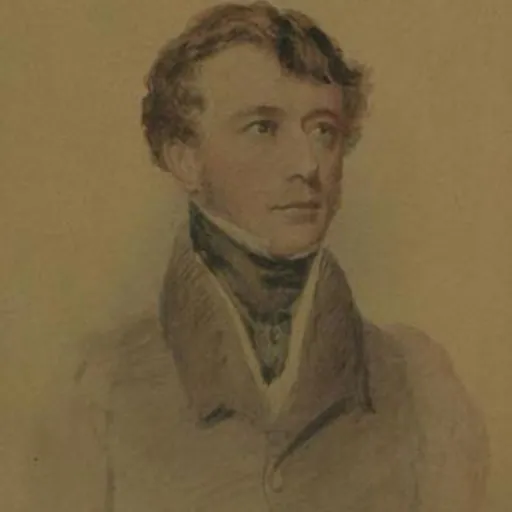
About Mark John Currie
Lived 1795 – 1874 (aged 78). Mark John Currie was a British explorer and naval officer.
Vice-Admiral Mark John Currie played a significant role in the exploration of Australia and the foundation of the Swan River Colony, later named Western Australia.
He explored areas in New South Wales, after which he returned to a post in England. In 1829 he married and left three weeks later for Australia on the 443-ton with his wife and servants, arriving at the coast of what was to become the Swan River settlement on 31 May 1829. Chief among the other passengers were Lieutenant Governor Captain James Stirling, Colonial Secretary Peter Brown, Surveyor-General Lieutenant John Septimus Roe, botanist James Drummond and their families.
The diaries and paintings by his wife, Jane Eliza Currie, provide a glimpse into the hard life of the first settlers. Her painting Panorama of the Swan River Settlement shows Fremantle in 1831. From it one can begin to appreciate the magnitude of the challenge faced by the colonists.
Family background Mark John was born on 21 June 1795, the second of eight children of Mark Currie, Esq. of Upper Gatton, Surrey, and Elizabeth (née Close) and he was educated at Charterhouse School. A portrait by Romney of his mother, entitled Mrs Mark Currie 1789, is in the Tate Gallery, London. His younger brother, Frederick was created 1st Baronet in 1847 for his services to the Government of India in negotiating the treaties of Lahore and Bhyrowal.
The family descended from the ancient Scots Corrie family of Annandale and the Western Isles, through Cuthbert Currie, a cadet living in Duns in the 16th century. It is not related to the Clan Currie created in the 18th century from a sept of the ancient Scots MacMhuirrich Clan.
Mark John married Jane Eliza née Wood on 14 January 1829. They had six children. The first two, Jane Eliza (17 January 1830) and Mark Riddell (17 August 1831) were born in the Swan River Colony. Charlotte (1833), Henrietta Blackwood (1834), Albert Purcell (12 September 1837) and Algernon (1840) were born in England.
Career Early days He entered the Royal Navy as a Volunteer, First-Class, at age 12 on 29 April 1808, and was posted to under Captain Blackwood (later Vice-Admiral Sir Henry Blackwood). There he met James Stirling and the two became close and lifelong friends.
He was promoted to Lieutenant on 23 September 1813 and served on (1814/15), (1816/17), (1818), (1820), (1821) and (1821/22). He was promoted to Commander on 9 July 1823.
In 1822 and 1823, as commander of , he carried out surveys of channels and port entries on the coast of New South Wales and in 1822 commented critically on the penal colony at Newcastle, reporting "King Lash is master here". He was probably not referring directly to the Commandant of the colony, James Thomas Morisset, but to the number and harshness of the punishments he saw at the time of his visit.
Starting in May 1823, Currie, together with Brigade Major John Ovens and experienced bushman Joseph Wild explored the country east and south-west of Lake George in New South Wales. After crossing several rivers and the Goulburn plains they arrived at the east bank of the lake, at about north of the southern end. They struck south-south-east and then west across the Limestone Plains through an area ideal for settlement, now Canberra, to an area which Currie named Isabella's Plain after Isabella Brisbane, the infant daughter of the Governor, Sir Thomas Brisbane. Today this is a suburb in the Tuggeranong district of Canberra.
They came to the Murrumbidgee River and followed it in a southerly direction, crossing the Umaralla River thinking it to be the Murrumbidgee. There they came to fertile plains which they named Brisbane Downs. Today the aboriginal name Monaro has been restored to the region. It is likely that the fertility of these areas of New South Wales led him to underestimate the problems that were later faced in the Swan River Settlement.
When he was a midshipman he must have given a good account of himself because, when in 1827 Vice-Admiral Sir Henry Blackwood became Commander-in-Chief, The Nore, he appointed Currie as his Secretary. The Nore was a naval station at the mouth of the River Thames and for several hundred years one of the most important commands for the defence of the United Kingdom.
The Swan River Settlement During most of the second half of 1828 Stirling was in London, vigorously promoting his dream of leading a settlement at the Swan River. Initial Government reaction was unfavourable, but his persistence and enthusiasm paid off and by November the scheme had support from Sir George Murray, Secretary for War and the Colonies, and had gained an unstoppable momentum. By this time the team of administrators had been decided and on 31 December 1828, Under Secretary Robert W Hay formally appointed Currie as Harbour Master for the new settlement, on no salary. At one time this river was mistaken for the Murray River.
The first task of the administrators was to find a site for the principal town. A location on the Swan River was selected and on 12 August Helen Dance, wife of Captain William Dance of , ceremoniously cut a tree to mark the foundation of Perth. Currie was present at the ceremony and later the same day took up his duties, at a salary of 100 pounds, as the first Harbour Master of Fremantle, responsible for pilotage and services at the port. The wreck is visible in Jane Currie's Panorama of the Swan River Settlement.
Currie became the Swan River Colony's first Auditor, appointed 1 July 1831, at a salary of 300 pounds "because his ability, intelligence and Integrity render him far more valuable to the public in that capacity than as Harbour Master".
On 6 February 1832, empowered by Parliament through the Order-in-Council officially constituting the colony, a legislative council was formed, comprising the governor, the Senior Military Officer, the Colonial Secretary, the Surveyor-General and the Advocate-General. On his own initiative Stirling added Currie to the list as clerk to the council, as he "could not find within the colony a person better calculated than the gentleman who now fills it".
Land development Crawley Bay in the 1890s. Originally part of Currie's land grant, it was later sold to Henry Sutherland and in 1910 acquired by the state. In 1922 it was vested in the University of Western Australia. Currie was allotted a grant of land south-west of the present centre of Perth, alongside a wide point in the Swan River known then as Eliza Bay and Point Currie. The Curries left Garden Island on 2 November to set up their tent on their allotment.
After Currie left the colony he sold this grant to Henry Sutherland, the Assistant Surveyor, who later changed the name to Crawley Bay after his mother's maiden name. Today the area is part of the suburb Redcliffe. A further grant was located about north-west of Beverley at the junction of the Avon River and Dale River, adjoining a grant made to Stirling. Currie's and Stirling's grants were combined in 1849 to form the Avondale Estate. In 1901, it was acquired by the state, and is now the site of the Avondale Agricultural Research Station.
Jane Brook, a suburb of the town of Swan about north-east of Perth, takes its name from the brook, a tributary of the Swan River. Stirling named this Jane Brook, in Jane Currie's honour.
Later career He was promoted to Post Captain in 1841.
In January 1854, Rear Admiral Sir James Stirling was appointed Commander-in-Chief China and the East Indies Station and immediately wrote to the Admiralty applying for Currie to be his secretary. They arrived in Hong Kong on 11 May and the Admiral's flag was transferred to . Two weeks later news was received from England that war had been declared on Russia.
The next day the Winchester led a small squadron northwards along the Chinese coast to make a show of strength and 'to prevent Russian ships of war and their prizes from making use of (Japanese) ports'. Stirling's letters and Currie's diaries record the patient and tactful negotiations with the Governor of Nagasaki to achieve this aim and the events leading up to Stirling signing the first Anglo-Japanese Friendship Treaty.
He received two further promotions, to Rear Admiral on the Reserved List in 1862 and to Vice-Admiral in 1867.
Vice-Admiral Mark John Currie died on 2 May 1874, in Thicket Road, Anerley, Crystal Palace, Surrey. Jane Eliza Currie survived him by two years. In the 1871 British Census she is recorded at 193 Clifton Villas, Beckenham, Kent, on a visit to her daughter Jane Eliza Macrae, who married Robert Campbell Macrae in 1854 and had eight children, the eldest of whom, Mark, later lived at Cranbrook Road, Rose Bay, New South Wales.
Footnotes
Don’t just read it —
keep it.
Full-length biographies made to live with: read them, listen on the way to work, watch them tonight.
- E-book
- Audio
- Video
Instant download · yours to keep · every purchase keeps this site free
Important facts
People in Mark John Currie's life
Named in this biography and alive at the same time



Related people
Same field, nearest in time


Contemporaries
People whose lives overlapped Mark John Currie's




Frequently asked questions
Who was Mark John Currie?
British Royal Navy admiral (1795–1874)
When was Mark John Currie born?
Mark John Currie was born on 21 June 1795.
When did Mark John Currie die?
Mark John Currie died on 2 May 1874.
What was Mark John Currie's occupation?
Mark John Currie was an explorer and naval officer.
What nationality was Mark John Currie?
Mark John Currie was British.
Sources & further reading
Cite this page
APA: Biography.guide. (2026). Mark John Currie. https://biography.guide/mark-john-currie/
MLA: "Mark John Currie." Biography.guide, https://biography.guide/mark-john-currie/.
Chicago: "Mark John Currie." Biography.guide. https://biography.guide/mark-john-currie/.
Data last updated: 2026-09-22 · Spot an error? Report a correction.
Portrait: Wikimedia Commons · author & licence
Page generated 2026-09-27 05:02 UTC