
About Mark Gertler
Lived 1891 – 1939 (aged 47). Mark Gertler was a British painter and artist.
Career
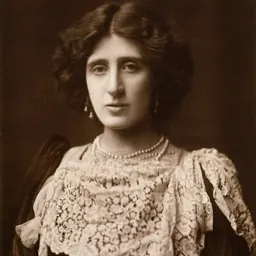
Mark Gertler with T. S. Eliot (left) and his patron Lady Ottoline Morrell Gertler's patron was Lady Ottoline Morrell, through whom he became acquainted with the Bloomsbury Group. She introduced him to Walter Sickert, the nominal leader of the Camden Town Group. Gertler was soon enjoying success as a painter of society portraits, but his temperamental manner and devotion to advancing his work according to his own vision led to increasing personal frustration and the alienation of potential sitters and buyers. As a result, he struggled frequently with poverty.
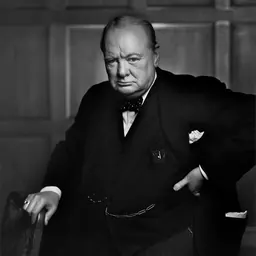
In 1914, the art collector Edward Marsh became Gertler's patron. The relationship between the two men proved a difficult one as Gertler felt that the system of patronage and the circle in which he moved were in direct conflict with his sense of self. In 1916, as World War I dragged on, Gertler ended the relationship due to his pacifism and conscientious objection (Marsh was secretary to Winston Churchill and patron to some of the war poets). Gertler's major painting Merry-Go-Round was created in the midst of the war years and was described by D. H. Lawrence as "the best modern picture I have seen".
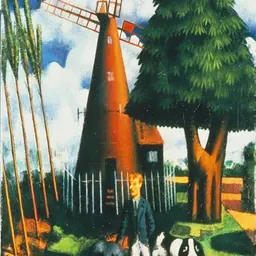
In 1913, Gertler met the author and poet Gilbert Cannan, who later described him as "a small passionate man with green eyes". Cannan invited Gertler to stay with him and his wife Mary at their Mill House in Cholesbury, and the two men became friends. Gertler lived there on and off during 1915–1916, and he painted Gilbert Cannan at his Mill (now on view in the Ashmolean Museum in Oxford). The picture depicts Cannan outside the Mill with his two dogs. The black and white one, Luath, had been the inspiration for the dog Nana in the stage production of J. M. Barrie's Peter Pan. It was Cannan who was responsible for introducing Lady Ottoline Morrell to Gertler's paintings and encouraging her to support his work. Cannan closely based the young Jewish character of his 1916 novel Mendel on Gertler's early life, including his infatuation and affair with fellow artist Dora Carrington. This relationship remained unfulfilled as Carrington spurned his numerous advances and instead declared her love for Lytton Strachey. The friendship of Cannan and Gertler waned after 1916, largely because of Cannan's increasingly unstable behaviour.
Virginia Woolf recorded her impressions of Gertler after he came to visit her and her husband in Sussex in September 1918: "Good God, what an egoist!" We have been talking about Gertler to Gertler for some 30 hours; it is like putting a microscope to your eye. One molehill is wonderfully clear; the surrounding world ceases to exist. But he is a forcible young man; if limited, able & respectable within those limits; as hard as a cricket ball; & as tightly rounded & stuffed in at the edges. We discussed—well, it always came back to Gertler. "I have a very peculiar character ... I am not like any other artist ... My picture would not have those blank spaces ... I don't see that, because in my case I have a sense which other people don't have ... I saw in a moment what she had never dreamt of seeing ..." & so on. And if you do slip a little away, he watches very jealously, from his own point of view, & somehow tricks you back again. He hoards an insatiable vanity. I suspect the truth to be that he is very anxious for the good opinion of people like ourselves, & would immensely like to be thought well of by Duncan [Grant], Vanessa [Bell] & Roger [Fry]. His triumphs have been too cheap so far. However this is honestly outspoken, & as I say, he has power & intelligence, & will, one sees, paint good interesting pictures, though some rupture of the brain would have to take place before he could be a painter.
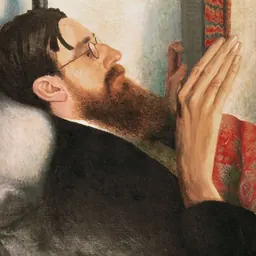
Gertler's later works developed a sometimes very harsh edge, influenced by his increasing ill health. In 1920, he was diagnosed with tuberculosis, which forced him to enter a sanatorium on a number of occasions during the 1920s and 1930s. Two of Gertler's close friends, D. H. Lawrence and Katherine Mansfield, succumbed to the disease.
In 1930, Gertler married Marjorie Greatorex Hodgkinson, which resulted in the birth of a son, Luke Gertler, in 1932. The marriage was often difficult, punctuated by the frequent ill health of both, and with Gertler often suffering from the same feelings of constraint that destroyed his relationships with a number of friends and patrons.
During the 1930s, he became a part-time teacher at the Westminster School of Art in order to supplement his intermittent income from painting. He also undertook commercial work, including a series of posters for the Empire Marketing Board. A still-life design by him of a fruit bowl was among the winning entries in the 1933 Famous Artists competition run by Cadbury's for a series of chocolate box designs and which were displayed at the Leicester Galleries in London.
Legacy Gertler's obituary in The Times described his death as "a serious loss to British art. Opinions of his work are likely to vary", it conceded, "but it is safe to say that a considered list of the half-dozen most important painters under fifty working in England would include him". Gertler's paintings are held in numerous public art collections, including in the Glasgow Museums. In June 2015 his 1912 painting The Violinist was auctioned for £542,500 at Christie's, London, a record for the sale of his work.
Gertler's former house and studio in Elder Street, Spitalfields, bears a blue plaque erected by the Greater London Council in 1975. Set into the pavement in front of it is a cast-iron roundel created by sculptor Keith Bowler in 1995, depicting a detail from Gertler's Merry-Go-Round.
Don’t just read it —
keep it.
Full-length biographies made to live with: read them, listen on the way to work, watch them tonight.
- E-book
- Audio
- Video
Instant download · yours to keep · every purchase keeps this site free
Important facts
People in Mark Gertler's life
Named in this biography and alive at the same time




Related people
Same field, nearest in time


Contemporaries
People whose lives overlapped Mark Gertler's


Frequently asked questions
Who was Mark Gertler?
British artist (1891–1939)
When was Mark Gertler born?
Mark Gertler was born on 9 December 1891 in Spitalfields.
When did Mark Gertler die?
Mark Gertler died on 23 June 1939 in London.
What was Mark Gertler's occupation?
Mark Gertler was a painter and artist.
What nationality was Mark Gertler?
Mark Gertler was British.
Sources & further reading
· DBpedia: Mark Gertler (artist)
Cite this page
APA: Biography.guide. (2026). Mark Gertler. https://biography.guide/mark-gertler/
MLA: "Mark Gertler." Biography.guide, https://biography.guide/mark-gertler/.
Chicago: "Mark Gertler." Biography.guide. https://biography.guide/mark-gertler/.
Data last updated: 2026-09-26 · Spot an error? Report a correction.
Page generated 2026-09-27 05:14 UTC