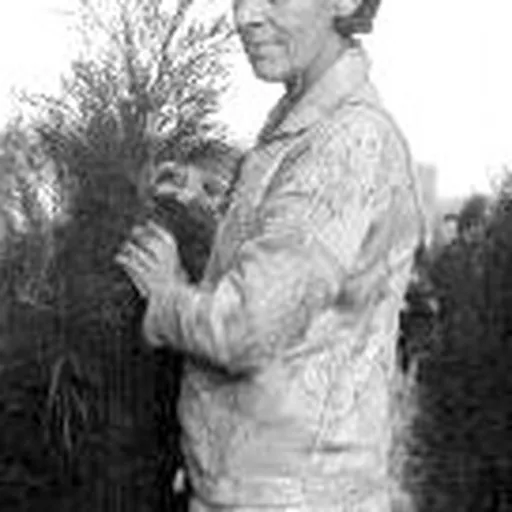
About Marion Mahony Griffin
Lived 1871 – 1961 (aged 90). Marion Mahony Griffin was an American and Australian architect and artist, known for Prairie School.
Artist's Studio (Section). Watercolor and ink by Marion Griffin 1894
Marion Mahony Griffin (; February 14, 1871 – August 10, 1961) was an American architect and artist. She was one of the first licensed female architects in the world, and is considered an original member of the Prairie School. Her work in the United States developed and expanded the American Prairie School, and her work in India and Australia reflected Prairie School ideals of indigenous landscape and materials in newly formed democracies. The scholar Debora Wood stated that Griffin "did the drawings people think of when they think of Frank Lloyd Wright (one of her collaborating architects)." According to architecture critic, Reyner Banham, Griffin was "America’s (and perhaps the world’s) first woman architect who needed no apology in a world of men."
She produced some of the finest architectural drawings in America and Australia, and was instrumental in envisioning the design plans for the capital city of Australia, Canberra. Towards the end of her life, she wrote The Magic of America, an autobiography accompanied with various illustrations dedicated toward showcasing her life's work and values. After the Great Chicago Fire in 1880, her family moved north of Chicago to nearby Winnetka. Winnetka's Unitarian Chapel often held discussions about the arts, politics, and social issues heavily revolving around democracy. Mahony often recalled her childhood in Winnetka in her autobiography, "The Magic of America", describing how she had become fascinated by the freeing nature and quickly disappearing landscape as suburban homes filled the area. Perkins himself was a former MIT student, however he never completed his architectural degree. Although Mahony was more educated than him, he fostered the significant improvement of her drafting and design skills as she gained hands-on experience. Subsequently, she became the first licensed female architect in Illinois in 1898. She was later hired and worked with Wright from 1895–1909 in both Chicago and his Oak Park studio. She went to work designing buildings, furniture, stained glass windows, and decorative panels. Barry Byrne, a coworker of Mahony's described her as “the most talented member of Frank Lloyd Wright’s staff." She combined art and architecture in her draftsmanship, and was known to have an "exceptional feel" for linear compositions that integrated architecture with nature. Her interest in Japanese prints gave her several unique compositional techniques of color, depth, emphasis, and line weight that played a crucial role in the development of the Prairie School. This new presentation of designs was revolutionary in presenting architectural work to the world. Mahony's work became a powerful marketing tool, that enabled conversations with clients as they had become able to visualize the plans presented. Her rendering of the K. C. DeRhodes House in South Bend, Indiana, in particular, was praised by Wright and many critics. Her presentation drawing of the home was exceptionally skillful with clear-cut lines, and her original use of stylized trees and flowers to frame the structure. The foliage was just as sharp as the structure presented, further highlighting her integration of architecture with the natural world. Her watercolor renderings of buildings and landscapes became known as a staple of Wright's style, though she was never given credit by the famous architect. For example, Wright "desperately" tried to attribute the K. C. DeRhodes House to himself. He annotated the rendering writing "after FLLW and Hiroshige". Yet, Mahony's initials, "MLM", were included in very small print under the foliage of the rendering. alt=Marion Mahony Griffin on the left with a watering can and Walter Burley Griffin with a shovel in front of a small building After Wright had gone, Hermann V. von Holst, who had taken on Wright's commissions, hired Mahony with the stipulation that she would have control of the design. in Grand Rapids, Michigan. During this time, Mahony recommended Walter Burley Griffin to von Holst to develop landscaping for the area surrounding the three houses commissioned from Wright in Decatur, Illinois. Griffin was a fellow architect, a fellow ex-employee of Wright, and a leading member of the Prairie School of architecture.
Mahony and Griffin worked on the Decatur project before their marriage in 1911; afterward, Mahony worked in Griffin's practice. However, deeply rooted in her collaborative approach, she would publicly refer to her contributions as "our projects", often making note of the love and loyalty she had for her husband. Cafe Australia, Newman College, and the Capitol Theatre were three architectural structures worked on by Mahony, and for which the couple hired local artists, Marion's memoirs record the rough journey across Bass Strait in the SS Loongana, compensated over December 1918–January 1919 with 'a wonderful fortnight which enabled me to add a number of unique trees to my set of Forest Portraits.'
In Australia, Mahony and Griffin was introduced to Anthroposophy and the ideas of Rudolf Steiner which they embraced enthusiastically, and in Sydney they joined the Anthroposophy Society. These would later have a great influence on her autobiography. In a manuscript of the letter between the two included in "The Magic of America", Mr. Halder stated, "Marion is working like a slave and she is the only effective help I have had for this exhibition."
She did however spend the next twenty years working on a massive volume of 1,400 pages and 650 illustrations detailing her and Walter's working lives, which she titled "The Magic of America", which has yet to be formally published in book form. A manuscript deposited at the Art Institute of Chicago in 1949 was digitized, and since 2007 has been available online.
Battling memory loss toward the end of her life, Marion Mahony Griffin died in poverty in 1961 at the age of 90. She was buried in Graceland Cemetery.
Among the few works attributed to Mahony that survive in the United States is a small mural in the George B. Armstrong elementary school in Chicago, and some of the homes she had designed in Decatur, Illinois.
The Australian Institute of Architects, NSW Chapter, honored her work with an annual award, the Marion Mahony Griffin Prize, for a distinctive body of work by a female architect for architectural education, journalism, research, theory, a professional practice or built architectural work. Since 2006 the Victorian Chapter of the AIA has presented a named award annually known as the Marion Mahony Award for Interior Architecture.
Exhibitions The following exhibitions have been displayed featured the work of Marion Mahony:
1998–1999: The Museum of Applied Arts & Sciences at Powerhouse Museum, Sydney held an exhibition entitled "Beyond Architecture: Marion Mahony and Walter Burley Griffin".
2013: An exhibition to celebrate the centenary of Canberra, held in the National Library of Australia and called "The Dream of a Century: the Griffins in Australia’s Capital", exhibited her drawings for the entire year.
2020–2021: An exhibition at the Museum of Sydney entitled "Paradise on Earth".
2022: An exhibition at the National Archives of Australia in Canberra entitled "Marion: the other Griffin".
Architectural works All Souls Church (demolished), Evanston, Illinois – 1901 The Gerald and Hattie Mahony Residence (demolished), Elkhart, Indiana – 1907 David Amberg Residence, 505 College Avenue SE, Grand Rapids, Michigan – 1909 Edward P. Irving Residence, 2 Millikin Place, Decatur, Illinois – 1909 Robert Mueller Residence, 1 Millikin Place, Decatur, Illinois – 1909 Adolph Mueller Residence, 4 Millikin Place, Decatur, Illinois – 1910 Niles Club Company, Club House, Niles, Michigan – 1911 Henry Ford Residence "FairLane" (unbuilt initial design; 1913) Koehne House (demolished 1974), Palm Beach, Florida – 1914 Cooley Residence, Grand St. at Texas Avenue, Monroe, Louisiana
Pholiota, 23 Glenard Drive, Eaglemont, Victoria (the Griffins own house) – 1920 Capitol Theatre, Swanston Street, Melbourne, Australia – 1921–1923 "Stokesay", residence of Mr. and Mrs. Onians, 289 Nepean Highway, Seaford, Victoria, Australia – 1925 Ellen Mower Residence, 12 The Rampart, Castlecrag, Sydney – 1926 Creswick Residence, Castlecrag, Sydney, Australia – 1926 S.R. Salter Residence (Knitlock construction), Toorak, Victoria, Australia – 1927 Vaughan Griffin Residence, 52 Darebin St., Heidelberg, Victoria, Australia – 1927
Don’t just read it —
keep it.
Full-length biographies made to live with: read them, listen on the way to work, watch them tonight.
- E-book
- Audio
- Video
Instant download · yours to keep · every purchase keeps this site free
Important facts
Family & relationships
People in Marion Mahony Griffin's life
Named in this biography and alive at the same time






Related people
Same field, nearest in time



Contemporaries
People whose lives overlapped Marion Mahony Griffin's

Frequently asked questions
Who was Marion Mahony Griffin?
American architect and artist (1871–1961)
When was Marion Mahony Griffin born?
Marion Mahony Griffin was born on 14 February 1871 in Chicago.
When did Marion Mahony Griffin die?
Marion Mahony Griffin died on 10 August 1961 in Chicago.
What was Marion Mahony Griffin's occupation?
Marion Mahony Griffin was an architect and artist.
What was Marion Mahony Griffin known for?
Marion Mahony Griffin was known for Prairie School.
What nationality was Marion Mahony Griffin?
Marion Mahony Griffin was American and Australian.
Sources & further reading
· Wikipedia: Marion Mahony Griffin
· DBpedia: Marion Mahony Griffin
Cite this page
APA: Biography.guide. (2026). Marion Mahony Griffin. https://biography.guide/marion-mahony-griffin/
MLA: "Marion Mahony Griffin." Biography.guide, https://biography.guide/marion-mahony-griffin/.
Chicago: "Marion Mahony Griffin." Biography.guide. https://biography.guide/marion-mahony-griffin/.
Data last updated: 2026-09-22 · Spot an error? Report a correction.
Portrait: Wikimedia Commons · author & licence
Page generated 2026-09-27 05:00 UTC