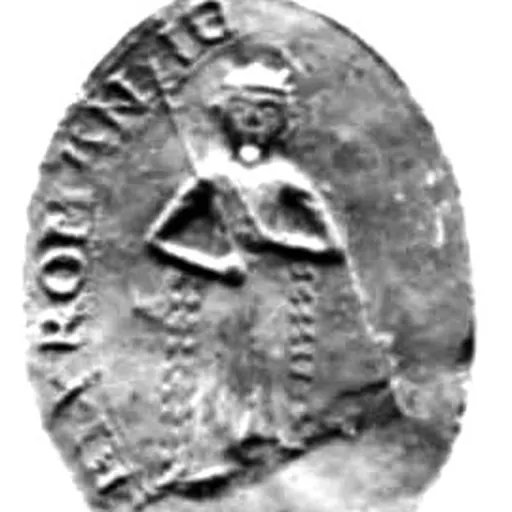
About Marie of Brienne
Lived 1224 – 1275 (aged 50–51). Marie of Brienne was a French politician.
Marie of Brienne (c. 1224–1275) was Latin Empress as the wife of Baldwin II of Courtenay. She served as regent during the absence of Baldwin II twice: in 1237–1239, and in 1243–1257.
Family
Marie of Brienne was a daughter of John of Brienne and his third wife Berenguela of Leon. Marie was a younger, paternal half-sister of Isabella II of Jerusalem. She was also a sister of Alphonso of Brienne.
In any case, John of Brienne had taken command of the defense of Constantinople. Baldwin II undertook another mission, heading to Western Europe in attempt of raising the funds and recruiting the armed forces needed to secure the survival of their Empire. Berenguela following him on 12 April. The twelve-year-old Marie was left in nominal command of the city, as the sole representative of the imperial family present in it. Baldwin would not return until July 1239.
Baldwin returned at the head of a Crusading force from Western Europe, variously estimated to include as few as thirty thousand men or as many as sixty thousand. This force was joined by a contingent of Cumans, combining to besiege Tzurulum, a Nicaean stronghold in Thrace. The city fell in 1240 but this seems to have been the only success of this force. They are not mentioned afterwards. John V. A. Fine presumes that most of them returned to their homes in Western Europe, only a few of them joining the existing garrison of Constantinople. For the moment, the Latin Empire had ensured its continued survival. Baldwin was absent for several years, first staying in France and then joining Louis IX of France in the Seventh Crusade. He returned by 8 October 1248, the date of a charter that empowered her to mortgage his western lands in order to pay the huge debt of 24,000 hyperpers.
Within a month of Baldwin's arrival, Marie left Constantinople for Western Europe. Marie's great-aunt, Blanche of Castile, had arranged for her travel and had given Baldwin 20,000 livres in exchange for two promises: not to sell his properties at Namur, and to send Marie to visit her within a month after his return to Constantinople. Baldwin prepared four armed ships to take Marie and her escort abroad. For the next years Marie contested unsuccessfully with Henry V of Luxembourg for control of those properties, which were the source of income for both Emperor and Empress, until her cession of these lands and castles 17 June 1258 to Margaret II, Countess of Flanders. Despite this, the Castle of Namur refused to surrender to Henry, the vassal of Margaret of Flanders, until St. Vincent's Day (21 January 1259). After this, she went to the court of Castile where she successfully raised the money to ransom her son Philip, who was held hostage by bankers in Venice and who was released at some date between June 1258 and 1 May 1261.
Reconquest of Constantinople
The imperial couple would not hold their capital for long. In July 1261, Alexios Strategopoulos, a general of Nicaea, was sent with a small advance force of 800 soldiers, most of them Cumans, to keep a watch on the Bulgarians and spy out the defences of the Latins. When the Byzantine force reached the village of Selymbria, they learned from independent local farmers (thelematarioi) that the entire Latin garrison, and the Venetian fleet, were absent conducting a raid against the Nicaean island of Daphnousia. Although initially hesitant, due to both the small size of his force, which might be fatal if the Latin army returned, and because he would exceed his orders, Strategopoulos eventually decided not to lose such a golden opportunity to retake the city. Namur was at the time actually held by Henry V of Luxembourg but Guy would successfully conquer it by 1268. In January 1266, their rights to the Kingdom of Thessalonica were bought by Hugh IV, Duke of Burgundy for 13,000 livres tournois. At the time the city was under the control of Michael VIII Palaiologos, the Nicaean emperor who had moved his capital to Constantinople, while the title was also claimed by William VII, Marquess of Montferrat.
On 27 May 1267, the Treaty of Viterbo, transferred much of the rights to the Latin Empire fiefs from Baldwin II to Charles I of Sicily. Charles was to be confirmed in possession of Corfu and some cities in Albania. He was also given suzerainty over the Principality of Achaea and sovereignty of the Aegean Islands, excepting those held by Venice and Lesbos, Chios, Samos, and Amorgos.
Baldwin and Marie spend the rest of their lives in the court of Charles. In October 1273, Baldwin died in Naples. Marie survived him by about two years. She was buried in Assisi.
Don’t just read it —
keep it.
Full-length biographies made to live with: read them, listen on the way to work, watch them tonight.
- E-book
- Audio
- Video
Instant download · yours to keep · every purchase keeps this site free
Important facts
Family & relationships
People in Marie of Brienne's life
Named in this biography and alive at the same time

Related people
Same field, nearest in time
Contemporaries
People whose lives overlapped Marie of Brienne's




Frequently asked questions
Who was Marie of Brienne?
Latin empress of Constantinople (1224-1275)
When was Marie of Brienne born?
Marie of Brienne was born in 1224 in Jerusalem.
When did Marie of Brienne die?
Marie of Brienne died in 1275 in Naples.
What was Marie of Brienne's occupation?
Marie of Brienne was a politician.
What nationality was Marie of Brienne?
Marie of Brienne was French.
Sources & further reading
Cite this page
APA: Biography.guide. (2026). Marie of Brienne. https://biography.guide/marie-of-brienne/
MLA: "Marie of Brienne." Biography.guide, https://biography.guide/marie-of-brienne/.
Chicago: "Marie of Brienne." Biography.guide. https://biography.guide/marie-of-brienne/.
Data last updated: 2026-09-21 · Spot an error? Report a correction.
Portrait: Wikimedia Commons · author & licence
Page generated 2026-09-27 05:00 UTC