
About Marian Wróbel
Lived 1907 – 1960 (aged 53). Marian Wróbel was a Polish author, chess player and chess composer.
Marian Wróbel (1 January 1907 – 25 April 1960) was a prominent Polish chess problemist of the mid-twentieth century. Between 1947 and 1950 he was considered the leading chess composer in the world. During his lifetime he published more than 1,000 problems and was a FIDE International Master of Chess Composition.
Biography Born in Lwów (now Lviv) on 1 January 1907, Wróbel learned to play chess as a child of 5 and became interested in chess problems. In 1922, he published his first problem at the age of 15 and in 1928 the International Association of Problemists ranked him fourth in the world.
He studied in Lwów and Warsaw and completed a Magister's degree in Polish philology in 1932. He became a teacher but due to health problems transferred to administrative work.
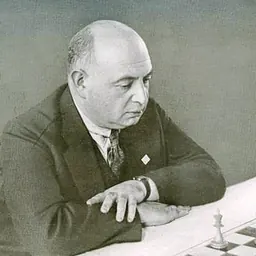
During the 1930s Wróbel was a close collaborator and friend of Dawid Przepiórka and hosted him following the German invasion of Poland in 1939 when Przepiórka's Warsaw home was destroyed. Wróbel was with Przepiórka during a private gathering of chess players in January 1940 when the Gestapo raided the meeting and arrested all the participants.
Wróbel was very active as a journalist of chess and published three major books on chess composition.
In 1954 he was awarded the FIDE title International Master of Chess Composition, and in 1959 he became an International Judge of Chess Composition, the first year the title was awarded.
Wróbel died in Warsaw on 25 April 1960.
The diagram on the left is one of the best twomovers of Wróbel. In the initial position White has answers to all Black's moves: 1... e3 2. dxe3#; 1... f3 2. Nxf3# (exploiting the half-pin of Pe4 and Pf4); 1. Bd-any 2. Nxe2#; 1... Bb2 2. Bxb2#; 1... Bc3 2. dxc3#; 1... Nf-any 2. Rxd6#. However, White has no waiting move, and the set play cannot be realized. The key 1. Qxe2! destroys the half-pin and pins the Queen. Black is in Zugzwang: 1... e3 2. Rd5#; 1... f3 2. Qe3#; 1... g4 (Ba4,Bb3) 2. Qxe4#; 1... Bc2 2. Nxc2#; 1... Bxe2+ 2. Nxe2#. The remaining variations remain unchanged.
The diagram on the right is one of Wróbel's best known threemovers. In the initial position White has a ready response to the only possible move of Black: 1... B-any 2. Bc4+ Ba7 3. Rxa7#. However, White has no waiting move. The solution is the unexpected 1. Re8!! Zugzwang. Other choices of the square for the Rook fail: 1. Rc8? Bc5!; 1. Rd8? Bd4!; 1. Rf8? Bb8!. In each case, capturing the Bishop leads to a stalemate.
Don’t just read it —
keep it.
Full-length biographies made to live with: read them, listen on the way to work, watch them tonight.
- E-book
- Audio
- Video
Instant download · yours to keep · every purchase keeps this site free
Important facts
People in Marian Wróbel's life
Named in this biography and alive at the same time
Related people
Same field, nearest in time



Contemporaries
People whose lives overlapped Marian Wróbel's


Frequently asked questions
Who was Marian Wróbel?
Polish chess problemist
When was Marian Wróbel born?
Marian Wróbel was born on 1 January 1907 in Lviv.
When did Marian Wróbel die?
Marian Wróbel died on 25 April 1960 in Warsaw.
What was Marian Wróbel's occupation?
Marian Wróbel was an author, chess player and chess composer.
What nationality was Marian Wróbel?
Marian Wróbel was Polish.
Sources & further reading
Cite this page
APA: Biography.guide. (2026). Marian Wróbel. https://biography.guide/marian-wrobel/
MLA: "Marian Wróbel." Biography.guide, https://biography.guide/marian-wrobel/.
Chicago: "Marian Wróbel." Biography.guide. https://biography.guide/marian-wrobel/.
Data last updated: 2026-09-25 · Spot an error? Report a correction.
Page generated 2026-09-27 05:13 UTC