
About Mariama Bâ
Lived 1929 – 1981 (aged 52). Mariama Bâ was a Senegalese writer, novelist, women's rights activist and teacher.
Mariama Bâ (April 17, 1929 – August 17, 1981) was a Senegalese author and feminist. Her two French-language novels have been translated into more than a dozen languages each. Born in Dakar, Senegal, she was raised a Muslim.
Her frustration with the fate of African women is expressed in her first novel, Une si longue lettre (1979; translated into English as So Long a Letter). In this semi-autobiographical epistolary work, Bâ depicts the sorrow and resignation of a widow who must share the work of mourning with her late husband's second, younger wife. The novel was awarded the first Noma Award for Publishing in Africa in 1980.
Biography
Early years and education Bâ was born in Dakar, Senegal, in 1929, into an educated and affluent Senegalese family of Lebu ethnicity. He was the Minister of Health for Senegal in 1956 while her paternal grandfather, Sarakholé, worked as an interpreter for French officials during the French occupation regime. After her mother's death, Bâ was primarily raised by her maternal grandparents, who emphasized conservative Muslim values.
Bâ's father enrolled her in a French-language Koranic school She described the transformative power of education in her later writing and advocacy. Some scholars draw on historical and contemporary contexts to interpret key events within the novel's timeline. Published in 1970s Senegal, the novel is situated within a period marked by significant socio-political developments, including the passage of the Family Code —which expanded women's rights but faced religious resistance—the resurgence of Islamic fundamentalism, and the pressures of rapid Westernization and modernization. Beyond this immediate context, Bâ highlights the social realities of Senegalese women in the 1970s, addressing themes such as polygamy, motherhood, and the challenging of stereotypes.
Within Bâ's work, she draws attention to contradictory ideals arising from the social dynamics of colonial and post-colonial societies. In So Long a Letter, Bâ focuses on the impacts of patriarchy while portraying the complexities faced by young people growing up under conflicting social expectations. In both of her novels, Bâ comments on African youth and their navigation of intergenerational conflict in a post-colonial era. Scholars note that these characters do not seek to reject their cultures outright but instead attempt to synthesize and understand multiple social realities that shape their lives. These themes reflect Bâ's own early life experiences, including the tension between her French colonial education and the expectation that she honor African cultural identity.
Bâ's work is also studied as early feminist literature within an African context. By depicting women living in intersecting realities of gender, caste, and colonialism, she illustrates how African women experience compounded forms of oppression. As Bâ centers the lives of African women in ways often overlooked historically, her novel contributes to increased visibility for women marginalized within patriarchal systems. Bâ writes, "as women we must work for our own future, we must overthrow the status quo which harms us and we must no longer submit to it". So Long a Letter follows this trajectory by serving as a framework for identity reclamation and by honoring women whose voices have been diminished within male-dominated structures.
Bâ was a vanguard of intersectionality and a Muslim feminist. Her work contributes to a comprehensive framework for understanding the oppression of women across various forms of discrimination and lived experiences. This epistolary is also used as a pedagogical tool to instill multicultural tolerance. So Long a Letter has been translated into many languages and remains widely taught in schools, particularly in West Africa.
Despite the patriarchal system within which the characters live, Bâ highlights differences in schools of thought and positionalities among African women. Although both Ramatoulaye and Aïssatou are Muslim women, Aïssatou adheres to the primacy of love rather than accepting cultural or religious justifications for polygamy. As she declares: "I will not yield to it. I cannot accept what you are offering me today in place of the happiness we once had. You want to draw a line between heartfelt love and physical love. I say that there can be no union of bodies without the heart's acceptance, however little that may be."
Bâ advocates for women's rights while avoiding the approach of more radical activists who openly criticize Islam. Ramatoulaye makes a conscious decision to remain in her marriage without overt coercion. Her decision is guided by her faith and her resilience as a woman: "I remained. I chose to remain. What could I do? A woman must endure." She further reflects, "God ordained it thus. He tests us but does not abandon us."
This divergence of opinion regarding polygamy symbolizes the cultural and religious diversity among Muslim women. As Nana Wilson-Tagoe observes, "the inscription of a woman's sphere and the meaning of female difference may deviate from culture to culture. We belong here too."
Bâ has been discussed as a pioneer in Islamic feminism and more broadly as a foundational figure in gender studies.I situate my reading of Ramatoulaye's expression of Islamic feminism within an African and Islamic feminist reading and further position these within the cultural context of the practice of Islam in Senegal. By her 'strategic self-positioning', as defined by Islamic feminist Miriam Cooke, among others, within a small group of Senegalese Muslims – locally known as ibadu Muslims – Ramatoulaye succeeds in enacting Islamic feminism in her spiritual persistence for a strict adherence to the Qur'an and in her resistance to the temptation to expand the Islamic precepts of her faith. Shirin Edwin
Scarlet Song Scarlet Song (1981) also gained international attention. This book deals with the critically urgent need for women to create "empowered" spaces for themselves, meaning, women need to create a space where they are not considered the "weaker sex". Scarlet Song is about a marriage between a European woman and an African man. Mireille, whose father is a French diplomat, marries Ousmane, son of a poor Senegalese Muslim family. Moving back from Paris to Senegal, Ousmane once again adopts his traditions and customs. But, as an occidental, Mireille cannot handle this kind of life, especially when Ousmane takes a second wife. However, Senegal has a polygamous society and in their religion it is acceptable but Mireille did not accept it. She suffers the marriage. Most notably, the book criticizes the tyranny of tradition and expounds upon the despair of cross-cultural marriages.
Scarlet Song has been interpreted as an exploration of marital conflict and cultural tension. The couple's relationship is marked by a dichotomy between individualism and collectivism, presenting their struggles as a commentary on the interplay between personal desires and cultural expectations. For instance, the young character Mireille challenges tradition by pursuing a marriage based on love, defying customary norms. Themes of intergenerational continuity, tradition, and cultural change are central to this novel as well.
Legacy Columbia University Libraries included So Long a Letter as one of the 20th century's 100 best books about Africa.
Mariama Bâ Boarding School (Maison d'Education Mariama Bâ)
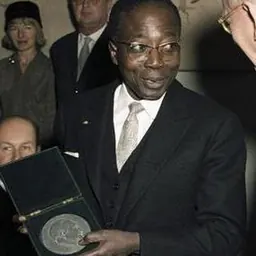
Following her death in 1981, Mariama Bâ's legacy was honored through the founding of the Maison d'Éducation Mariama Bâ, an elite all-girls boarding school located on Gorée Island, Senegal. The school was established in 1977 by the Senegalese government and named in her honor by then-President Léopold Sédar Senghor, who recognized Bâ's influence as both an educator and advocate for women's advancement. The institution was created to provide gifted young women with access to a rigorous education that combined academic excellence with civic responsibility. Today, the Maison d'Éducation Mariama Bâ remains one of Senegal's most prestigious schools, continuing Bâ's vision of empowering women through education and leadership. Bâ, Mariama (1981). Un Chant écarlate (in French). Dakar: Les Nouvelles Éditions Africaines. Republished as Translated as The first edition of the translation was published in 1981.
Mbye Cham. 1994. The female condition in Africa: A literary exploration by Mariama Ba. A current bibliography on African Affairs. Journals Sagepub.com. This is an article reviewed by a global academic publisher. The author was a professor in Higher Education.
Don’t just read it —
keep it.
Full-length biographies made to live with: read them, listen on the way to work, watch them tonight.
- E-book
- Audio
- Video
Instant download · yours to keep · every purchase keeps this site free
Important facts
People in Mariama Bâ's life
Named in this biography and alive at the same time
Related people
Same field, nearest in time



Contemporaries
People whose lives overlapped Mariama Bâ's


Frequently asked questions
Who was Mariama Bâ?
Senegalese writer (1929–1981)
When was Mariama Bâ born?
Mariama Bâ was born on 17 April 1929 in Dakar.
When did Mariama Bâ die?
Mariama Bâ died on 17 August 1981 in Dakar.
What was Mariama Bâ's occupation?
Mariama Bâ was a writer, novelist, women's rights activist and teacher.
What nationality was Mariama Bâ?
Mariama Bâ was Senegalese.
Sources & further reading
Cite this page
APA: Biography.guide. (2026). Mariama Bâ. https://biography.guide/mariama-ba/
MLA: "Mariama Bâ." Biography.guide, https://biography.guide/mariama-ba/.
Chicago: "Mariama Bâ." Biography.guide. https://biography.guide/mariama-ba/.
Data last updated: 2026-09-20 · Spot an error? Report a correction.
Page generated 2026-09-27 05:32 UTC